
Setting Powder with No Flashback: 5 Dupes to Try
You checked the mirror, the powder looked invisible, and then the group photo landed. Your forehead and under-eyes read pale, almost chalky, while everyone else looks like themselves. That mismatch is what sends people hunting for a setting powder with no flashback the week before a wedding, a party, or a night full of phone cameras.
A front-label claim is a starting point. The result that matters is how your foundation, sunscreen, and powder behave under the flash you will face.
Setting Powders That Avoid Flashback at a Glance
A powder that disappears in bathroom light can turn pale once a phone flash hits it. That is why shoppers look for a no-flashback claim, and why the claim needs a closer look before you spend.
This post may contain affiliate links, which means I may receive a commission if you purchase through my links, at no extra cost to you. Please read the disclosure policy for more information.
Laura Mercier publishes several translucent powders with flash language on the label. Laura Mercier's product page lists the standard Translucent Loose Setting Powder at $43 and claims 24-hour oil and shine control with no photo flashback, on a page updated in 2026. The Light Catcher collection page lists Translucent Loose Setting Powder Light Catcher at a regular price of $47 and states 12-hour pore blurring, skin smoothing, and no photo flashback, also updated in 2026.
Laura Mercier's Ultra-Blur note says the loose and pressed powders provide 16-hour wear, 16-hour shine control, and no photo flashback in 2024. That page does not list a price, so the price here is unknown. The Finishing Touch page reports a 4.9-out-of-5 rating from 41 reviews and says the powder and puff resists flashback, updated in 2026. No price is stated on that page either.
| Product | Price (USD) | Stated Flashback Claim |
|---|---|---|
| Translucent Loose Setting Powder Light Catcher | $47 | No photo flashback, 12-hour pore blurring |
| Translucent Loose Setting Powder | $43 | No photo flashback, 24-hour oil and shine control |
| Ultra-Blur Loose Setting Powder | Unknown | No photo flashback, 16-hour wear and shine control |
| The Finishing Touch Translucent Loose Setting Powder and Puff | Unknown | Resists flashback, rated 4.9 of 5 from 41 reviews |
These figures are brand-stated results, not independent flash tests. Treat the table as a shortlist, not a verdict.
Carry three checks into the rest of your search.
- Flash test on your skin: Photograph the powder over your real base, not on a bare swatch.
- Ingredient list: Note where silica sits, and whether the powder is loose or pressed.
- Shade under flash: A translucent powder can still look lighter than your complexion once the flash fires.
Why Setting Powder Turns White in Flash Photos
A camera flash is a hard, directional burst. Particles sitting on the skin can send more of that light back toward the lens than the complexion around them, so a patch reads pale or white in the frame.
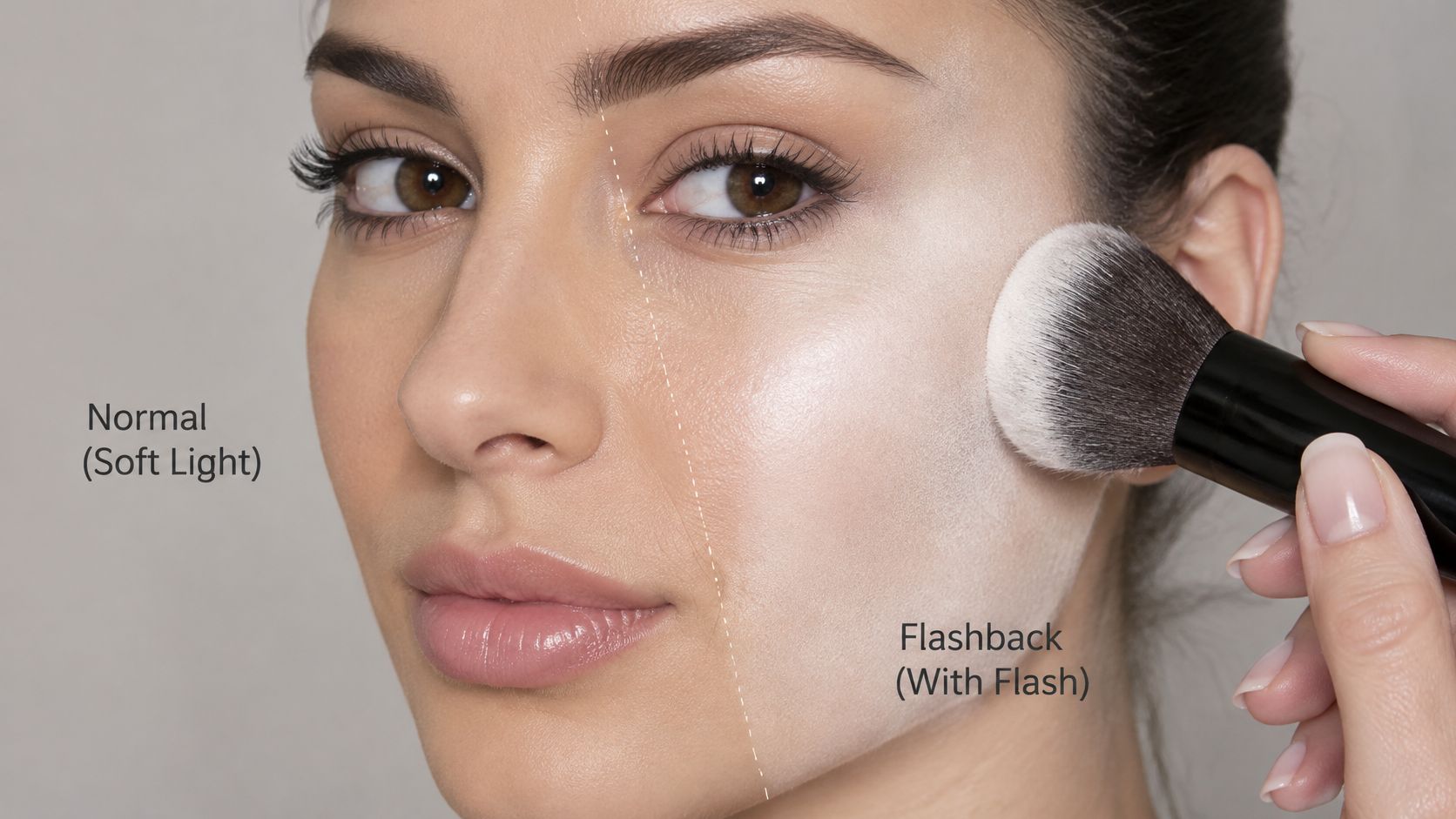
FDA historical material on cosmetic powder testing ties a no flashback claim to how ingredients interact with intense, directional light, not to one universal ingredient standard. Visible flashback shows up when highly reflective or light-scattering particles return more light toward the camera than the surrounding skin. Common powder minerals, including silica, titanium dioxide, zinc oxide, mica, and some synthetic powders, can differ a lot in particle size, surface treatment, concentration, and refractive behavior.
Same name, different photo
Two powders can share an ingredient name and still photograph differently. A fine, treated particle in a small amount may look quiet. A high load of loose, highly scattering particles can throw a white veil under direct flash even when the mirror looks fine.
Ordinary indoor light is softer and comes from several directions. Flash comes from one small source near the lens. A powder can look transparent at the vanity and pale in the photo because the light, not your eyes, changed.
Translucent describes how a powder looks in everyday light. It does not promise camera neutrality. The same FDA discussion of powder claims treats a labeled no-flashback result as a performance claim that still needs real-world testing, alongside ingredient order, finish, and shade transparency.
Flashback is not the same as ashiness
Optical flashback is a bright return of flash toward the camera. Ordinary ashiness is an untinted or too-light powder sitting visibly on the skin, including in daylight, without necessarily looking brighter only in flash.
The fix is different. Flashback points you toward a different formula or a lighter hand. Ashiness often improves when you pick a shade closer to your skin, or when you stop using a bright translucent powder on deeper complexions.
Practical rule: Treat "no flashback" as a performance claim you still have to photograph, not as an ingredient guarantee.
Ingredients That Reflect Flash and Those That Do Not
The ingredient list is the first filter, before price or finish. Ingredients are listed in descending order of concentration, so a name near the top is doing more of the work than a name near the end.
A peer-reviewed cosmetic-materials study, published through PMC, tested flashback on eight human volunteers using marked skin areas, DSLR photos with and without flash, and a camera about 15 cm above the site. The benchmark was measurable specular backscatter toward the camera, not whether the powder looked white in person.
| Ingredient | Tested Flashback Result | What to Check on Labels |
|---|---|---|
| Spherical silica | Strong measurable flashback | Avoid high loose amounts when flash is likely |
| Fumed silica | Strong flashback in tested raw ingredient | Note where it appears in the ingredient order |
| Talc | No measurable flashback | Check the full ingredient list and testing statements |
| Mica | No measurable flashback | Check the shade and tint |
| Magnesium carbonate | No measurable flashback | Confirm it is in the full ingredient list |
| Zinc oxide and titanium dioxide | Unknown | Relevant when a mineral sunscreen is worn underneath |
How to read the rows
Under that protocol, the tested spherical silica showed a clearly measurable and strong flashback effect. The tested magnesium carbonate, talc, and mica produced no measurable flashback. A separate look at the raw grade of fumed silica also reported strong flashback, which is why both silica rows point you away from a heavy loose load when flash is likely.
Zinc oxide and titanium dioxide do not have a flashback result in that powder test, so the table marks them unknown. They still matter once a mineral sunscreen is underneath, which is a layering question rather than a powder-only score.
What the test does not prove
The result applies to the specific grades and application conditions tested. It does not prove that every silica-containing finished powder will flash back equally. Eight people, one DSLR-flash setup, and raw ingredients are a narrow screen, not a finished-formula ranking.
Silica-free is not a scientific guarantee. A finished powder's photo depends on grade, amount, and how you apply it. Two label habits help more than a single banned word.
- Check silica's place: High on the list means a larger share of the formula.
- Verify the claim: A no-flashback line is something you photograph, not something the ingredient order settles by itself.
A quiet ingredient on paper can still look loud if you bake it on thick.
Wearing Sunscreen and Setting Powder for Flash Photos
The reception lights come on, someone lifts a phone, and the first impulse is to skip sunscreen so the face will not go white. That swap trades a photo problem for a skin problem, and the powder is often not the only layer that failed.
Mineral filters such as zinc oxide and titanium dioxide sit on the skin as pale particles. On their own they can leave a cast. A very pale translucent powder on top works like a second reflector: the flash hits both films, and the camera records them together. Facial Adviser treats this as a layering issue, not a reason to drop SPF, and names the variables that change the result: filter type, thickness, absorption time, foundation shade, and flash distance.
A sequence that keeps the SPF
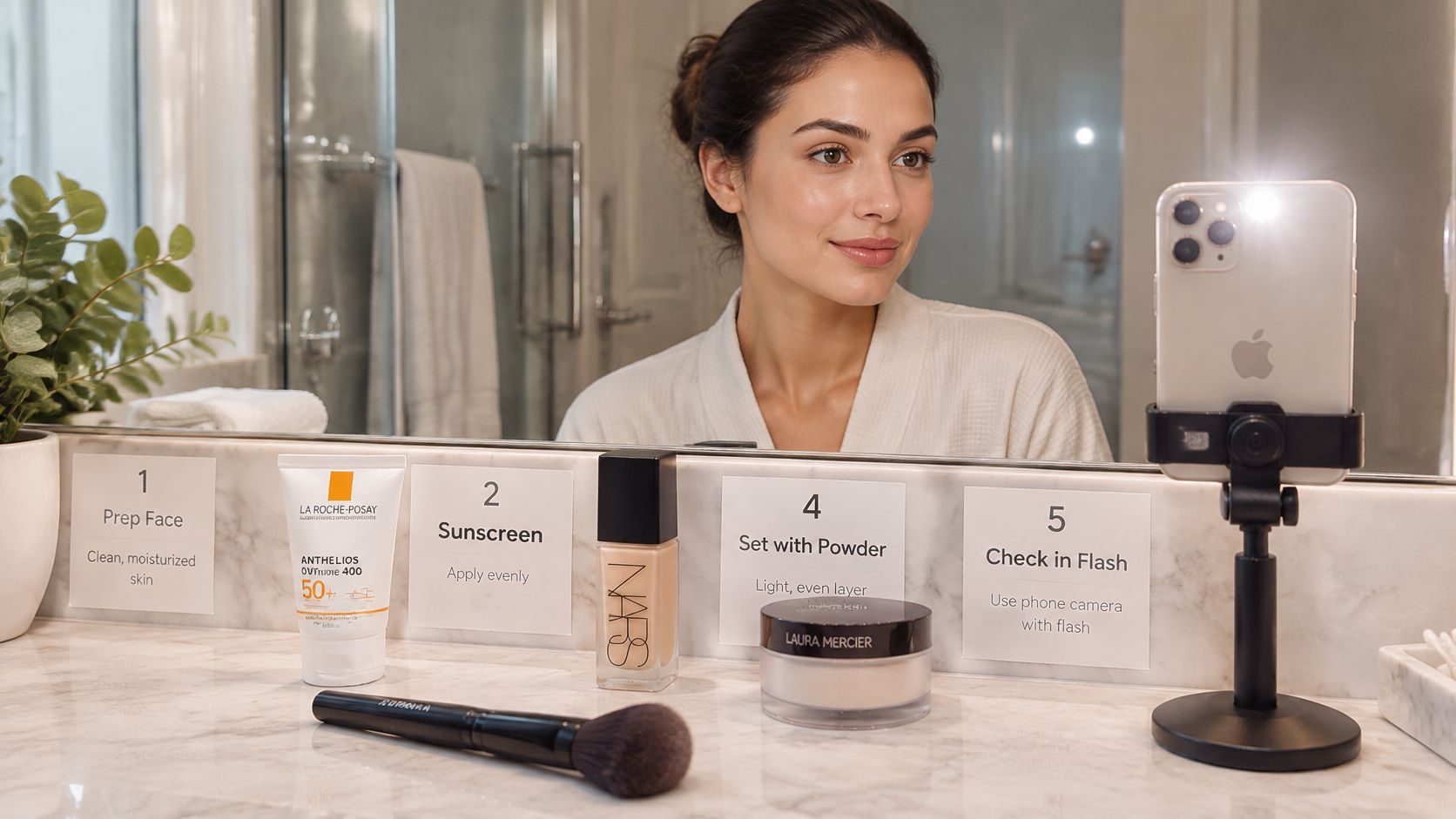
Use a thin, even sunscreen, then wait several minutes so the film can absorb and set. Foundation goes on after that film has settled. Powder goes on last, with a light hand, only where you need hold.
Do not stack a high-mineral SPF complexion product and a pale powder on the same zone. One mineral layer, set and then covered by a matched foundation, is easier to photograph than three pale films on one cheek. If the SPF already looks chalky before any powder starts, the sunscreen selection tips from BotoxBarb cover formulas that stay clearer on skin. For an affordable daytime base, compare options in the best drugstore sunscreen roundup.
Dust versus a pressed pan
Loose powder releases more airborne product than a pressed pan. A pressed powder, or a very light loose pass, is the lower-dust choice for daytime wear, and sun protection can stay in the routine.
Photograph that full stack with the camera and lighting you will use. If a pale cast shows up, change one product at a time so you can tell the filter, the powder, and the amount apart.
How to Test a Setting Powder for Flashback at Home
A label cannot see your foundation, your SPF, or your phone. A short side-by-side test can.
Looksmaxscan's breakdown of white powder in photos points out the gap in most coverage. One small test of raw ingredients was funded and conducted by an ingredient company, used only eight volunteers, one DSLR-flash setup, and raw materials rather than finished powders. Shoppers should not read silica-free as a proven guarantee, and they should not assume every silica powder will photograph the same. The missing piece is a record of amount, what sat underneath, and more than one skin tone.
If loose powder technique is the variable you keep changing, our guide on how to use loose powder keeps the application consistent before you judge the photo.
The home protocol
- Start with your event base. Apply your usual sunscreen and foundation first. Those layers change how light hits the powder, so a bare-skin swatch will not match the night.
- Powder one half only, in the amount you would really wear. A heavy bake and a thin brush pass are different products in a photo. Use the pass you would leave the house with.
- Leave the other half as the control. You need untreated skin, with the same base, so you can see a patch instead of guessing from memory.
- Shoot direct flash, phone flash, and daylight. Lab work used a DSLR, so a phone will not copy it exactly. Phone flashes sit close to the lens and are usually weaker, which is why you need the device you will carry.
- Look for a pale, chalky patch or a sharp highlight on the treated half. A cast that also shows in soft daylight is often untinted powder, not optical flashback, and the fix is shade rather than a new brand hunt.
- Repeat on a second complexion. Pale and deep skin can separate the same powder differently. A friend with a different tone, or a second test on your neck versus your face, stops a one-tone pass.
- Write down the powder, the amount, the light, the distance, and the foundation shade. Without that note, the next product is not a fair comparison.
A passing result is simple. In every flash frame, the treated half looks like the control, with no patch that stands out from the surrounding skin.
Watch a close-up of flash on finished makeup before you run your own test, so you know the pale patch you are looking for.
5 Budget Dupes That Hold Up Under Flash
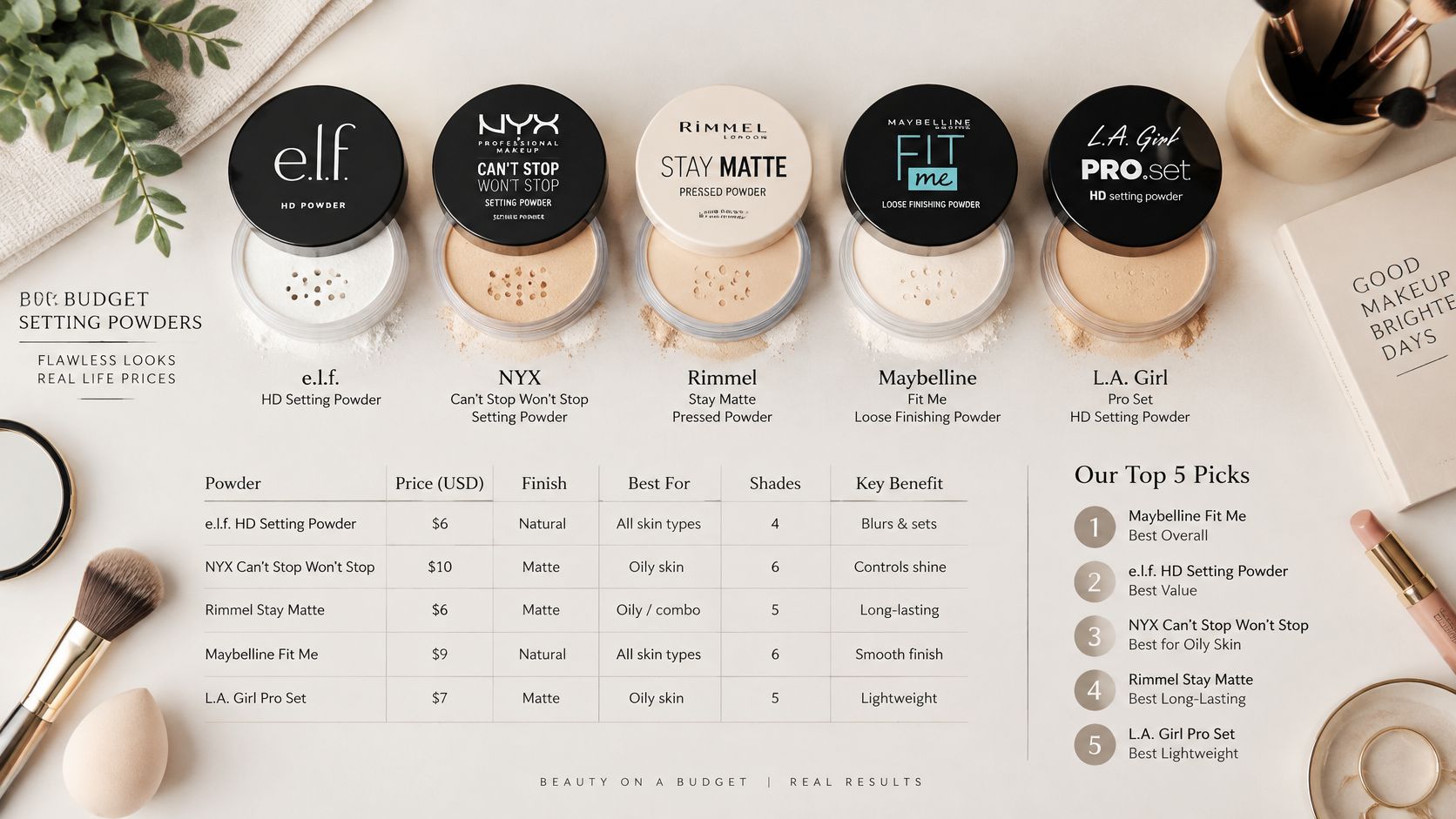
Flashback claims on luxury powders are easy to put in product copy and hard to prove on your face. The five below are common drugstore and mass-market picks that stand in for Laura Mercier on price and texture, not on a guarantee about flash. A setting powder is one layer in a stack that includes sunscreen, foundation, and the flash itself, so the same powder can look clean on one person and chalky on another.
| Dupe | Closest Original | Best For |
|---|---|---|
| NYX Professional Makeup Translucent Finishing Powder | Laura Mercier Translucent Loose Setting Powder | Oily skin and all-day wear |
| Maybelline Fit Me Loose Setting Powder | Laura Mercier Translucent Loose Setting Powder | Everyday light coverage |
| Rimmel Stay Matte Pressed Powder | Laura Mercier Translucent Loose Setting Powder | Pressed touch-ups |
| e.l.f. Mineral Infused Face Powder | Laura Mercier Translucent Loose Setting Powder Light Catcher | Budget mineral finish |
| Revlon ColorStay Pressed Powder | Laura Mercier Ultra-Blur Loose Setting Powder | Oily skin and pressed use |
The table gives you the closest match and the job each powder handles best. A brand's "no flashback" wording is a claim, not a result you can borrow. Test each one over the sunscreen and foundation you plan to wear, with the phone you will carry, before a big event.
Five drugstore picks, one check each
- NYX Professional Makeup Translucent Finishing Powder is the closest budget match to a classic translucent loose powder, and it is the one oily-skin shoppers reach for when they want all-day hold without a luxury jar. Read the ingredient list for silica before you commit it to photos.
- Maybelline Fit Me Loose Setting Powder is the lighter everyday option when you want a soft set rather than a full bake. Check the shade under flash, because a translucent loose powder can still lift lighter than your foundation.
- Rimmel Stay Matte Pressed Powder swaps the loose jar for a pan you can touch up in a bathroom. The pressed format also means less powder in the air. Judge the finish in a phone photo, not only in the compact mirror.
- e.l.f. Mineral Infused Face Powder is the budget pick if you are curious about a mineral finish in the same lane as Light Catcher. Scan where mineral filters and silica sit on the label, then test a thin layer over foundation.
- Revlon ColorStay Pressed Powder is the pressed stand-in when you want oil control in the Ultra-Blur lane without carrying a loose pot. Confirm the shade matches your neck in daylight, then repeat the shot with flash.
Buy the smallest size first. A dupe that sets makeup beautifully can still fail the only test that counts, which is your camera.
Common Questions About Flashback in Setting Powder
Why the mirror looks fine and the photo does not
Mirror light is diffuse and close to your face. Flash is intense and directional, so the same powder can look invisible in one and pale in the other. If the photo is the problem, judge the photo, not the vanity bulb.
Does a phone flash match a DSLR flash
Not necessarily. Phone flashes usually sit very close to the lens and are weaker than a DSLR unit. Run the check with the phone you will use that night.
Does pressed powder flash less than loose powder
The available ingredient test did not compare formats, so a pressed pan is not automatically safer. Test both if you own both. A lighter layer often matters more than the compact shape, and our best powder for dry skin notes are useful if a matte pan is leaving you chalky for a different reason.
Should you skip powder for flash photos
Usually not. Most faces need some set through shine, tears, or a long event. Try a lighter application or a different product in your home test first, and keep your sunscreen in the routine rather than deleting SPF to chase a cleaner photo.
If one change does not fix the cast, change the next layer, not the whole face.
Wrap Up and Test Your Setting Powder First
Laura Mercier still publishes the clearest flash claims in this roundup, and those claims are the brand's own, not an independent flash test. Among the budget options, NYX Professional Makeup Translucent Finishing Powder is the best dupe to try for flash photos, provided it passes on your skin with your camera.
Flashback comes from how particles return intense, directional light. The tested raw-ingredient data points to spherical and fumed silica as the main concern, while talc, mica, and magnesium carbonate showed no measurable flashback in that protocol. Sunscreen can stay if you use a thin layer and let it set. Your home test, under your foundation and your lighting, decides the powder.
On Finding Favourites we focus on beauty dupes, the affordable stand-ins for well-known makeup, skincare, and fragrance, including drugstore swaps. We also publish roundups such as 7 Best Charlotte Tilbury Setting Spray Dupes and 5 Best Supergoop! Unseen Sunscreen Dupes From The Drugstore, in the same spirit as this powder list. Run your flash test at least a week before the event so you still have time to switch.
Test first, buy second.
Finding Favourites is where we sort affordable makeup, skincare, and fragrance swaps so you can skip the luxury price without guessing in the aisle. If you are still comparing powders, sunscreens, or setting sprays for real photos, browse the dupe guides on Finding Favourites and test the shortlist on your own skin before the event.