
Personal Microderm Reviews: Top At-Home Devices for 2026
You know the feeling. It's 11:47 p.m., you've got three tabs open, and every personal microderm review seems to say something different. One person says their skin looked glassy after one use, another says the device irritated their face, and a third says it collected dust in a bathroom drawer after two weeks. That's exactly why this guide takes a harder line, it separates real value from glossy marketing and shows which at-home microderm tools are worth your money.
This post may contain affiliate links, which means I may receive a commission if you purchase through my links, at no extra cost to you. Please read the disclosure policy for more information.
| Device Name | Price Range | Best For |
|---|---|---|
| PMD Personal Microderm Classic | Lower tier | Simple at-home exfoliation, first-timers |
| PMD Personal Microderm Pro | Mid tier | More control without going full pro-device |
| PMD Personal Microderm Elite Pro | Higher tier | Adjustable treatments, cordless convenience |
| Dupe 4 | Budget tier | Value shoppers who want a basic exfoliation tool |
| Dupe 5 | Budget to mid tier | Sensitive skin users who want gentler control |
| Dupe 6 | Mid tier | Users who want stronger suction and more tip variety |
| Dupe 7 | Mid tier | Shoppers comparing long-term utility and upkeep |
Why Personal Microderm Reviews Are So Confusing
A lot of people end up in the same late-night loop. They start with the PMD Personal Microderm, read one review praising the glow, then find another warning about redness, overuse, or a device that felt underpowered. By the time they've clicked through a few more opinions, they still don't know whether they need a more basic model, a more adjustable one, or a completely different exfoliation tool.
That confusion exists because most personal microderm reviews obsess over the first session. They talk about smoothness, a little radiance, maybe a fresh-faced feel after one treatment, but they rarely follow through on the boring parts that matter, like maintenance, storage, replacement parts, and whether the device still gets used three months later. They also don't usually answer the most important question, which is whether a device is safe for your skin, not just flattering on normal skin.
PMD's own materials point to an 8-week clinical study in which 100% of participants experienced smoother, softer skin, 91% noticed a brighter and more radiant complexion, 89% reported refreshed, revitalized-looking skin, and 86% observed better skin tone and texture, but that's brand-reported trial evidence, not a broad independent dermatology consensus, as summarized in this PMD review analysis. Retail feedback is solid too, with Best Buy listings showing ratings of 4.8/5 from 37 reviews, 4.5/5 from 41 reviews, and 4.4/5 from 51 reviews across different variants, which suggests sustained interest without mass-market saturation, as seen in the Best Buy review listings.
The real divide isn't “does microderm work,” it's “does this device fit your skin, your patience, and your budget.”
If you're comparing exfoliation methods too, this AHA vs glycolic acid guide is useful context before you buy a device that may be more maintenance than you want. And if you're trying to build a cheaper routine overall, I'd also look at this cheap face exfoliator breakdown before assuming a machine is the only answer.
How At-Home Microdermabrasion Works
At-home microdermabrasion is mechanical exfoliation with vacuum assist. The device uses a tip, cap, or disc to lift dead surface cells while suction draws the skin toward the exfoliating surface. That pairing can smooth rough texture and leave skin feeling cleaner, but professional treatment rooms deliver stronger results, and at-home devices should be judged on that basis.
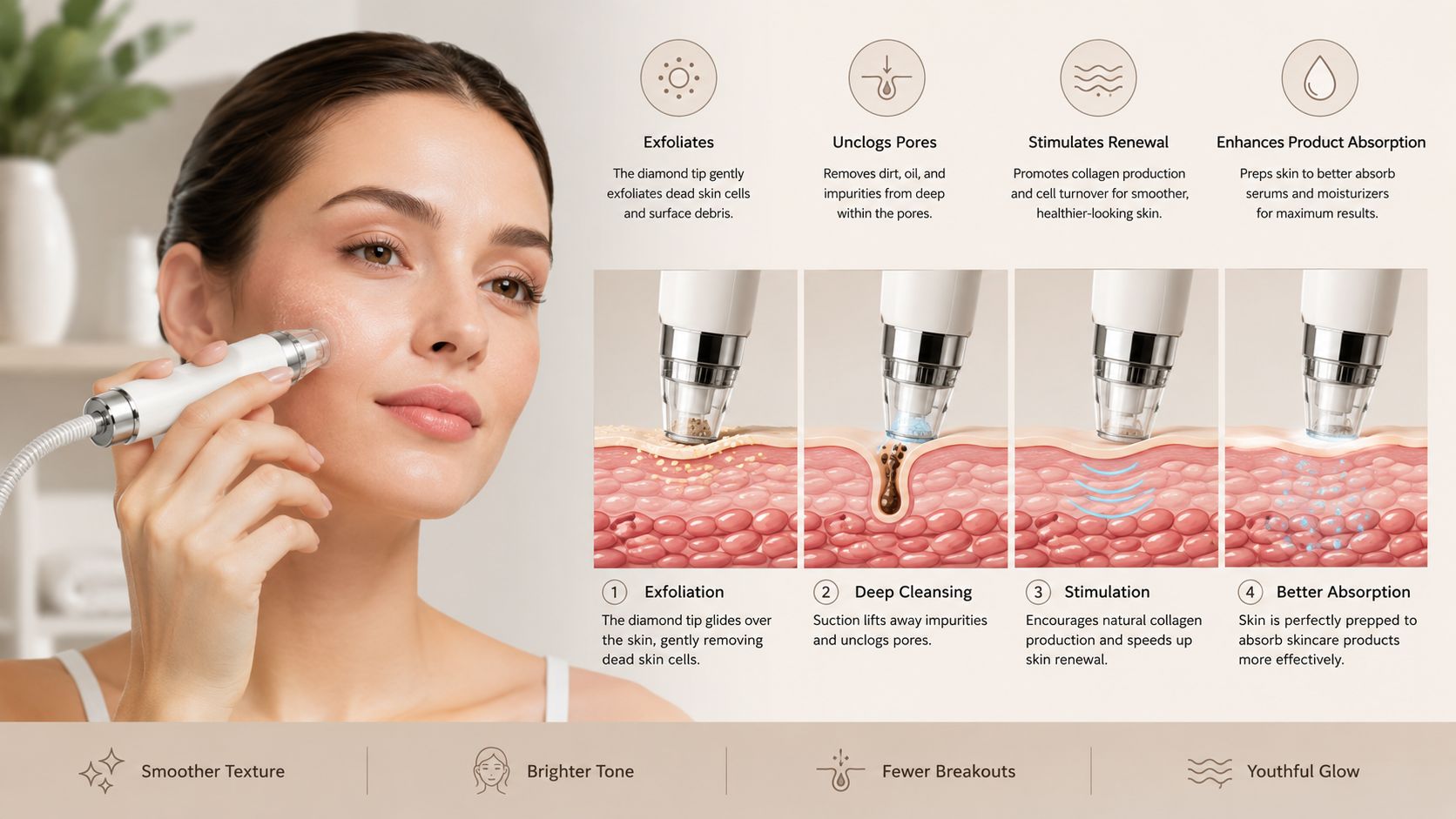
What the suction changes
Suction determines how firmly the exfoliating tip contacts the skin. More control usually gives better targeting around the nose, chin, and forehead, while a fixed setting stays simpler but leaves less room to adjust intensity. That is why the PMD lineup matters so much. The Classic has 2 classic caps and 1 speed setting, the Pro adds 2 speed settings and 2 smooth-glide caps, and the Elite Pro expands to 3 caps, 3 speed settings, 3 suction options, plus cordless rechargeable operation according to PMD's comparison page.
That tiering is not just branding. It tells you who each device serves, because more suction settings let you tailor intensity across sensitive and resilient areas. A basic tool is easier to use, but it also limits how precisely you can treat different parts of the face.
For a practical explainer on at-home tools from a clinical point of view, the nurse's guide to beauty tools is a smart companion read. It keeps the focus on what a tool can do, what it cannot do, and how to judge it without buying into hype.
What results are realistic
At-home devices can improve the look of rough texture, dullness, and some surface-level discoloration, but they work gradually. Expect to use one consistently before you judge it. Shoppers who expect a single-session transformation usually end up disappointed, or they overuse the device chasing results it was never designed to deliver.
Practical rule: if your face looks angrier after a session, the problem is the treatment intensity, not your moisturizer.
Sensitive skin needs extra caution here. Redness, tightness, stinging, and flare-ups are clear signs to stop, and those reactions are more likely if you already deal with a compromised barrier or reactive skin. If you want a budget-conscious exfoliation route without buying hardware, compare devices against this cheap exfoliator guide before you commit to something that adds maintenance without enough payoff.
Top 7 Personal Microderm Dupes Compared
Here's the blunt truth, most shoppers don't need the most expensive PMD model, they need the right amount of control for their skin and a device they'll keep using. The strongest dupe strategy is simple, compare suction, tip variety, maintenance, and comfort before you pay for brand prestige. If a device is awkward to clean, too intense, or too limited, it'll lose the value war fast.
| Device Name | Price Range | Best For |
|---|---|---|
| PMD Personal Microderm Classic | Lower tier | New users who want a simpler starting point |
| PMD Personal Microderm Pro | Mid tier | Users who want extra control without paying for cordless convenience |
| PMD Personal Microderm Elite Pro | Higher tier | Buyers who want the most adjustability in the PMD line |
| Dupe 1 | Budget tier | Shoppers who want a low-commitment intro device |
| Dupe 2 | Budget to mid tier | People who prefer gentler control on sensitive zones |
| Dupe 3 | Mid tier | Users who care about stronger suction and tip flexibility |
| Dupe 4 | Mid tier | Buyers focused on easy upkeep and durable ownership |
The PMD Classic is the simplest option in the lineup, and that can be a virtue if you're wary of overdoing exfoliation. The Pro is the sweet spot for people who want a little more control without paying for the Elite Pro's cordless extras. The Elite Pro is the most versatile PMD model, but it also asks the most from your technique, which means it's not the right purchase for a careless user.
For dupe shoppers, my advice is to prioritize adjustable suction and a tip system that matches your skin's tolerance. Independent at-home comparison roundups consistently treat those as performance markers, and one review specifically recommends at least two suction settings because different facial zones need different intensities, while noting that some devices go up to 8 suction levels. That same logic explains why a single-speed device can be safe and simple, but not always ideal for mixed-sensitivity skin.
One more thing, don't ignore the ownership side. A device can look cheap upfront and still turn expensive if it needs constant part replacement or you stop using it after the novelty wears off.
Buyer filter: if you won't use it at least occasionally, buy the cheaper tool or skip the device entirely and stick with a chemical exfoliant.
If you're building a sensitive-skin routine on a tighter budget, the affordable skincare for sensitive skin guide is the better place to spend first.
Who Should Avoid At-Home Microdermabrasion
This is the section most personal microderm reviews gloss over, and it's the one that can save your face. At-home microdermabrasion is not a cute little glow hack for everyone, and the wrong skin condition turns it into a bad idea fast. If your barrier is already irritated, abrasive exfoliation plus suction can make the problem worse, not better.
Skin types and conditions that need to skip it
People with rosacea, active acne, eczema, psoriasis, or a compromised skin barrier should be cautious or avoid these devices altogether. Sensitive, inflamed, or broken skin doesn't need more friction. It needs recovery. PMD's own guidance also tells users to avoid active or peeling products for 48 hours before and after use because skin sensitivity increases around treatment time, as noted on the product page for PMD Personal Microderm International.
That warning matters more than most reviews admit. A lot of review content focuses on visible exfoliation and convenience, but not on the people who should not be testing suction-based resurfacing in the first place. If you've got a flare-prone complexion, this is not a “try it and see” category.
Safer alternatives if your skin reacts easily
If your skin stings easily, heals slowly, or breaks out after aggressive cleansing, a softer routine usually wins. That means less mechanical action, more barrier support, and fewer overlapping actives. The sensitive skin exfoliation guide is a better fit if you need a gentler approach than a vacuum device.
A simple rule helps here.
If you're already using retinoids, exfoliating acids, or you've recently irritated your face, don't stack another resurfacing treatment on top.
For readers trying to avoid wasting money on a tool they shouldn't use, the affordable skincare for sensitive skin guide is a smarter first stop than any device aisle. And if your concern is irritation rather than glow, that's the right order of operations.
The Real Cost of Ownership and Maintenance
The sticker price is only the opening bid. A lot of people buy a microderm device because they want an at-home facial effect, then realize the machine also asks for cleaning time, careful storage, and enough consistency to justify the purchase. If you don't use it, even the nicest device becomes an expensive bathroom ornament.
What ownership really costs in time and attention
Some devices use more durable, reusable components, while others push you toward replacement parts. Either way, maintenance is part of the deal. You have to clean the device after use, avoid cross-contamination, and stay honest about how often you'll reach for it once the novelty fades.
That's why long-term value beats price alone. A lower-cost tool with simpler upkeep may outlast a more expensive model that you resent maintaining. I'd rather see someone buy a modest device and use it regularly than overbuy a premium one that gets abandoned after three sessions.
How this compares to other beauty spend
The ownership math matters. PMD's product positioning keeps framing the device as a home version of a more professional treatment, but value only exists if the device replaces other spend in a way that feels realistic for your routine. If you're already looking at med-spa or clinic visits, the device can make sense as a convenience purchase. If you're more of a one-and-done buyer, the economics get shaky fast.
For a related cost comparison on a different in-office service, the in-office LED facial pricing breakdown is a useful model for how to think about treatment math, not just device hype. The same logic applies here, cheap upfront doesn't always mean cheap over time.
One more point most reviews skip, follow-through matters. If you're not the kind of person who maintains tools, cleans tips, and reads instructions, don't buy a gadget that rewards discipline.
Which Device Should You Buy
If you want the short answer, here it is. For budget-conscious shoppers, buy the device that gives you enough control to reduce irritation without turning upkeep into a hassle. The shiny option is rarely the smartest one, especially if your skin is only mildly textured and you are not trying to mimic salon-level intensity at home.
Best pick for beginners
If you are new to microdermabrasion and your skin is normal, start with the PMD Personal Microderm Classic or a similarly simple dupe. Fewer settings mean fewer ways to misuse it, and that matters more than chasing a longer feature list. A basic device makes sense when you want a gentle entry point and you are still learning how your skin handles suction-based exfoliation.
Best pick for more resilient skin
If your skin tolerates exfoliation well and you want more control, the PMD Personal Microderm Elite Pro is the stronger PMD option. Its full spec breakdown appears in the how-it-works section above, so the central question here is whether those features match your skin type and your habits. For users who want flexibility, the extra caps, speed choices, suction options, and cordless rechargeable operation give it a clear edge. More control only helps if you use it with restraint, because the same features make it easier to overdo.
Best pick for sensitive or cautious users
If your skin is touchy, skip aggressive devices and choose the gentlest option available, or leave microdermabrasion out of your routine entirely and use a softer exfoliant instead. That is the safer call for reactive skin, especially if you already deal with redness, dryness, or easy irritation. If you insist on trying a device, keep to the simplest settings and the lowest risk of overuse so you stay closer to the tolerance your skin can handle.
Where Finding Favourites fits in
Finding Favourites is useful if you want a side-by-side look before buying. It focuses on affordable alternatives and product research, so it works well when you are comparing tools, skincare, and value buys instead of chasing the priciest model in the category.
If you want to weigh more options before you spend, the PMD comparison page is useful, but the practical question stays the same. Will you keep using it, and will your skin tolerate it?
Frequently Asked Questions About Personal Microderm Devices
How often should you use one?
Not every day. These tools are meant for occasional treatment, not routine cleansing. If you overuse them, you'll usually notice redness, sensitivity, or that tight, irritated feeling people mistake for “working.”
Can you use them on your body?
Some devices are designed with body caps or broader attachment options, but that doesn't mean every area is fair game. Start conservatively and avoid any skin that's already irritated, broken, or inflamed.
Do they really help with acne scars?
They can help improve the look of texture and surface irregularity, but they're not a fix for deep scarring. If your main concern is true scar remodeling, you'll need a different strategy than at-home microdermabrasion.
What if your skin gets irritated?
Stop using the device. Then give your routine a break from actives and let the skin calm down before trying anything abrasive again. If irritation keeps happening, the device is probably wrong for your skin type.
How do they compare with chemical exfoliants?
They're different tools. Chemical exfoliants can be easier to dose and often play better with sensitive users, while microderm gives you a more mechanical treatment feel. If you're already using strong actives, adding a device is usually too much.
Is a more expensive model always better?
No. A pricier device can offer more control, but only if you'll use those settings correctly. For a lot of shoppers, simpler is smarter.
Final Verdict and Best Overall Dupe
After sorting through the hype, the best overall choice is the device that balances control, safety, and long-term use. For many users, that means the PMD Personal Microderm Elite Pro if they want maximum flexibility, or a simpler dupe if they care more about low-risk upkeep and budget than advanced settings.
That's the key takeaway from these personal microderm reviews. The strongest device is not the one with the most dramatic marketing, it's the one that fits your skin type, your patience, and your willingness to maintain it. If your skin is sensitive, reactive, or currently inflamed, skip the category or choose a much gentler route. If your skin is resilient and you're disciplined, the more adjustable option is worth the extra effort.
Maintenance still matters more than people want to admit. Clean the device properly, don't stack it with harsh actives, and don't expect instant perfection after one use. The shoppers who get the best results are usually the ones who treat microderm as a careful weekly tool, not a daily rescue plan.
For the best budget-friendly path, I'd still favor the dupe that gives you solid control without turning into a maintenance project. If you want the most versatile PMD option, the Elite Pro is the clear standout.
If you're ready to compare more affordable beauty buys without wading through hype, visit Finding Favourites for curated dupe roundups and practical shopping guidance. It's a smart next stop if you want skincare recommendations that respect your budget and your skin.