
7 Best Drugstore Barrier Repair Cream Dupes That Actually
You wake up after a week of retinol, exfoliating acids, and an ambitious skincare routine to find skin that feels tight, flaky, and oddly stingy. Even your usual cleanser burns, and the expensive moisturizer you bought for “barrier support” seems to sit on top without making your face comfortable.
That's the point where a drugstore barrier repair cream can make more sense than another luxury purchase. The right formula won't magically undo aggressive actives, but it can provide water, lipids, and protective occlusion while you simplify the routine. The seven options below are widely available in the United States and match different types of irritation, from retinol sensitivity to dry winter skin and oily, over-exfoliated complexions.
This post may contain affiliate links, which means I may receive a commission if you purchase through my links, at no extra cost to you. Please read the disclosure policy for more information.
Drugstore Barrier Repair Cream Dupes at a Glance
| Drugstore Dupe | Luxury Equivalent | You Save |
|---|---|---|
| CeraVe Moisturizing Cream | La Mer Crème de la Mer | Luxury markup |
| Vanicream Moisturizing Cream | Skinfix Barrier+ Triple Lipid-Peptide Cream | Premium pricing |
| La Roche-Posay Toleriane Double Repair | Dr. Jart+ Ceramidin Cream | Luxury markup |
| Aveeno Skin Relief Moisturizing Cream | First Aid Beauty Ultra Repair Cream | Premium pricing |
| Eucerin Advanced Repair Cream | Augustinus Bader The Cream | Luxury markup |
| Neutrogena Hydro Boost Gel-Cream | Tatcha The Water Cream | Premium pricing |
| Aquaphor Healing Ointment | Dr. Barbara Sturm Face Cream Rich | Luxury markup |
The table uses qualitative savings because exact prices vary by retailer, package size, and promotion. The important point is simpler: you can find credible barrier-support ingredients at drugstore prices without paying for prestige packaging or a luxury brand story.
Why Your Skin Barrier Needs Help Right Now
Barrier problems often start with good intentions. You add retinol for smoother texture, an acid for clogged pores, and perhaps a scrub or strong cleanser because your skin still doesn't look “clear” quickly enough. A few days later, makeup clings to flakes, moisturizer tingles, and your face feels uncomfortable before you've even applied anything.
That reaction usually calls for a routine reset, not more exfoliation. Dermatologist-led guidance identifies frequent acids, high-strength retinol, harsh cleansers, and over-washing as common contributors to a compromised barrier, and notes that calming the skin can take about two to four weeks with consistent gentle care. DermApproved's guidance on compromised skin barriers also challenges the assumption that the thickest cream automatically performs best.
The drugstore category has matured since CeraVe launched in 2005, when dermatologists built the brand around affordable therapeutic skincare, three essential ceramides, and time-release MVE Technology. CeraVe's 20th-anniversary history describes the brand's role in making ceramide-based barrier care a defining mass-market format rather than a luxury-only concept.
My editorial rule: Stop the trigger first. Then choose a cream that matches what your skin is missing.
A cream can help, but it can't compensate for continuing to use a product that causes burning or escalating redness. If your face is oily but stinging, choose a lighter barrier lotion or gel-cream. If it's cracked, rough, and losing moisture rapidly, a richer cream or ointment makes more sense. The rest of this guide treats those formats as different tools, because they are.
What a Damaged Skin Barrier Actually Looks Like
Think of the outer skin barrier as a brick wall. The skin cells act as the bricks, while ceramides, cholesterol, and fatty acids form the mortar between them. When that mortar becomes disorganized or depleted, water escapes more easily and irritants can enter more readily.
Simple dryness usually feels rough or tight but remains fairly predictable. A damaged barrier behaves differently. Your familiar moisturizer suddenly stings, water feels irritating, redness lasts longer, and products that never caused trouble now leave your face hot or itchy.
A practical diagnosis
Look for a cluster of symptoms rather than one flaky patch:
- Stinging: Water, moisturizer, or sunscreen burns on contact.
- Tightness: Your skin feels pulled even shortly after applying cream.
- Redness: Irritation appears in areas that previously tolerated your routine.
- New sensitivity: Retinol, acids, fragrance, or even a basic cleanser suddenly feels aggressive.
- Texture changes: Fine flakes and roughness appear alongside discomfort.
Cold weather can worsen dryness, but overdoing actives is a frequent modern trigger. Retinol, AHAs, BHAs, scrubs, and aggressive cleansing can all create a cycle in which you keep treating texture while making the underlying irritation worse.
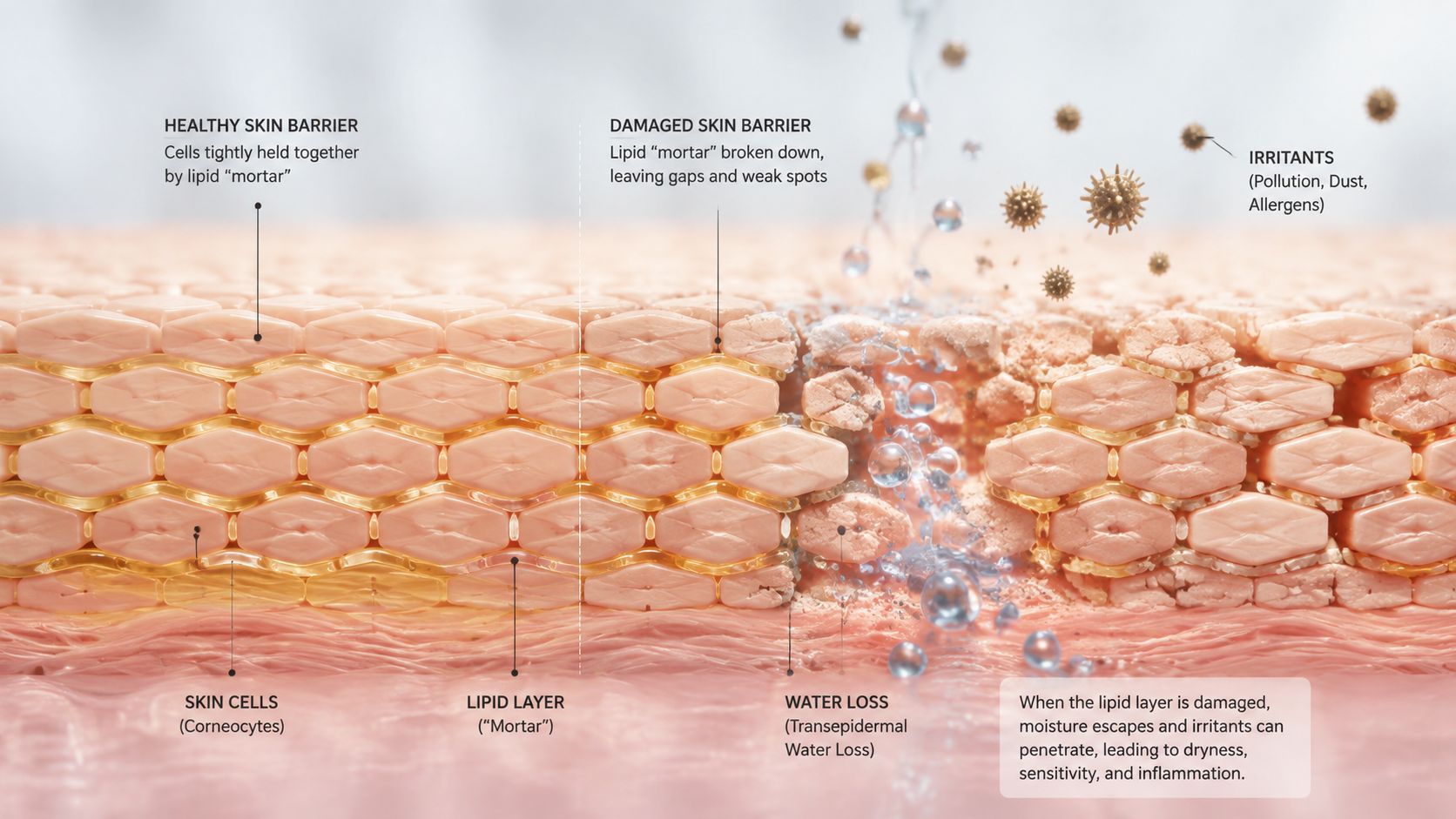
A useful repair plan starts with removing the obvious stressors, using a mild cleanser, and applying a bland moisturizer consistently. The step-by-step barrier repair plan is helpful if you need a simple routine rather than another complicated product rotation.
Dryness versus barrier disruption
Dry skin may need more humectants and emollients. A compromised barrier needs fewer variables. That means pausing the acid toner, reducing cleansing intensity, and resisting the temptation to test several “soothing” products at once.
Watch this visual explanation after you've identified your symptoms. It reinforces why water loss and irritant exposure are connected, rather than treating dryness as an isolated surface problem.
Seek medical advice if redness, itching, swelling, pain, cracking, or oozing persists, spreads, or becomes severe. A barrier cream is skincare support, not a diagnosis for eczema, infection, allergy, or another inflammatory condition.
Ingredients That Rebuild Your Barrier and Ones to Skip
A good formula usually combines three jobs. Humectants attract water, lipids support the mortar between skin cells, and occlusives slow water loss by forming a protective layer. Independent dermatology guidance commonly highlights glycerin, hyaluronic acid, squalane, natural moisturizing factors, and ceramides when evaluating barrier-support moisturizers. Allure's barrier-repair ingredient guidance provides a useful checklist for reading labels.
The three-part formula
Glycerin and hyaluronic acid are humectants. They help the skin hold onto water, but they work best when the formula also includes emollients or occlusives. A water-binding ingredient alone may leave very dry skin wanting more protection.
Ceramides, cholesterol, and fatty acids are the more strategic lipid combination. A five-center randomized trial in people with moderate-to-severe atopic dermatitis examined a triple-lipid emulsion using a 3:1:1 ceramide-to-cholesterol-to-free-fatty-acid ratio. The evidence linked this structure with improved barrier function, reduced transepidermal water loss, and better restoration of the stratum corneum lipid architecture. The clinical review in PMC explains why a formula that pairs these lipids is more technically persuasive than one that throws in as many oils as possible.
Petrolatum and dimethicone provide occlusion. Petrolatum has a specific role in the FDA skin-protectant framework, where it temporarily protects and helps relieve chapped or cracked skin. This overview of the OTC skin-protectant framework explains why petrolatum-containing products can support repair rather than functioning as ordinary moisturizers alone.
CeraVe Itch Relief Moisturizing Cream illustrates the combination clearly. Its cited DailyMed label lists water, glycerin, petrolatum, dimethicone, and ceramide 3 among the top ingredients, bringing humectant hydration, occlusive protection, and ceramide support into one formula. The cited ingredient label is more useful than vague “barrier boosting” language on a front label.
What I'd leave out during a flare
Pause fragrance, essential oils, strong alcohol-heavy formulas, and additional exfoliating acids while your skin is stinging. Don't assume a botanical label means gentle, and don't add a new active just because your complexion looks dull.
For a broader look at how treatment-oriented formulas differ from ordinary moisturizers, this medical-grade skincare overview offers useful context. If you're comparing soothing ingredients beyond the usual ceramide conversation, beta-glucan skincare products are another category worth researching, especially for hydration-focused routines.
7 Drugstore Barrier Repair Cream Dupes Worth Your Money
These creams are not molecular copies of luxury formulas. They are functional dupes, meaning they serve a similar moisturizing role, use a comparable texture, or follow a related ingredient strategy at a more accessible price. The right choice depends on the trigger behind your barrier damage. Over-exfoliated skin needs cushioning and occlusion, retinol irritation often calls for a plain, protective cream, and environmental stress may respond better to a lighter hydrating format.
1. CeraVe Moisturizing Cream versus La Mer Crème de la Mer
CeraVe is the strongest all-around pick on this list. Its formula contains three essential ceramides, 1, 3, and 6-II, plus hyaluronic acid, and the cited product information also notes petrolatum. That combination supplies lipid support and water-loss protection, which is what I want after over-exfoliation or retinol irritation. The CeraVe product breakdown supports its role as a practical alternative to La Mer's rich barrier-focused cream.
The texture is dense but spreadable, with a soft, low-shine finish rather than a glossy ointment effect. Dry and combination skin can use it across the face, while oily skin should apply a smaller amount to irritated zones. It offers the most practical balance here of recognizable barrier ingredients, wide availability, and flexible use.
2. Vanicream Moisturizing Cream versus Skinfix Barrier+ Triple Lipid-Peptide Cream
Vanicream is the sensible sensitive-skin choice. Its plain, cushiony texture feels utilitarian rather than luxurious, which helps when your face reacts to crowded formulas. Choose it for dry, reactive skin that needs a simple moisturizer without unnecessary extras.
The finish is comfortable and protective without turning into an ointment. Vanicream does not imitate Skinfix's exact lipid-peptide profile, but it fills the same routine role: a substantial cream for redness-prone, over-treated skin. Pick it when ingredient restraint matters more than a silky cosmetic experience.
3. La Roche-Posay Toleriane Double Repair versus Dr. Jart+ Ceramidin Cream
Toleriane Double Repair is the most useful middle-ground option for combination skin. It feels lighter than CeraVe Moisturizing Cream, spreads quickly, and leaves a smoother finish under sunscreen.
Use it for environmental stress, mild dehydration, or tight skin without visible cracking. Compared with Dr. Jart+ Ceramidin Cream, it delivers a less rich experience while staying within the same broad ceramide-led barrier category. I would choose it for daytime use when a heavy cream makes your T-zone look slick.
4. Aveeno Skin Relief Moisturizing Cream versus First Aid Beauty Ultra Repair Cream
Aveeno Skin Relief suits dry skin that wants a plush cream and a comfortable finish. It works particularly well for body dryness, rough hands, and facial areas that tolerate richer formulas.
This is not a strict lipid-ratio match for First Aid Beauty. Both belong to the soothing, comfort-first category, though. Choose Aveeno when tightness and roughness are the main complaints and you want one drugstore cream for face and body.
5. Eucerin Advanced Repair Cream versus Augustinus Bader The Cream
Eucerin Advanced Repair targets visibly rough, flaky skin, especially on the body or very dry facial zones that do not break out easily. Its finish is richer and more noticeable than Toleriane's, so apply it selectively instead of covering the entire face with a thick layer.
Its value lies in straightforward moisturization and surface smoothing, not luxury sensorial appeal. It will not reproduce Augustinus Bader's proprietary positioning, but it makes more sense when your skin needs comfort and softness rather than prestige branding.
6. Neutrogena Hydro Boost Gel-Cream versus Tatcha The Water Cream
Oily and combination skin often needs hydration without a heavy seal. Neutrogena Hydro Boost Gel-Cream provides a cool, lightweight texture and a fresh finish that layers cleanly under sunscreen.
It is not my choice for cracked, inflamed skin because it feels less protective than CeraVe or Vanicream. It suits environmental dehydration, mild retinoid dryness, and oily skin that dislikes dense creams. Choose it when hydration matters more than occlusion.
7. Aquaphor Healing Ointment versus Dr. Barbara Sturm Face Cream Rich
Aquaphor is the emergency option for cracked lips, irritated nose corners, and small areas that need a strong protective seal. Its ointment texture is shiny and occlusive, so it is not a universal face moisturizer and may feel too heavy for acne-prone complexions.
Apply a thin layer over moisturizer instead of using it as a complete routine. It matches this category through function rather than elegance, helping reduce water loss from a particularly dry patch. For another comparison of rich barrier products, see this Rhode Barrier Butter dupe guide.
How to Layer Barrier Repair Cream Into Your Routine
The routine should become boring. That's a feature, not a failure.
Morning order
Start with a gentle, non-foaming cleanser, or rinse with water if cleansing leaves your skin tight. Apply a hydrating toner or serum only if it doesn't sting. Press your barrier cream onto slightly damp skin, then finish with sunscreen.
Applying cream while skin is slightly damp can help humectants such as glycerin and hyaluronic acid work within a hydrated routine. Don't soak your face, because a dripping-wet surface can make the product slide around instead of settling evenly.
For oily skin, use a thin layer on the cheeks and around the mouth, then less across the T-zone. For dry skin, apply a consistent layer and reserve petrolatum ointment for small areas that crack or lose moisture quickly.
Evening order
At night, cleanse gently, apply any bland hydrating layer you already tolerate, and use the barrier cream as your final moisturizing step. If you use a prescription topical, follow the prescriber's instructions. Some treatments belong directly on clean, dry skin, while others may be buffered with moisturizer, so don't improvise around a prescription without professional guidance.
Pause retinoids and exfoliating acids if your skin burns, flakes heavily, or reacts to basic products. Reintroduce them only after your skin has calmed and feels consistently comfortable. Dermatologist-led guidance places recovery at about two to four weeks for many compromised barriers, but symptoms should guide the timing rather than a calendar alone. Start with one active, low frequency, and plenty of bland moisturizer between applications.
Don't introduce a new serum, exfoliant, cleanser, and cream at the same time. If your skin improves, you won't know which change helped. If it worsens, you'll have several suspects and no clear way to identify the problem.
Common Barrier Repair Mistakes That Make Things Worse
The richest cream isn't automatically the most effective. Texture and performance are different things. A heavy balm may reduce water loss well, but it can feel uncomfortable, encourage overapplication, or contribute to congestion for some users.
Layering multiple occlusives is another common mistake. Applying a dense cream, facial oil, and ointment over the same area can trap heat and feel suffocating without rebuilding the lipid structure more effectively. Choose one main cream, then add an ointment only where you need extra protection.
Continuing retinol or acids “just once a week” can also keep irritated skin in a loop. If your face stings during basic cleansing, the problem isn't that you need a gentler exfoliation schedule that day. You need a pause.
Your cleanser matters just as much as the moisturizer. A foaming, strongly fragranced, or overly stripping cleanser can undo the comfort your cream provides. Switch to a gentle, non-foaming option and keep water lukewarm.
The best repair routine is the one that removes irritation faster than it adds new products.
Finally, don't use a barrier cream to ignore persistent symptoms. Ongoing itching, swelling, pain, rash, or cracking deserves evaluation, particularly when a simplified routine doesn't help.
Frequently Asked Questions and Final Verdict
Is barrier cream safe for acne-prone skin?
Usually, yes, but format matters. Choose a lighter lotion or gel-cream for the full face, and reserve dense creams or petrolatum ointments for dry patches. Patch test new products and watch for congestion.
Can I use it around my eyes?
Use only a bland product that the label supports for that area, and keep it away from the lash line. Stop if it causes watering, burning, or swelling.
Do I need a barrier serum too?
Not necessarily. A cream may be enough. If you prefer a lighter layer, a skin barrier repair serum guide can help you compare formats before adding another step.
Which dupe should I buy first?
Buy CeraVe Moisturizing Cream first. It earns the top spot because its three essential ceramides, hyaluronic acid, and petrolatum offer a practical blend of hydration, lipid support, and occlusion. It works especially well for dry and combination skin, while the other picks are better targeted to oily, highly sensitive, rough, or spot-specific needs.
CeraVe is the best overall drugstore barrier repair cream dupe in this roundup, not because it copies La Mer perfectly, but because it solves the more important problem with a straightforward formula and flexible texture. Stop the irritating actives, simplify your cleanser, and use the cream consistently before judging the result.
Finding Favourites helps beauty shoppers compare affordable alternatives to luxury skincare, makeup, and fragrance, including barrier-focused moisturizers and practical dupe roundups. Visit Finding Favourites to find budget-conscious product comparisons, skincare guides, and new luxury swaps.