
7 Best Skin Barrier Repair Serum Dupes That Actually Work
Your skin feels tight after cleansing, looks shiny and flaky by lunch, and stings when you try to fix it with a heavier cream. That's the moment many individuals start searching for a skin barrier repair serum, then get buried in marketing that treats every hydrating serum like it's doing the same job. It isn't. A real barrier-focused formula repairs the skin's protective lipids and lowers water loss, while a basic hydrator mostly gives temporary comfort.
This post may contain affiliate links, which means I may receive a commission if you purchase through my links, at no extra cost to you. Please read the disclosure policy for more information.
If you want a practical starting point for damaged or sensitized skin, the Ohio clinical barrier repair guide from Face Studio and Wellness Center is a useful reality check. For a broader budget-skin routine angle, I also like the approach in this sensitive-skin guide, because it keeps the focus on reducing irritation instead of piling on more products.
Why Your Skin Barrier Needs More Than Just Hydration
The most common mistake is treating tight, reactive skin like it just needs more moisture. That's what people do after over-cleansing, over-exfoliating, or using strong actives every night, and it usually backfires. The skin barrier is a structured system that limits water loss and protects against environmental damage, so once it's disrupted, transepidermal water loss, or TEWL, rises and hydration drops independent barrier research.
A lot of shoppers keep reaching for basic hydrating serums because they feel soothing for a few hours. That can help on the surface, but it doesn't automatically fix the permeability problem underneath. If your skin still stings when you apply products, your barrier wants more than a water-binding layer.
Practical rule: if your face burns with bland moisturizers, the routine is too aggressive, not too simple.
A useful way to think about it is this, a hydrating serum can plump, but a barrier repair serum is supposed to rebuild. That means lipid support, less water loss, and better tolerance to the rest of your routine. The difference matters if you're using retinoids, acids, or even a cleanser that leaves your skin feeling squeaky and stripped.
If you're still unsure whether you need repair or just a gentler moisturizer, compare your current routine with the reset approach in this affordable sensitive-skin roundup. In practice, the people who benefit most from a skin barrier repair serum are the ones dealing with recurring tightness, flaking, redness, and that annoying cycle where every fix seems to create another problem.
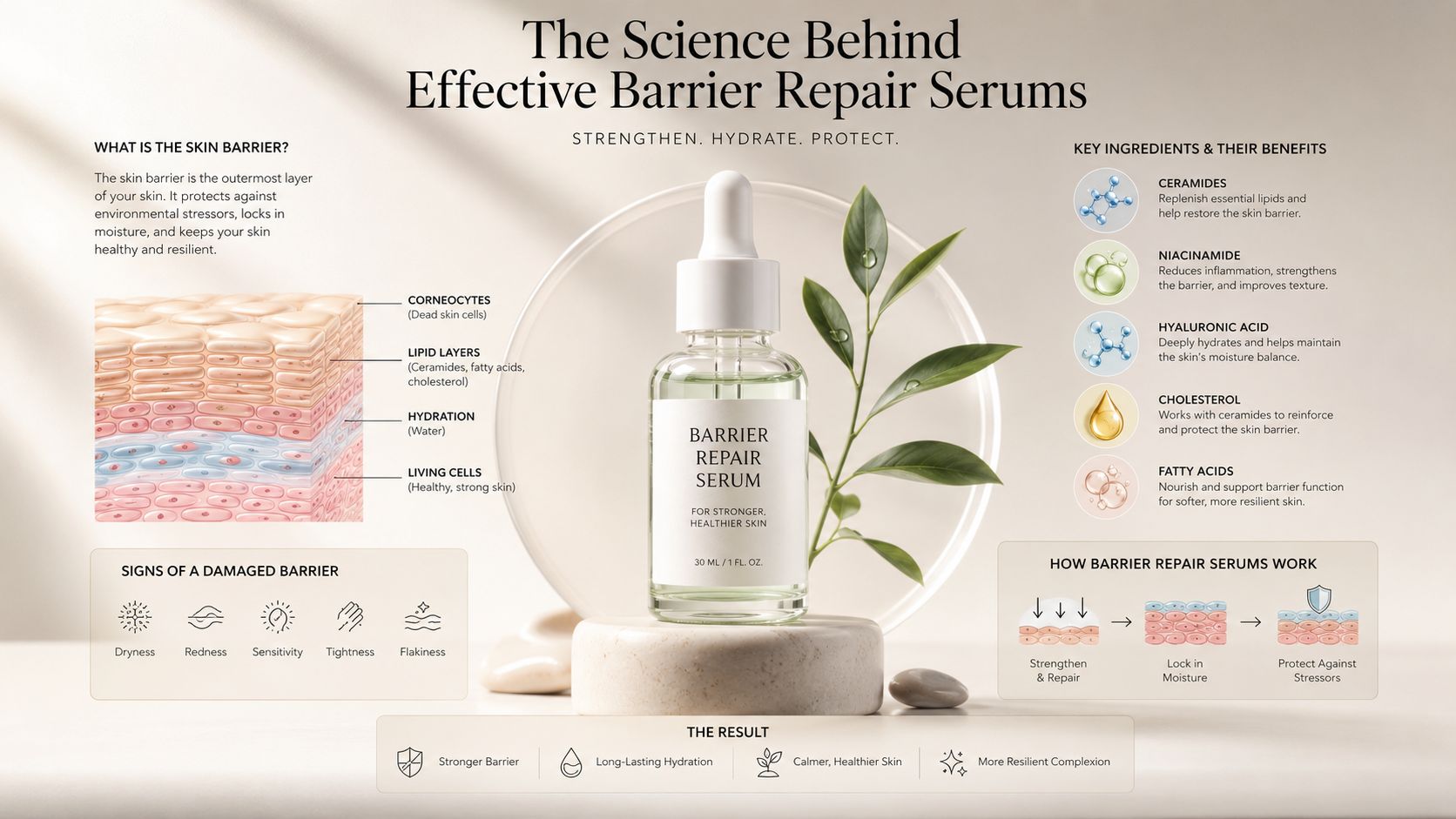
The Science Behind Effective Barrier Repair Serums
A real barrier formula has to do more than add slip and temporary hydration. The skin barrier is an interdependent system of physical, chemical, microbiologic, and immunologic layers, which is why a single-mechanism serum rarely gets the job done barrier architecture overview. If a product only drops water into the top layer, it may feel better for a short window, but it does nothing to close the lipid gap that keeps moisture leaking out.
What the best formulas do
Ceramides rebuild the structural “mortar” between skin cells. Humectants like glycerin draw water into the skin. Acidic pH support helps the enzymes that generate ceramides and maintain the acid mantle. That combination is why a well-built barrier serum outperforms a basic hydrator for compromised skin.
Clinical evidence backs that up. In 2025, a barrier repair serum formula showed measurable recovery after very short use, with significantly lower TEWL after 1 application versus untreated skin after harsh cleanser exposure, and continued improvement after 14 days of daily use, with the effect maintained through day 56 with p < 0.0001 versus day 3 2025 clinical study. The same study also found lower TEWL after tape stripping and 1 to 2 hours of hot-condition exposure on serum-treated skin, which shows the formula helped the barrier recover faster under stress.
If you want the same logic in plain English, look for formulas built around lipid replacement, water binding, and barrier support together. A product that only hydrates can make skin look better for a few hours. A true repair serum is built to reduce water loss and help skin tolerate the rest of your routine. For a closer look at ingredient structures that follow this pattern, see beta glucan barrier repair products.
What timeline to expect
Do not expect a dramatic overnight reset. Structural recovery takes time, even when surface comfort improves quickly. A good serum can calm the skin sooner, but the deeper repair story is slower and more meaningful.
Judge these products by reduced TEWL, better tolerance, and fewer flare-ups, not by a glossy “instant glow” promise.
Key Ingredients to Look for in Barrier Repair Formulas
Start with the ingredient list, not the claims panel. If a product calls itself a barrier serum but the formula reads like a basic hydrator, skip it. A technically credible formula should show barrier support, not just surface slip.
The ingredients that deserve your money
Look for ceramides, because they help replace the lipids your skin needs to hold itself together. Look for cholesterol and fatty acids as well, since barrier-focused formulas commonly use a 3:1:1 ratio of ceramides, cholesterol, and fatty acids to mimic the natural barrier validated serum architecture. That ratio isn't magic, but it does signal that a brand is thinking about barrier structure instead of just moisture.
Also watch for niacinamide, panthenol, and glycerin. Niacinamide supports ceramide production, panthenol helps calm stressed skin, and glycerin draws in water without feeling greasy. If your skin is reactive, those ingredients tend to be more useful than fragrance-heavy formulas that smell luxe but behave badly.
Keep this in mind, a serum that only attracts water can temporarily plump the surface, but without lipid replacement and retention it doesn't correct the underlying permeability defect.
What I'd avoid
Skip formulas that lean on high alcohol, heavy fragrance, or essential oils if your barrier is already compromised. Those ingredients can turn a sensitive-skin routine into a guessing game. I'd also be skeptical of anything that promises “barrier repair” but reads like a standard hyaluronic acid serum with a prettier label.
For shoppers comparing ingredient families, this beta-glucan guide is worth a look because beta-glucan is one of the quieter supportive ingredients that often gets overlooked. It's not the star of every formula, but it shows up in products that aim to soothe instead of merely hydrate.
7 Best Skin Barrier Repair Serum Dupes Under $30
| Product | Price | Best For |
|---|---|---|
| CeraVe Hydrating Hyaluronic Acid Serum | Under $30 | Dry, reactive skin that needs ceramides and simple barrier support |
| Cocokind Ceramide Barrier Serum | Under $30 | Sensitive skin and lightweight daily repair |
| The Inkey List Bio-Active Ceramide Repairing & Plumping Serum | Under $30 | Dull, stressed skin that wants barrier support without heaviness |
| Versed Skin Soak Rich Moisture Serum | Under $30 | Very dry skin that wants a cushiony texture |
| e.l.f. SKIN Holy Hydration Thirst Burst Drops | Under $30 | Oily or combo skin that wants a lighter barrier-friendly serum |
| Aveeno Calm + Restore Triple Oat Serum | Under $30 | Easily irritated skin that needs soothing support |
| Good Molecules Hyaluronic Acid Serum | Under $30 | Budget hydration layered under a richer moisturizer |
1. CeraVe Hydrating Hyaluronic Acid Serum
This is the safest mainstream pick if your skin hates drama. It's a practical dupe choice because CeraVe builds around ceramides and hydration support rather than fragrance and fluff. The texture is light enough for daytime, but it still feels more purposeful than a plain humectant serum.
I'd recommend it for people who want a starter barrier serum that can live under sunscreen and a moisturizer without pilling. It won't feel fancy, and that's the point. If you're trying to compare it with a luxury barrier serum, the value is that it targets the same repair mindset without the prestige markup.
2. Cocokind Ceramide Barrier Serum
Cocokind is one of the better low-cost choices for skin that gets angry fast. It reads like a barrier product first, and a glow product second. That's exactly what I want from a dupe.
The formula works best when you're trying to calm the skin and keep the routine lean. If your current serum feels sticky, perfume-y, or overly trendy, this is the kind of swap that makes sense immediately. It's also easy to slot into a morning or night routine without adding extra layers.
3. The Inkey List Bio-Active Ceramide Repairing & Plumping Serum
This is the better pick if your skin looks exhausted and flat, not just dry. The Inkey List tends to keep formulas straightforward, and that makes it easier to trust on compromised skin. The name is a little long, but the idea is simple, give the barrier what it needs and stop there.
I'd reach for this when I want something with more of a treatment feel than a basic hydrating serum. It fits the barrier-repair brief because it doesn't pretend hydration alone is enough. For shoppers who usually buy pricier “repair” serums, this is one of the more sensible US drugstore-adjacent alternatives.
4. Versed Skin Soak Rich Moisture Serum
Versed leans richer, so it suits drier skin types that want a serum with more cushion. If your face gets tight within an hour of cleansing, this is the kind of formula that can feel immediately more comfortable. It's not trying to be a minimalist splash of hydration.
I like this pick for night routines, especially if you follow it with a plain moisturizer. It won't replace a true lipid cream for everyone, but it can absolutely fill the gap between a watery serum and an occlusive finish. That makes it a smart dupe for people who want comfort without spending luxury money.
5. e.l.f. SKIN Holy Hydration Thirst Burst Drops
This is the lightweight option for people who hate the feel of heavy repair products. It makes sense for combo skin, or for anyone whose T-zone turns slippery the second a serum gets too rich. The main win here is that it keeps barrier support from feeling claustrophobic.
If you've been burned by thick “repair” formulas that sit on the skin, this is a good reset. It's not the deepest repair pick on the list, but it can be a solid daily support serum when your main issue is dehydration plus sensitivity. Pair it with a better moisturizer if your barrier is very compromised.
6. Aveeno Calm + Restore Triple Oat Serum
Aveeno is the obvious choice when irritation is the headline problem. The oat-first positioning makes sense for skin that's red, prickly, or just generally fed up. It's the kind of formula I'd recommend when a barrier serum needs to calm first and impress second.
This one is especially useful if your skin reacts to a lot of ingredient noise. It feels reassuring, not flashy. For a shopper trying to keep a routine gentle while still doing something active for the barrier, it's a strong under-$30 move.
7. Good Molecules Hyaluronic Acid Serum
This is the most basic option here, and I'm including it with a caveat. It's not a full barrier repair serum on its own, but it is a budget-friendly hydration layer that can work if you're already using a richer cream. That's the honest version, and honesty matters more than marketing.
I'd only choose this if you want a cheap, easy layer and you're not expecting it to rebuild a damaged barrier by itself. It's better as a supporting player than the star. If you need actual repair, buy one of the ceramide-led options above instead.
How to Layer and Use Your Barrier Repair Serum
Apply barrier serum right after cleansing, while skin is still slightly damp if the formula tolerates it, then seal with moisturizer. That simple order is the one many people overcomplicate. Serums go in before cream because the cream helps keep what you applied from evaporating too quickly.
A routine that actually makes sense
If you use retinoids, vitamin C, or exfoliating acids, don't stack everything at once when your barrier is already fragile. Pick your battles. A barrier repair serum should make the routine calmer, not turn it into a science experiment.
- Cleanse gently: Use a non-stripping cleanser and keep the water lukewarm.
- Apply serum: Use a thin layer, not a flood.
- Wait briefly if needed: Let it settle so your moisturizer doesn't drag it around.
- Seal with cream: Choose a bland moisturizer or an occlusive if you're very dry.
The best routine is boring and repeatable. That's how you give the skin time to stop reacting to itself.
For a simple application refresher, this hyaluronic acid usage guide helps because it shows how hydration layers behave in a routine. The principle is the same here, serums work best when they're placed and sealed correctly.
Practical rule: if a new serum starts stinging more each day, stop adding actives and simplify before you “push through.”
Marketing Claims to Question and Red Flags to Avoid
The most suspect claim in this category is the one that sounds impressive but says almost nothing. “Strengthens skin,” “supports glow,” and “visible comfort” are all easy phrases to print on a box. They're not enough if the formula itself is just a basic hydrator with a luxury price tag.
The clearest example of time-based hype is The Ordinary's Soothing & Barrier Support Serum, which claims it can strengthen the skin barrier within 2 hours and deliver an immediate 86% boost in hydration while visibly reducing irritation-induced redness The Ordinary claim. That tells you exactly how brands try to sell certainty. It doesn't mean every fast claim is fake, but it does mean you should ask what the formula contains and what kind of testing sits behind the statement.
Red flags I'd avoid
- Vague barrier language: If the brand never mentions lipids, ceramides, or TEWL, it's probably not a serious repair formula.
- Overnight repair promises: Structural recovery takes time, so dramatic instant-cure language is usually hype.
- Luxury packaging, basic formula: A frosted bottle doesn't make a watery serum more effective.
- Fragrance-first positioning: Sensitized skin doesn't need perfume when it already feels inflamed.
I'm not saying fast relief is impossible. I'm saying brands love to sell symptom relief as structural repair, and those aren't the same thing. Buy the formula, not the slogan.
Frequently Asked Questions About Barrier Repair Serums
How long should I use one before I judge it
Give it at least a couple of weeks of consistent use before you decide it's useless. If your skin is severely irritated, the first win may be reduced stinging rather than dramatic glow. Judge the product by whether your skin feels less reactive, not by whether it transforms overnight.
Can people with acne use a barrier repair serum
Yes, and many should. Acne-prone skin often gets stripped by harsh cleansers and over-treatment, which makes irritation worse. A well-built serum can support the barrier without clogging things up, as long as the formula is lightweight and fragrance-free.
Do I still need a moisturizer
Usually, yes. A serum helps, but a moisturizer seals in the benefit and gives you better day-to-day comfort. If your skin is very dry, think of the serum as treatment and the moisturizer as the finish.
What if a serum makes me break out
Stop using it and simplify the rest of your routine. Breakouts can happen from overload, not just from one bad ingredient. If your skin is already stressed, the smartest move is to remove extras before blaming the whole category.
Final Thoughts on Finding Your Perfect Barrier Repair Serum
If you want the best all-around dupe, I'd start with CeraVe Hydrating Hyaluronic Acid Serum for the most dependable blend of accessibility, barrier-friendly ingredients, and easy layering. The bigger lesson is simple, a true skin barrier repair serum supports lipids, reduces water loss, and earns its place by making your skin less reactive over time. Skip the glossy promises and buy the formula that behaves like repair, not just hydration.
Finding Favourites is built for exactly this kind of decision, choosing the product that performs like the expensive one without paying for the label. If you want more practical dupe roundups, affordable skincare picks, and smart swaps that cut through hype, visit Finding Favourites and keep your next beauty buy focused on results, not markup.