
Best Perfume Sillage: How to Find Scents That Truly Project
“Strongest” is usually treated as a synonym for best perfume sillage, but that shortcut can waste your money. A scent that fills a room for a brief opening may be less useful than one that leaves a moderate trail for most of the day. The smarter question is not “Which perfume is loudest?” It's “Which fragrance creates the kind of trail I want, on my skin, in the places where I'll wear it?”
This guide separates sillage, projection, longevity, and personal perception, then applies that framework to affordable fragrance dupes. You'll get a practical test for comparing a luxury scent with a lower-cost alternative instead of trusting a store blotter or a “beast mode” label.
This post may contain affiliate links, which means I may receive a commission if you purchase through my links, at no extra cost to you. Please read the disclosure policy for more information.
What Sillage Actually Means and Why It Matters
Strong sillage doesn't automatically mean strong value. A fragrance can be powerful, expensive, and attention-grabbing without giving you the kind of wear you want. If you commute in a small office, a restrained trail may be more useful than a cloud that announces your arrival before you enter the room.
Sillage is the scented trail that extends away from the wearer. It's what someone notices after you walk past, sit nearby, or move through a space. Projection describes how far the fragrance radiates outward at a particular moment, while longevity describes how long the scent remains detectable on your skin or clothing.
Those qualities overlap, but they aren't identical.
Three different ways to judge a fragrance
- Sillage: The lingering trail left in the air as you move.
- Projection: The distance at which another person can detect the fragrance right now.
- Longevity: The length of time the fragrance remains detectable on skin or fabric.
A perfume might last for many hours as a close skin scent but have modest sillage. Another might project noticeably during the opening, especially while you're walking, then become much quieter later. Neither result is automatically better. It depends on whether you want a personal scent bubble, a noticeable entrance, or a trail that follows movement.
The distinction matters when comparing affordable alternatives with luxury fragrances. A dupe may resemble the original's notes but create a different scent radius because its opening materials, base structure, concentration, and interaction with skin aren't identical. Your test should therefore record at least two impressions: how far the perfume travels early in the wear, and whether anyone can still detect its trail later.
Useful rule: A fragrance earns a place in your collection by matching your wearing habits, not by being the loudest bottle on a shelf.
For readers building a broader fragrance wardrobe, Cedar & Lily Clothier's fragrance guide offers useful context for thinking about scent styles alongside performance. The same fragrance can feel elegant, dramatic, intimate, or casual depending on its setting, and sillage is only one part of that decision.
Before buying a “long-lasting” perfume, ask what the claim describes. Does the scent remain on your wrist, or does it continue to announce itself as you move? Those are separate tests, and the answer can change which perfume feels like the better value.
The Science Behind How a Scent Trail Travels
A scent trail doesn't move through a room as a perfectly even invisible ribbon. Aroma molecules evaporate from skin, then air currents carry and disperse them. Movement, ventilation, temperature, and the shape of the room all influence what another person eventually smells.
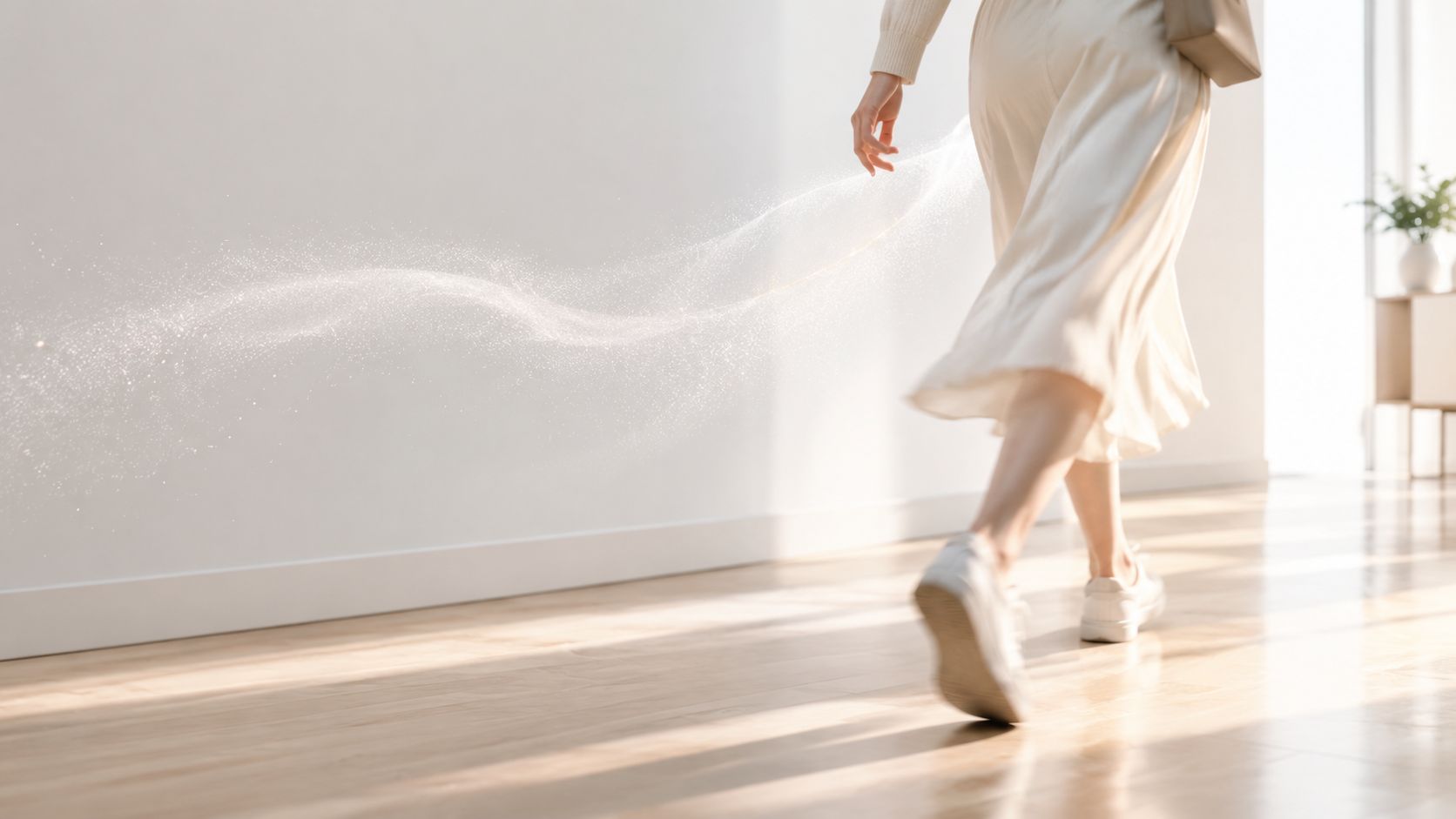
Why walking changes the result
In a controlled engineering example, a person walking indoors at 1.34 metres per second creates airflow conditions where turbulent, or eddy, diffusion dominates molecular diffusion. The study reports that turbulent diffusion can be two orders of magnitude greater than molecular diffusion, approximately 100 times larger. That helps explain why a moving wearer can project fragrance farther than scent molecules would spread through still air alone. The engineering study explains how human movement affects airborne transport.
This is why a wrist test at a desk can mislead you. Your hand is still, the surrounding air may be calm, and your nose is close to the application site. Walking through a hallway introduces wake turbulence around your body, while a fan or open window can stretch, break up, or redirect the scented plume.
Atmospheric-science research treats odor plumes as moving structures shaped by wind and dispersion. Concentration changes across both space and time, so one person standing beside you may detect a perfume while someone several steps away notices nothing. A fragrance doesn't have one fixed radius under every condition.
Build movement into your test
Test a perfume while walking through a room, not only while smelling your wrist. Notice whether the scent follows you, gathers around your body, or disappears quickly when airflow changes. For more background on performance beyond simple projection claims, this guide to what type of fragrance lasts the longest provides a useful companion perspective.
Temperature adds another variable. Warmer conditions generally make evaporation more noticeable, while a cool, still room can make the same application feel quieter. Air conditioning may carry the scent sideways, and an open doorway can pull it away before another person detects it.
The practical conclusion is simple. Sillage belongs to a fragrance in motion and in context, not to a bottle considered in isolation. Your comparison should recreate the way you intend to wear the perfume.
Concentration, Notes, and the Honest Limits of the Label
The word parfum sounds stronger than eau de toilette, but the label doesn't guarantee a larger scent trail. Concentration tells you how much aromatic material is present in the finished liquid. It doesn't tell you how far the fragrance will travel or how long it will remain noticeable to other people.
A 1988 account of perfume classification described traditional perfume as containing roughly 10% to 25% fragrance materials, while cologne contained approximately 5% to 7%. It also described shifting market definitions, with perfumes often reaching 20% to 35%, and eau de toilette and cologne commonly positioned around 10% to 25%. These ranges helped establish the labels shoppers still use, but they shouldn't be treated as a performance scoreboard. The historical fragrance classification account explains why concentration labels are useful but imperfect.
What the formula does with that concentrate
A formula built around volatile citrus or aromatic materials may create a bright, noticeable opening before fading into a quieter phase. Heavier base materials can remain on the skin for much longer but stay close to the wearer. A concentrated extrait may therefore feel smooth and intimate, while an eau de toilette may create a more obvious early burst.
That difference is especially important in the dupe market. Two bottles can share a recognizable accord while using different proportions of materials, producing different movement through the air. If you judge only by the word parfum on the box, you may miss the scent that gives you the desired trail.
Treat concentration as one comparison variable. Record the opening projection, the trail during movement, and the later detectability separately. Keep the spray amount consistent, because applying more of one fragrance can make a comparison meaningless.
For readers who also care about keeping fragrance noticeable over the course of a day, these tips for longer lasting scent provide additional application context. Longevity practices can help preserve a scent, but they don't turn every long-lasting perfume into a high-projection fragrance.
A useful shopping note looks like this: "Noticeable trail during movement, then close to skin later," or "Strong opening radius, moderate persistence." That description tells you more than writing "powerful" beside the bottle.
Why the Same Perfume Behaves Differently on Different People
Your skin is part of the fragrance formula. The same perfume can feel expansive on one person and quiet on another because evaporation depends on the perfume materials and the surface they leave behind.
A 2025 study in the International Journal of Cosmetic Science found that skin parameters, particularly hydration, significantly influence fragrance evaporation profiles. In practical terms, the same juice can project differently from a hydrated arm than from a dry one. The 2025 fragrance evaporation study examines how skin parameters affect evaporation.
The variables you bring to the test
Skin hydration is only one piece of the puzzle. Temperature, humidity, application site, and the natural scent of your skin can all change what you perceive. A warm neck may release fragrance differently from a cooler wrist, while dry winter skin may make a perfume seem less expressive than it does in humid weather.
Application site also affects the experience. A fragrance placed beneath clothing may remain more contained, while an exposed area encounters more airflow. Hair and fabric can create a different diffusion pattern again, although they shouldn't replace a controlled skin comparison when you're evaluating dupes.
Then there's olfactory fatigue, the temporary reduction in your ability to notice a smell after repeated exposure. If you keep lifting your wrist to your nose, your brain may stop registering the fragrance even though another person can still detect it. This is one reason personal perception can understate or overstate a perfume's apparent sillage.
Why a store test can fail
A tester strip shows the perfume's development away from skin, but it can't reproduce your hydration, body temperature, or personal scent. A quick spray on one wrist also gives you no reliable comparison point. You may remember the perfume as “strong” because the first few minutes were vivid, or as “weak” because your nose adapted before you asked anyone else to smell it.
Your nose is a measuring instrument, but it needs breaks and a second observer.
A fair test uses matching areas on the body, equal applications, and fixed check-in times. Ask another person to walk past you or enter the room without knowing which perfume you applied. Their response won't create a laboratory result, but it can separate personal fatigue from detectable projection.
This approach also changes the definition of value. A perfume that projects loudly for a short opening may not outperform a moderate fragrance that remains noticeable during the occasions when you wear it.
How to Test Sillage Fairly and Which Notes Project Most
A useful sillage test should be repeatable enough to reveal differences without pretending that home testing is a laboratory experiment. The aim is consistency. If every fragrance receives the same treatment, your comparison becomes much more informative.
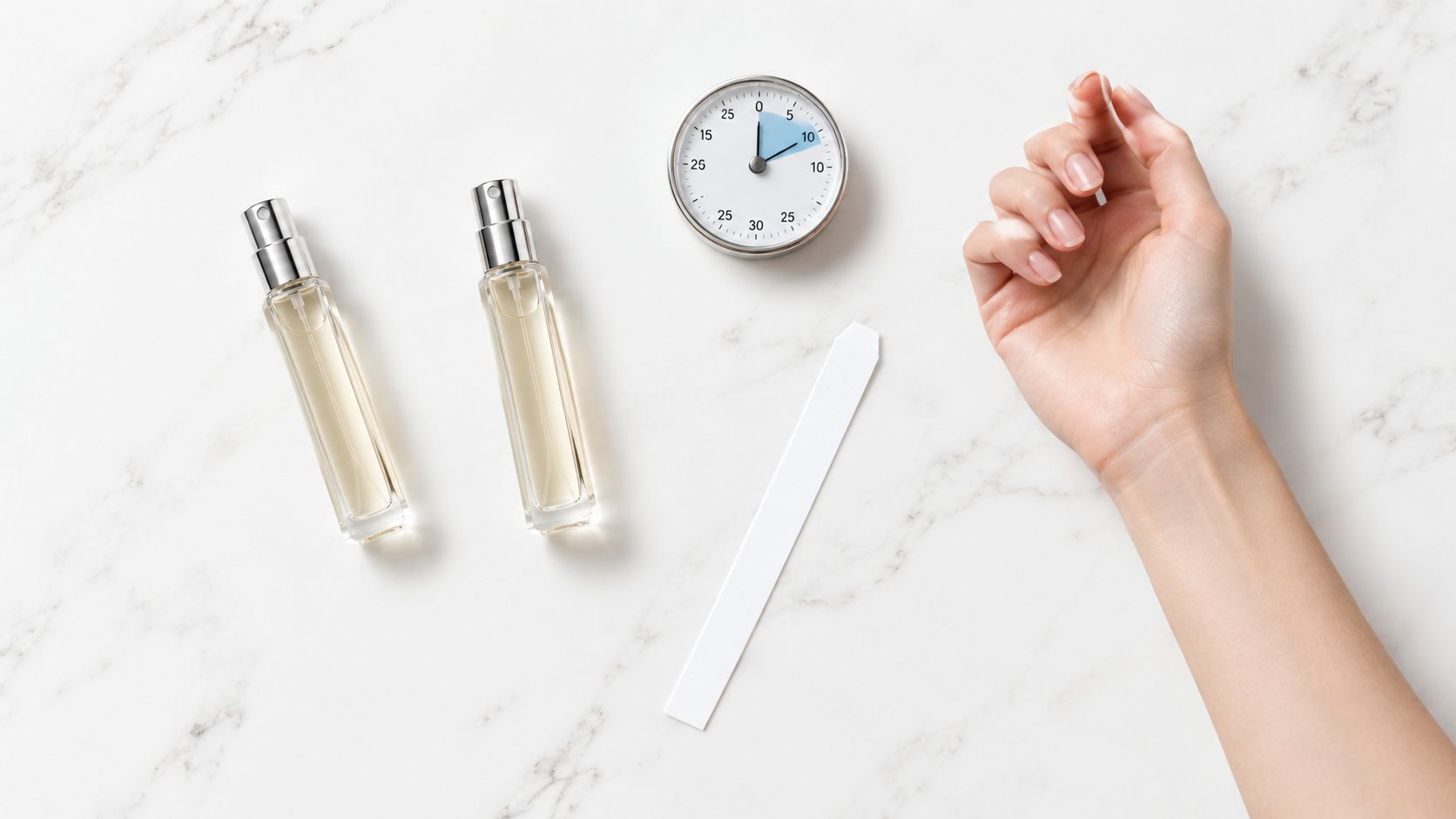
Use this comparison protocol
- Choose matching application sites. Apply the luxury fragrance and the dupe to corresponding areas, such as the left and right forearms. Don't compare a neck application with a wrist application.
- Use equal sprayer counts. Keep the number of sprays the same and avoid rubbing the perfume into the skin.
- Record the conditions. Note whether the room feels warm, cool, dry, humid, still, or ventilated. Write down anything that could move the air.
- Check at fixed intervals. Assess the opening, the early drydown, and the later wear at the same times for both perfumes. Don't rely on one five-minute impression.
- Test in motion. Walk through the room, leave, and return. Notice whether the trail remains detectable away from the original application point.
- Ask another person to evaluate. Have someone smell from a consistent distance, then walk past you without knowing which arm carries which fragrance.
- Separate the scores. Record projection, movement trail, longevity, and personal enjoyment as different observations.
For a more complete approach to combining scents without confusing the result, these fragrance layering tips can help you decide when layering belongs in a separate wear test rather than in a direct dupe comparison.
The scent family offers clues, but not guarantees. Citrus aromatics can feel immediately expansive because their bright opening materials reach the nose quickly. Ambroxan-heavy modern ambers often create a clean, diffusive effect, while white florals such as tuberose and gardenia can carry strongly through a room.
Powdery musks and soft gourmands often feel closer to skin, although a formula can always break the pattern. Iso E Super can create a transparent woody aura that some people notice more readily in motion than at rest. A sweet vanilla blend may project strongly at first but settle into a warmer, quieter presence later.
Write down the result in plain language. “The dupe projects farther during walking, but the original smells smoother at close range” is more useful than “the original wins.” Your goal is to find the bottle that performs well for your routine, not to crown a universal champion.
Affordable Dupes for Strong-Sillage Fragrances Worth Buying
The pairings below are starting points for shoppers who want recognizable luxury-inspired profiles without assuming that similarity equals identical performance. Availability can change, so check the current US listing before purchasing. For the most useful comparison, test the original and alternative with the same method described above.
Quick Sillage Dupe Comparison
| Luxury Reference | Affordable US Dupe | Sillage Note |
|---|---|---|
| Baccarat Rouge 540 | ALT. Crystal | Airy amberwood trail |
| Sol de Janeiro Cheirosa 62 | Zara Rose Gourmand | Sweet, noticeable opening |
| Le Labo Santal 33 | Zara Energetically New York | Woody, moderate aura |
| Tom Ford Lost Cherry | ALT. Cherry Smash | Fruity opening, warmer drydown |
| YSL Libre | Burberry Goddess | Vanilla-floral presence |
| Delina | Yara by Lattafa | Creamy fruity-floral trail |
1. Baccarat Rouge 540 and ALT. Crystal
ALT. Crystal is commonly chosen for its airy amberwood direction, with a transparent sweetness and a radiating quality that can feel noticeable during movement. The luxury reference has a more polished, distinctive texture, while the alternative gives budget shoppers a practical way to explore the profile before committing to the original.
The projection may feel most apparent in the opening and in open indoor spaces. The original can still earn its premium for its smoother transitions, recognizable identity, and more refined balance. Choose the dupe when you want the general effect and plan to validate the trail on your own skin.
2. Sol de Janeiro Cheirosa 62 and Zara Rose Gourmand
Zara Rose Gourmand offers a sweet, warm profile that can appeal to shoppers who like playful gourmand fragrance with a visible opening. Its sweetness can make the scent easy to notice, although the texture and development won't be identical to Cheirosa 62.
This is a good comparison for testing whether sweetness equals useful sillage for you. If the fragrance feels loud at first but becomes quiet quickly, the original may provide the more satisfying overall wear. A shopper who mainly wants a cheerful, affordable scent for casual outings may prefer the Zara option.
3. Le Labo Santal 33 and Zara Energetically New York
Zara Energetically New York explores a woody, modern profile associated with dry woods and a clean, urban feel. Its trail is more likely to read as a moderate woody aura than a room-filling cloud, which may suit people who want presence without heavy sweetness.
Le Labo Santal 33 remains the more distinctive choice if the original's exact wood, leather, and spicy character matter to you. The affordable alternative wins when you want a wearable interpretation for everyday use and are willing to judge the difference by texture and drydown rather than by the first spray.
4. Tom Ford Lost Cherry and ALT. Cherry Smash
ALT. Cherry Smash centers on a juicy cherry impression with a warm, sweet base. Fruity openings can attract attention quickly, but you should check how the fragrance changes after the initial brightness fades.
Tom Ford Lost Cherry may justify its price for shoppers who want a more nuanced balance between fruit, sweetness, and darker warmth. The dupe is the sensible experiment when you enjoy the concept but aren't sure whether a cherry-led scent belongs in your regular rotation. Ask another person to assess the trail, because repeated smelling can make the fruit seem less noticeable to you.
5. YSL Libre and Burberry Goddess
Burberry Goddess provides a vanilla-forward floral direction with an approachable presence. It isn't a one-to-one replacement for YSL Libre, which has its own aromatic, floral, and citrus structure, but it can satisfy shoppers seeking a polished feminine fragrance with noticeable warmth.
The dupe may win for daily wear when you want a softer interpretation and a lower-cost entry into the category. The original remains preferable if you specifically want Libre's lavender-led identity and sharper contrast between freshness and orange blossom.
6. Delina and Yara by Lattafa
Yara by Lattafa is widely available through mainstream US fragrance retailers and offers a creamy, sweet, fruity-floral style. It shouldn't be treated as an exact Delina substitute, but shoppers who want a romantic, soft-focus profile may find the resemblance useful as a wardrobe alternative.
Its trail may feel smooth rather than aggressively projecting. Delina earns its price for its distinctive tart fruit, floral detail, and more elaborate character. Yara makes more sense when affordability and easy daily wear matter more than exact duplication. For shoppers exploring a different Club de Nuit comparison, the Armaf Club de Nuit Sillage product page provides another example of how a fragrance marketed around sillage can be evaluated by profile and performance separately.
These aren't universal winners. The standout depends on what you want from your fragrance, whether that means an airy amber trail, a sweet opening, or a quieter woody aura. You can find more comparison-led guidance in Finding Favourites' luxury perfume dupe guide, then verify any candidate on your own skin before treating a performance claim as fact.
Sillage Questions Worth Answering Before You Buy
Does layering always increase sillage?
Layering can make a fragrance feel more cohesive or noticeable, especially when compatible products support the same scent direction. It doesn't guarantee greater distance, so test the layered version separately from the perfume alone.
Does humidity change projection?
Humid weather can make fragrance feel more present, while dry conditions may produce a quieter impression. Compare perfumes in similar conditions whenever possible, and record the room environment rather than assuming the bottle changed.
Why does the bottle smell different from skin?
A bottle and a blotter don't reproduce your skin's hydration, temperature, or natural scent. Give the fragrance time on skin before judging the drydown or asking someone else to assess the trail.
Does extrait always project farther than eau de parfum?
No. Concentration describes aromatic material in the liquid, not a guaranteed scent radius. An eau de parfum with volatile, diffusive materials can project more obviously than a richer extrait that stays closer to skin.
The strongest affordable choice from this list is ALT. Crystal for shoppers seeking an airy amberwood style with noticeable movement and broad everyday appeal. Still, the smarter conclusion is methodological: compare equal applications, fixed intervals, real movement, and another person's perception before deciding which dupe delivers the best value for you.
Finding Favourites helps beauty shoppers compare affordable fragrance alternatives with luxury-inspired scents, including differences in profile, texture, and wear. Visit Finding Favourites to explore dupe guides and use a testing-first approach when choosing your next trail-forward perfume.