Best Loose Setting Powder: Luxury & Dupes
You do your foundation, tap in concealer, blend everything until your skin looks expensive, and then by lunch your T-zone is shiny, your under-eyes are creasing, and the sides of your nose look patchy. That's usually the moment people decide powder “doesn't work for them,” when the problem is that they haven't found the best loose setting powder for their skin type, finish preference, and application style.
This post may contain affiliate links, which means I may receive a commission if you purchase through my links, at no extra cost to you. Please read the disclosure policy for more information.
If you're comparing formulas and shades, it also helps to browse a broad retailer mix so you can check what's available before you commit. I often suggest starting with curated beauty selections like Find beauty items at Jolitee and then narrowing your options by finish and skin type. If you want a wider look at face powder categories before settling on loose formulas, this roundup of best facial powders is a useful companion.
Your Guide to a Flawless All Day Finish
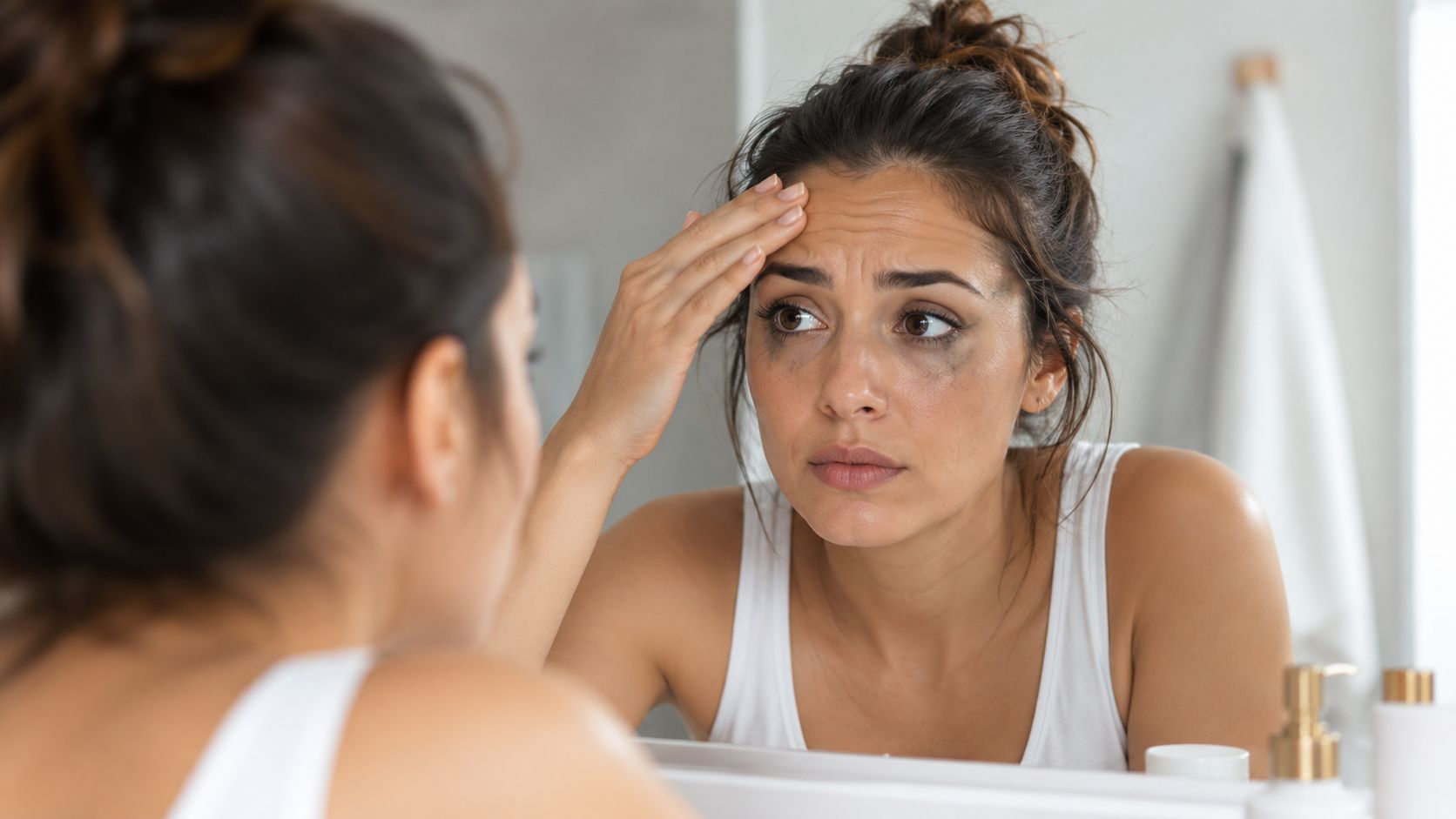
Loose setting powder is one of the most misunderstood products in a makeup bag. People expect it to do one thing, usually mattify, when a good one needs to do several jobs at once. It should lock cream products in place, cut unwanted shine, blur texture, and still leave skin looking like skin.
The best formulas don't all look the same on the face, either. Some give a soft natural matte finish. Some lean velvety and perfected. Some are better for under-eyes, while others are strongest on an oily forehead or around the nose.
The powder that looks flawless on an oily T-zone can look too flat or too dry on cheeks and under-eyes.
That's why side-by-side comparison matters more than hype. A luxury powder may feel silkier, look smoother in flash photography, or stay neater longer. But sometimes the dupe gets surprisingly close, especially when it matches the feel of the original instead of just the category.
Here's the part that saves money and frustration. You don't need the most expensive jar on the shelf to get a polished result. You need the right texture, the right amount, and a formula that behaves well on your skin after real wear, not just in the first five minutes.
Best Loose Powder Dupes Quick Comparison
If you want the fast answer, these are the pairings I'd look at first. The strongest dupes are the ones that recreate the luxury powder's texture and finish, not just the color story.
| Luxury Pick | Best Dupe | Best For |
|---|---|---|
| Laura Mercier Translucent Loose Setting Powder | Maybelline Fit Me Loose Finishing Powder | Natural matte, everyday setting, normal to oily skin |
| Huda Beauty Easy Bake Loose Baking & Setting Powder | e.l.f. Halo Glow Setting Powder | Blurred finish with a softer, more forgiving look |
| Givenchy Prisme Libre Loose Powder | NYX HD Finishing Powder | Soft-focus blurring and a lighter-feel finish |
| Laura Mercier Ultra Blur style experience | e.l.f. Prime & Stay Finishing Powder | Drier skin types that still want a smooth set |
| Dermablend Loose Setting Powder | Coty Airspun Loose Face Powder | Strong setting power and more traditional matte hold |
A quick note on expectations. A dupe can be excellent without being identical. The best ones mimic the experience of the luxury product on the skin: how finely it disperses, how it handles shine, how it behaves under the eyes, and whether it stays elegant after hours of wear.
What Is Loose Setting Powder Anyway
Loose setting powder has been around far longer than commonly understood. According to Jane Iredale, the history of setting powder goes back to ancient Egypt, and modern loose formulas are generally translucent or sheer and used to control oil, reduce shine, and increase longevity of complexion makeup (Jane Iredale on setting powder history and modern use).
What it actually does
At the most basic level, loose setting powder sits over liquid and cream makeup to help keep it from sliding, transferring, or creasing too quickly. Think of it as the step that helps your base hold its shape.
A good loose powder usually helps with a few things at once:
- Setting wet products so foundation and concealer don't stay tacky
- Reducing surface shine without making skin look chalky
- Smoothing the look of texture around pores or fine lines
- Keeping the finish balanced so the face doesn't go greasy too fast
That last point matters. Some powders are technically effective but make skin look flat, dry, or overly processed. That's not a win.
Why loose powder feels different from pressed powder
Loose powder usually gives a lighter, more diffused finish because the texture tends to disperse more thinly across the skin. The effect can look more natural, especially when you use a small amount and press it in rather than dusting on a heavy layer.
Pressed powder is often more convenient for handbags and touch-ups. Loose powder is usually the better choice when you want that airy, softly set finish that doesn't announce itself.
Practical rule: If you want your makeup to look like polished skin instead of “powdered skin,” loose formulas are often easier to control.
Who should use it
Almost everyone can use loose setting powder, but not everyone should use it the same way. Oily skin often benefits from more targeted mattifying. Dry or mature skin usually needs a lighter hand, a finer texture, and placement only where movement or shine occurs.
The best loose setting powder isn't always the strongest one. Sometimes it's the one that disappears best.
The Luxury Powders Everyone Raves About
Luxury loose powders earn their reputation when they nail three things at once: finish, wear, and photo behavior. If a powder looks beautiful for the first hour but turns heavy later, it's not elite. If it mattifies well but gives flashback, that's another problem.
According to Laura Mercier, its Translucent Loose Setting Powder is positioned with 16HR wear and hyaluronic acid for comfort, while Dermablend's Loose Setting Powder also claims wear extension and shine control for up to 16 hours without caking or flashback (Laura Mercier product details and wear claims). Those claims tell you exactly what shoppers care about now: longevity and how the powder looks in photos.
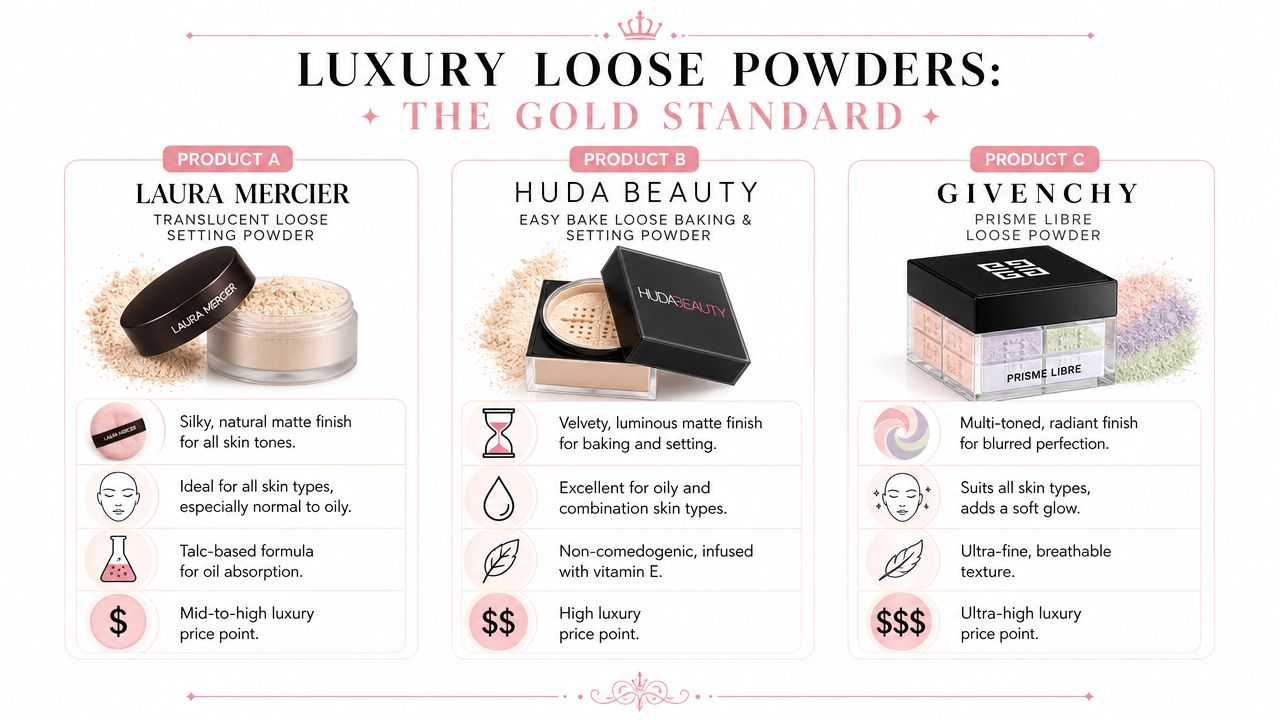
Laura Mercier Translucent Loose Setting Powder
This is the benchmark powder for a reason. The appeal isn't just that it sets makeup. It's the balanced feel. It usually lands in that sweet spot between matte and skin-like, with enough blur to polish the face without making everything look dry.
For side-by-side testing, this is the powder I use as the standard for a luxury natural matte. It tends to suit people who want their skin to look neat, smooth, and controlled, but not flat.
What works:
- Balanced finish that doesn't scream “baking powder”
- Strong everyday versatility for face and under-eyes
- Photo-friendly reputation tied to no-flashback positioning in brand claims
What doesn't:
- Not the cheapest mistake to make if the finish ends up too matte for your skin
- Can be more than dry skin needs if you powder too broadly
Huda Beauty Easy Bake Loose Baking and Setting Powder
This is for people who want more visible perfection. The texture and finish usually lean more statement-making than Laura Mercier. It's the type of powder many people reach for when they want under-eye brightening, stronger smoothing, and that velvety look that reads extra polished on camera.
It can be beautiful. It can also be a lot if you already have dryness, fine lines, or a preference for very bare-looking skin.
Givenchy Prisme Libre Loose Powder
Givenchy's loose powder is the luxury pick for people who want refinement without an obvious matte cast. The feel is often what wins people over. It tends to register as very fine, very airy, and more complexion-enhancing than strictly oil-soaking.
If you prefer your skin to keep a bit of life and light, this category of powder makes sense. It's less about locking everything down as hard as possible and more about making the whole face look softly filtered.
For readers who like complexion products with a lighter, polished finish, looking at options such as Magic Fair face powder can also help frame the difference between classic mattifying powders and those that lean more natural-looking on the skin.
What separates luxury from average
Here's where the best luxury powders usually pull ahead:
| Performance area | What luxury often does better |
|---|---|
| Texture | Feels finer and less gritty |
| Finish | Looks smoother with less visible buildup |
| Wear | Stays neater as oils come through |
| Flash | Tends to be benchmarked more closely for photo finish |
That said, not every expensive powder is automatically better. Some drugstore formulas get surprisingly close once you apply them with restraint and pair them with the right base products.
Get The Look For Less 5 Perfect Powder Dupes
The best dupes don't just copy the marketing. They recreate the way the powder behaves on the skin. In ingredient guidance from expert commentary, strong loose powders often combine silica for optical blurring with oil-absorbing ingredients like kaolin clay, rice powder, or cornstarch, which is why some affordable formulas can get close to a high-end effect when they balance blur, oil control, and comfort (expert ingredient discussion on blurring and oil absorption).
If your biggest concern is shine control first and everything else second, this guide to drugstore setting powders for oily skin is worth bookmarking too.
1. Maybelline Fit Me Loose Finishing Powder as a Laura Mercier dupe
This is my favorite type of dupe. It doesn't try to be flashy. It just performs in a very similar lane.
Why it works:
- The finish reads soft matte and believable
- The powder usually sits well on the center of the face
- It gives that “put together” look without turning the skin powdery too fast
Where it falls short:
- It doesn't always have the same refined, silky glide as Laura Mercier
- Under-eyes may need a lighter hand, especially if your concealer already creases
Best match for: anyone who wants the Laura Mercier effect without paying luxury prices.
2. e.l.f. Halo Glow Setting Powder as a Huda Beauty Easy Bake dupe
These two aren't identical, but the pairing makes sense if what you love about Huda is the blurred, perfected finish. e.l.f. gives a softer version of that result.
This is the difference in feel. Huda often gives more drama and more structure. e.l.f. gives a gentler glow-through set that can be easier to wear every day.
Best for:
- Combination skin that wants smoothing without a hard matte look
- Under-eyes when you want brightness but not a dry finish
- People scared of baking because it looks more forgiving
If a luxury powder gives you a flawless look only when every other part of your base is perfect, a softer dupe can actually be the better buy.
3. NYX HD Finishing Powder as a Givenchy Prisme Libre inspired swap
Givenchy is hard to dupe exactly because a lot of its appeal is the elegant feel. NYX gets into that territory through soft-focus blur rather than a direct one-to-one finish match.
Why this pairing works:
- Both are chosen for a smoother-looking complexion
- Both can make pores look less obvious when applied lightly
- The skin can still look alive rather than aggressively matte
Use this one carefully. HD-style powders can look amazing in thin layers and less amazing when overapplied. This is not the powder to dump heavily under the eyes and hope for the best.
4. e.l.f. Prime & Stay Finishing Powder for the Laura Mercier Ultra Blur experience
If what you're chasing is a blurred look with a bit more softness for drier areas, this is a smart budget direction. It won't reproduce every nuance of a more expensive formula, but it can give that lightweight, less harshly matte payoff that many people need.
What I like in this kind of dupe:
- It doesn't have to feel bone-dry to be effective
- The finish can be smoother on cheeks than old-school oil-control powders
- It works better when you press it in, not when you sweep it around
This is the sort of powder I'd reserve for targeted areas first, then build only where needed.
5. Coty Airspun Loose Face Powder as a Dermablend alternative
This is the classic stronger-hold category. If you want your makeup set and staying put, this kind of powder still has a place. The experience is more traditional and more obvious than some newer formulas, but for certain routines that's exactly the point.
Why people still reach for this style:
- It has that serious setting reputation
- It works well for longer makeup days
- It suits people who prefer a more matte, locked-in finish
The trade-off is elegance. Compared with more modern, finer powders, it can read heavier if you're not careful. I'd use less than you think you need and focus on high-movement areas only.
How I judge whether a powder is a real dupe
A real dupe should check most of these boxes:
- Texture match. Does it disperse finely, or does it feel dusty?
- Finish match. Is the result natural matte, velvety, radiant, or flat?
- Wear behavior. Does it stay smooth as oils come through?
- Under-eye tolerance. Does it settle fast or stay light?
- Photo behavior. Does it keep the skin looking even under flash?
A powder can miss on one point and still be worth buying. But if it looks good for ten minutes and then turns crusty around the nose, it's not a dupe. It's just cheaper.
How to Choose and Apply Powder Like a Pro
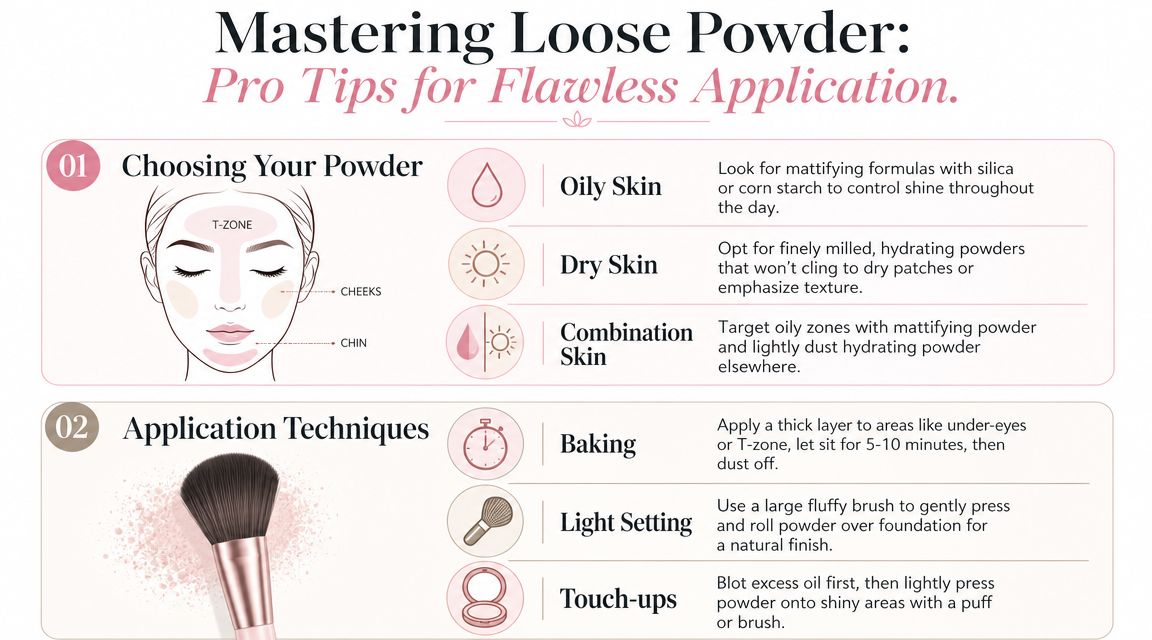
A powder can be excellent and still look bad if it's wrong for your skin type or applied with too much enthusiasm. A frequent misstep involves choosing for trend first, then wondering why the result looks off by midday.
Guidance around powder still skews heavily toward oil control, but there's a real need for better advice for dry, mature, and under-eye-prone skin. Recent review commentary has highlighted that some formulas are better for normal-to-oily skin, while others are preferred for dry skin because they feel more hydrating, and lightweight powders like Jones Road's tinted face powder are often called out as more comfortable for mature or dry skin that doesn't want settling into lines (review discussion on powders for dry and mature skin).
If you want a more technique-focused deep dive on strong setting methods, this guide to the best baking powder for makeup is helpful.
Choose by skin behavior, not hype
Start with how your makeup fails.
| If your makeup does this | Look for this kind of powder |
|---|---|
| Gets shiny fast in the T-zone | Oil-absorbing, more matte loose powder |
| Looks dry around cheeks | Finely milled, softer-focus formula |
| Creases under the eyes | Lightweight powder used in tiny amounts |
| Settles into lines | Less product, less coverage, more precision |
Best approach for oily skin
Go for powders that are known for shine control and a more matte set. Keep application focused where oil appears. The forehead, nose, chin, and inner cheek area usually need more than the perimeter of the face.
Use a puff if you want stronger hold. Press the powder in. Don't scrub it around.
Best approach for dry or mature skin
This group needs discipline more than extra powder. Dry or mature skin usually looks better with strategic placement than all-over setting.
Try this:
- Set only where needed like under-eyes, sides of nose, and center forehead
- Use a small amount and stop before the skin looks fully matte
- Choose softer textures that don't cling the second they touch the face
Powders for dry or mature skin should disappear into the makeup. The second you can clearly see them sitting on top, you've used too much or chosen the wrong texture.
Brush or puff
Use a puff when you want maximum adherence and a more perfected finish. This works well for oily skin, long days, or event makeup.
Use a fluffy brush when you want a lighter set and more natural movement in the skin. This is often the better option for dry skin, mature skin, or anyone who hates a powdery look.
Baking versus light setting
Baking has a place, but it's not automatically the better technique. It gives more hold and a more stylized result. It can also exaggerate dryness or under-eye texture if the formula or prep isn't right.
Light setting is the smarter default:
- Tap a little powder into the lid.
- Load a brush or puff sparingly.
- Press into the skin.
- Check in natural light before adding more.
That last part matters most. Most powder mistakes happen because people keep going after the skin was already set.
Your Loose Powder Questions Answered
What's the difference between setting powder and finishing powder
Setting powder is there to help lock makeup in place and reduce tackiness or shine. Finishing powder is more about the visual effect at the end, usually softening the look of texture or adding a final veil over the skin.
Some powders can do both. But if a product mainly helps foundation and concealer stay put, it belongs in the setting category.
Can I use loose powder if I have dry or mature skin
Yes, but the amount and placement matter more. Dry and mature skin usually does better with a finer texture and a much lighter application. Stick to areas that need help, instead of dusting the whole face out of habit.
Why do my under-eyes look cakey with powder
Usually one of three things is happening:
- Too much product went on
- The concealer was already creasing before powder touched it
- The powder is too dry or too heavy for that area
Product education from Glo Skin Beauty also recommends using only a minimal amount and building gradually, because over-applying loose powder can create a heavy look and settle into fine lines while both pressed and loose formulas still work to mattify and extend wear (Glo Skin Beauty on loose powder application and common mistakes).
Should I bake every day
Probably not. Baking is useful when you want extra hold or a more perfected makeup look. For everyday wear, a light press of powder usually looks fresher and is less likely to emphasize texture.
Is loose powder better than pressed powder
Not always. Loose powder is usually the better option for the most smooth, diffused set. Pressed powder is easier to carry and easier to use for touch-ups. If your goal is the most skin-like finish at home, loose usually wins.
If you want more beauty dupes, practical comparisons, and affordable swaps that feel worth buying, browse Finding Favourites. It's a smart place to narrow down luxury-inspired picks without wasting money on near-misses.
The best loose setting powder dupe in this roundup is Maybelline Fit Me Loose Finishing Powder if you want the closest everyday alternative to a luxury classic. It gives that polished, natural matte effect that makes makeup look finished without looking stiff. The right powder depends on whether you prioritize flashback, wear, finish, or under-eye comfort, but if you shop by how a formula feels and wears, not just by hype, you'll land on a powder that earns its spot in your routine.