
Best Budget Dark Spot Corrector That Really Works
A large international analysis covered 50,552 people aged 16 and older across 20 countries and found a weighted worldwide prevalence of 10.6% for hyperpigmentation disorders, according to the international hyperpigmentation prevalence analysis. That scale matters for budget shopping. A best budget dark spot corrector isn't a niche purchase for one age group or skin tone, so I judge it by tolerability, label clarity, and whether you can stick with it long enough to see a change.
Price per ounce tells you little on its own. I weigh the full routine cost across the under-$10, under-$25 and under-$50 tiers, including the daily sunscreen that keeps new spots from forming while the corrector fades existing ones. A serum whose label states the active and its concentration earns more trust than a cheaper tube that hides both.
Budget Dark Spot Correctors Worth Buying
The best budget dark spot corrector for many shoppers is a niacinamide or azelaic acid serum under $15, worn with daily sunscreen rather than used alone. I'd start there before paying prestige prices, because the active and your consistency do more work than glass bottles or fragrance. A cheap serum you use every night beats an expensive one you save for special occasions.
The trade-off is speed and polish. Budget formulas tend to do one job well instead of stacking five actives, and textures can pill or feel tacky under makeup. That's acceptable if the label states the active and concentration clearly. If a spot is spreading, raised, or won't budge after a full trial, professional care is the smarter spend, and readers comparing in-office routes can review hyperpigmentation treatment options in DC before booking anything.
This post may contain affiliate links, which means I may receive a commission if you purchase through my links, at no extra cost to you. Please read the disclosure policy for more information.
The Quick-Pick Shortlist
| Corrector | Key Active and Price Tier | Best For |
|---|---|---|
| The Ordinary Niacinamide 10% + Zinc 1% | Niacinamide 10%, under $10 | Post-acne marks and uneven tone |
| The Ordinary Alpha Arbutin 2% + HA | Alpha arbutin 2%, under $15 | Sun spots and stubborn patches |
| The Ordinary Azelaic Acid Suspension 10% | Azelaic acid 10%, under $15 | Acne-linked marks, melasma with a dermatologist check |
| La Roche-Posay Mela B3 Serum (benchmark) | Niacinamide 10%, $44.99 listed | Premium comparison point |
The benchmark row is there to keep you honest. La Roche-Posay's Mela B3 Serum Dark Spot Corrector was listed at $44.99 and formulated with 10% niacinamide in 2026, according to Ulta Beauty. You're paying for a more elegant base, brand testing, and a pump that doesn't fight you. You're not paying for a different headline active. Listed tiers change, so confirm the current price before buying, especially during sales when drugstore and prestige prices briefly overlap.
What the Full Routine Actually Costs
Price per ounce misleads if you ignore sunscreen. In 2024 United States retail listings, dark-spot products ranged from approximately $19 for drugstore options to $108 for prestige serums, according to Ken Research. Add a reliable broad-spectrum SPF to any corrector price and that's your real cost, because the sunscreen protects the results you're paying the serum to create.
I split budgets into three practical bands:
- Under $10: One single-active serum, usually niacinamide or alpha arbutin, if you already own moisturizer and sunscreen.
- $10 to $25: The sweet spot for many buyers, covering a corrector plus a fragrance-free moisturizer to buffer irritation.
- $25 to $50: Benchmark territory like the Mela B3 above, worth it only if texture determines whether you'll use it daily.
On Finding Favourites, dupes can be browsed by price tier, under $10, under $25 and under $50, which makes it easier to compare within your band instead of against every product on the internet. Treat the table as a shortlist, not a ranking. The right pick depends on what kind of spot you're treating, and that's where most shoppers go wrong.
Practical rule: If buying the serum means skipping sunscreen, buy the sunscreen first and the cheaper serum second.
Match Your Spot Type to the Right Active
A dark spot behaves like a stain on fabric. A fresh one often lifts with a mild treatment, while an old, set one needs a stronger approach, more time, and honest expectations about what remains. Skin follows the same logic. The spot type tells you which active to try, how patient to be, and when a serum is the wrong tool entirely.
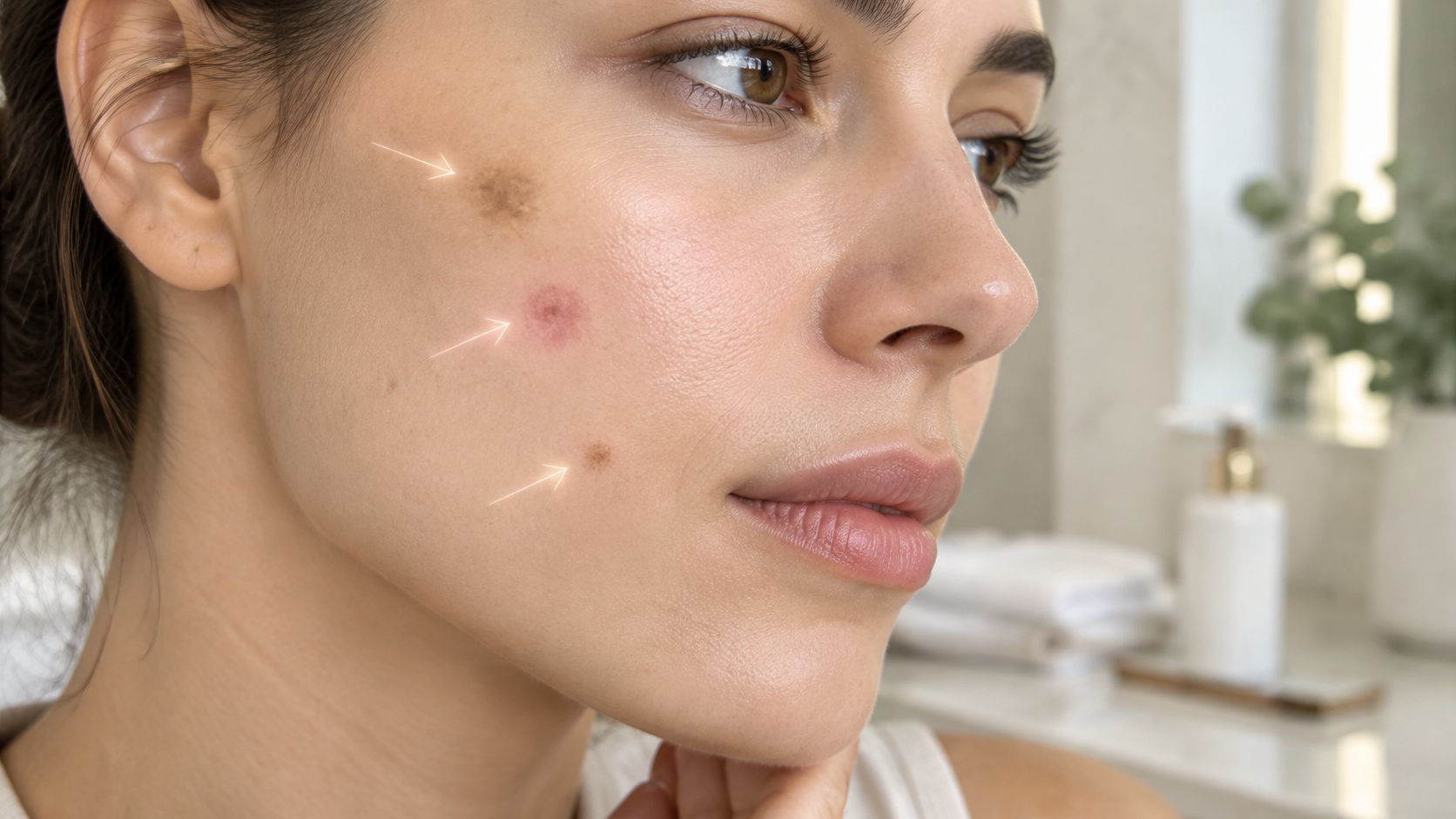
Post-acne marks are flat brown or pink marks left after a breakout heals. The pimple is gone, but inflammation triggered extra pigment on its way out, which is post-inflammatory hyperpigmentation. These respond best to gentle, steady treatment, because aggressive scrubbing creates fresh inflammation and fresh marks. Prevention counts here too: habits that limit skin injury matter, the same thinking behind dermatologist-approved advice on burn scar prevention.
Sun spots, or solar lentigines, were reported by 13,192 people, equal to 27.5% of a worldwide survey of 48,000 adults in 34 countries, according to the worldwide pigmentary disorder survey. They cluster on cheeks, hands, and shoulders where sun hits hardest. A serum can soften them, though unprotected weekends rebuild them. Spots that darken every summer call for sunscreen before any corrector.
Melasma and Under-Eye Darkness Need Different Thinking
Melasma forms symmetrical patches on cheeks, forehead, and upper lip, driven by hormones, heat, and light. It fades slowly and returns easily, which frustrates anyone expecting a six week fix. Azelaic acid has the most comparison data among budget options, and readers who want another gentle route can compare the picks in our guide to the best tranexamic acid serums for stubborn patches. Treat any budget product here as ongoing maintenance, since the pigment tends to reappear.
Under-eye darkness is usually shadow, thin skin, or visible blood vessels rather than excess pigment. No face serum changes bone structure or sleep debt.
Do a quick check: gently stretch the skin in good light. If the area still looks brown, pigment plays a role and a targeted eye formula earns its place. If it reads purple or hollow, concealer and rest will do more than any bottle.
| Spot Type | Likely Cause | Budget Active to Try |
|---|---|---|
| Post-acne marks | Post-inflammatory hyperpigmentation after breakouts | Niacinamide or azelaic acid |
| Sun spots | UV-stimulated melanin, often on face and hands | Niacinamide or alpha arbutin with daily SPF |
| Melasma | Hormones, heat and sun exposure | Azelaic acid with SPF; see a dermatologist if no change |
| Under-eye darkness | Thin skin, shadow or pigment | Eye formula with niacinamide, typically 4% to 10%, when pigment is confirmed |
Whichever row you land on, favour the bottle that states its active and concentration on the label. A serum you can verify beats a cheaper one that only promises glow.
Judge a corrector only against the spot type it's matched to. A niacinamide serum that fades fresh acne marks can look useless on melasma, and that doesn't make it a bad product. It makes it the wrong assignment.
Key Actives and Concentrations That Earn Their Place
A label that states a percentage earns more trust than one that promises radiance. Words like brightening, glow, and even tone carry no dose information. A stated concentration lets you compare a budget serum against what studies used, and that comparison is the whole game at this price level. It also keeps the true cost honest: the actives below only hold their results when daily sunscreen rides along, so the price of the routine matters more than the price of the bottle.
Niacinamide
A randomized, double-blind, vehicle-controlled trial enrolled 202 women aged 40 to 60 and tested a regimen containing 4% niacinamide plus 2% N-acetyl glucosamine, alongside an SPF 15 moisturizer, for 10 weeks, according to the niacinamide and N-acetyl glucosamine trial. The combination significantly reduced the detectable area and visual appearance of facial pigmentation versus the vehicle control. Mechanistically, niacinamide reduces melanosome transfer from melanocytes to keratinocytes, so less pigment reaches surface cells.
Read the trial design carefully. The tested regimen combined two actives with a sunscreen moisturizer, so a lone 10% bottle doesn't automatically outgun it. That matters for budgeting: factor in a daily SPF alongside the serum, because the protocol that produced the result included one. Look for 4% to 10% niacinamide, expect gradual evening of tone, and remember higher isn't automatically better. Some people flush or itch at 10%, and a comfortable 4% used nightly beats a strong bottle that sits in a drawer.
For a sense of how much ingredient detail a brand page can disclose, Epionce ingredients and clinical evidence breaks formulas down at ingredient level, which is the kind of transparency a label should offer before you trust its claims.
Azelaic Acid
A 2023 systematic review and meta-analysis found azelaic acid produced a statistically significant improvement in melasma severity compared with hydroquinone, with a mean MASI difference of -1.23 and a 95% confidence interval of -2.05 to -0.40, published in the National Library of Medicine meta-analysis. That's unusually strong support for a budget friendly active. It also treats the breakouts that leave marks behind, which gives it dual value for acne prone skin.
The trade-off is comfort. A 2023 randomized clinical trial included 50 patients with central facial melasma and compared nightly 20% azelaic acid cream with 4% hydroquinone cream for 10 weeks, and 21% of azelaic acid users experienced side effects, according to a 2024 review in the National Library of Medicine. Expect tingling in the first weeks, especially on damp skin. Budget suspensions at 10% are gentler starting points, and pilling under sunscreen is their most common annoyance, so test the pair together before committing to a full face.
Alpha Arbutin, Kojic Acid, and Vitamin C
Alpha arbutin at 2% is the gentle daily option. It suits people who react to almost everything, but comparison data is thinner, so I'd pair it with patience rather than big promises. Kojic acid has a long track record in brightening formulas and can irritate sensitive skin, so frequency matters more than enthusiasm. Vitamin C earns its place as a morning antioxidant under sunscreen for sun related uneven tone, supporting the routine rather than carrying it alone.
Hydroquinone sits in a different category. It has strong clinical evidence at prescription strengths, but it isn't a casual budget buy and shouldn't be purchased as an over the counter bargain. If a marketplace listing offers it cheaply with dramatic language, treat it as a safety problem.
A good budget label answers three questions fast: which active, what concentration, and which standard retailer stands behind the sale.
Run that checklist on every candidate. If a brand hides the percentage behind a proprietary complex name, you're paying for mystery. At prestige prices that's annoying; at budget prices, where the stated active is the entire value proposition, it's a reason to walk away. Price per ounce is the wrong yardstick anyway. The cheapest corrector is the one whose label verifies, whose dose matches the research, and whose results survive because sunscreen stayed in the routine.
How to Layer and Patch-Test Your Corrector
Order and restraint decide whether a good serum works or backfires. Most budget corrector failures I hear about aren't weak formulas. They're three new actives started on the same Monday, layered over a strong exfoliant, with no sunscreen by Friday.
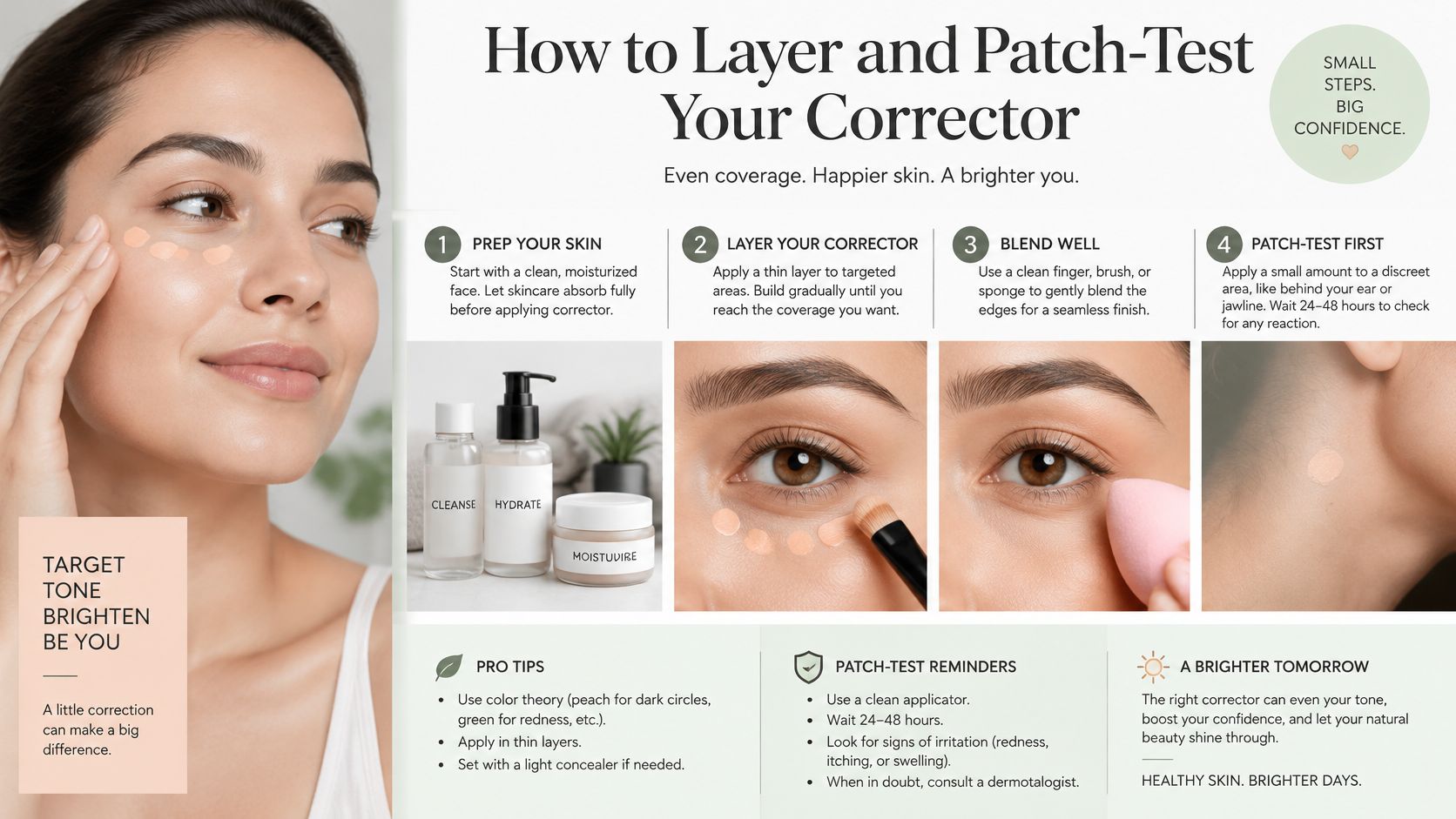
The Six-Step Routine
- Cleanse gently: Use a non-stripping cleanser at night, because a stressed, tight barrier makes every active sting more and irritation can deepen pigment.
- Patch-test for 48 hours: Apply a small amount on your jawline or inner forearm once daily. Burning, itching, or spreading redness means stop, not push through.
- Add one active at a time: Wait about two weeks before introducing another product, so any reaction points to one clear suspect.
- Apply to clean, dry skin: Use a thin layer in the evening before moisturizer. Skip strong exfoliants that night, and if you're starting azelaic acid, our step by step guide on how to use azelaic acid without the tingle taking over covers sandwiching it between moisturizer layers.
- Moisturize without fragrance: A plain moisturizer supports the barrier while the active does its slow work, and it reduces the flaking that makes people quit early.
- Wear broad-spectrum SPF every morning: Reapply outdoors. This step protects new skin and stops light from re-darkening the spot you're treating.
Start every other night if your skin is reactive, then build to nightly as tolerated. A pea sized amount covers most faces when you're treating overall tone. Dot extra only on stubborn patches rather than flooding your whole face, which saves product and limits irritation.
Why Sunscreen Is the Performance Step
A randomized, investigator-blinded study in 20 participants with Fitzpatrick skin types IV to V found a broad-spectrum sunscreen containing niacinamide and sclareolide significantly prevented induced pigmentation, with protected areas improving by 5.96 ΔITA° versus a 9.88 ΔITA° decline without protection and no adverse events reported, according to the sunscreen and induced pigmentation study. That's prevention evidence, which is different from treatment evidence, and it's exactly why a corrector can look ineffective when morning protection is inconsistent.
Watch how a simple evening application looks in practice before you build your own order.
If visible light worries you, especially with melasma or deeper skin tones, consider a tinted sunscreen with iron oxides. The tint does functional work there, it isn't just cosmetic coverage. Keep expectations calibrated though. That study was small and short, so no single formula is universally proven, and the sunscreen you'll wear generously every day beats a theoretically superior one you apply in a thin, resentful layer.
Keep the routine for at least eight weeks before judging it. Pause if irritation persists beyond a few days, and restart at lower frequency once skin feels normal. Photograph your face in the same light every two weeks, because gradual fading is nearly invisible in a daily mirror check.
Realistic Timelines for Each Active
Dark spots take longer to fade than they took to form. One sunburn or one squeezed pimple can leave a mark that needs months of steady care, and that mismatch is why so many half used bottles sit in bathroom cabinets. Most shoppers quit around week four, right before the window where change usually becomes visible.
| Active or Habit | Visible Change Window | Key Caveat |
|---|---|---|
| Niacinamide (4% to 10%) | 8 to 10 weeks | Needs consistent daily use with SPF |
| Azelaic acid (10% to 20%) | About 10 weeks | Tingling or irritation may appear first |
| Alpha arbutin (2%) | Judge at 12 weeks | Limited timeline data in the research |
| Daily broad-spectrum sunscreen | Ongoing | Prevents UV from reversing gains |
Reading the Windows Honestly
The niacinamide window mirrors the 10 week trial structure for the combination regimen, so budget at least 8 to 10 weeks before calling it. Azelaic acid melasma trials also ran about 10 weeks, and irritation often shows up before improvement does, which feels unfair but is common. Progress looks like softening edges and a more even overall tone around weeks six to eight, not a spot vanishing between Tuesday and Thursday.
Prescription hydroquinone sets the speed benchmark people secretly compare everything against. Dermatology evidence identifies 2% to 4% hydroquinone as capable of producing visible lightening within approximately 8 to 12 weeks, while prolonged or inappropriate use can cause irritant dermatitis and exogenous ochronosis, according to the American Academy of Dermatology melasma treatment guidance. Even the strongest option needs two to three months. Any budget product promising overnight or one week erasure is telling you it can't be trusted.
Alpha arbutin gets a 12 week judgment date from me because the research doesn't give a reliable timeline. Mark the date when you open the bottle. Without a deadline, people either give up at week three or keep a useless product for a year out of hope.
The 12 week rule: No visible change by week 12 means book a dermatologist, especially for melasma or any patch that's raised, bleeding, or changing shape.
Sunscreen has no finish line. Stop wearing it and light restarts pigment production, so last season's progress fades in the wrong direction. Think of the corrector as the treatment phase and sunscreen as permanent maintenance. That framing also helps your budget, because you'll stop buying replacement serums to redo work that one consistent habit would have protected.
Safety Checks Before You Buy
Cheap is not the same as unsafe, but the cheapest corner of this market hides real hazards. The FDA warns that some products marketed for age spots, freckles, blemishes, wrinkles, or skin lightening have contained mercury, and repeated application can permit mercury absorption into the bloodstream, potentially causing serious or permanent health effects, according to the FDA warning on skin products containing mercury and hydroquinone. Star ratings don't capture that risk. Label checks do.
The Pre-Purchase Checklist
- Read the full ingredient list: Walk away from mercury terms including mercurous chloride, calomel, mercuric, or mercurio, and from any jar with no ingredient list at all.
- Skip OTC hydroquinone listings: The FDA states manufacturers and distributors were required to remove non-approved OTC hydroquinone products from the US market effective September 23, 2020, according to the FDA drug safety communication on OTC skin lightening products. A current US listing selling it without a prescription is a red flag, not a loophole.
- Know the reported reactions: Hydroquinone reactions reported to regulators include rashes, facial swelling, and permanent discoloration called ochronosis, the opposite outcome from the one you're buying.
- Reject instant whitening language: Promises of permanent or overnight whitening, aggressive bleaching claims, and unlabeled imported jars belong in the same avoid pile.
Marketplace bargains deserve extra suspicion. Third party sellers can list products a standard retailer wouldn't stock, and packaging photos sometimes crop out the ingredient panel on purpose. Buy from the brand or an authorized retailer with a clear return policy instead. Saving a few dollars isn't worth a product whose origin nobody will vouch for.
Spend the money you save on the protective half of the routine. Our roundup of the best drugstore sunscreen options that layer well under makeup is a sensible place to reallocate budget you didn't waste on a suspicious import.
A low price isn't evidence of value when the origin, ingredients, or regulatory status can't be verified.
Before checkout, run three questions. Can I read every ingredient? Is it sold by a retailer I'd trust with a return? Does the promise match what the active can plausibly do in 8 to 12 weeks? Three yes answers and you've found affordable care. Any no and you're looking at unsafe skin lightening marketing wearing a budget costume.
Quick Answers and Your Starting Pick
These are the follow-ups that decide most purchases, answered without repeating the full routine.
Frequently Asked Questions
Can a budget corrector help melasma? It can help mild melasma look softer, but melasma responds slowly and returns with heat and sun. Pair azelaic acid with strict sunscreen use, expect management rather than erasure, and see a dermatologist if nothing changes by week 12.
Will 10% niacinamide irritate sensitive skin? It can. Flushing, itching, and stinging are common complaints at that strength, even though lower concentrations suit many skin types well. Start every other night, buffer with moisturizer, and stop if irritation lasts more than a few days instead of hoping your skin toughens up.
Do I need sunscreen if the serum contains brighteners? Yes. The corrector treats pigment that's already there while sunscreen prevents light from making new pigment. Skipping the second step effectively cancels the first, which is the most expensive mistake in this whole category.
What works for deeper skin tones? Gentle, consistent treatment with strong sun protection, since irritation itself can trigger new marks. Raised, changing, or persistent patches need a dermatologist rather than a stronger serum, because the wrong product can darken the surrounding skin.
Where I'd Start
Start with The Ordinary Niacinamide 10% + Zinc 1% if your main issue is post-acne marks and uneven tone. It's the cheapest credible entry point, the active is stated plainly, and it layers easily. Move to azelaic acid as the next step if active breakouts keep leaving marks or your patches look melasma prone. Keep alpha arbutin for maintenance once the worst spots soften, and keep the Mela B3 benchmark in mind only if you know texture is what makes you consistent.
That's the pattern across this site. The website has dupe sections for drugstore, makeup, skincare and fragrance products, and for Charlotte Tilbury products, and the focus stays on beauty dupes as affordable alternatives to well-known products. The best budget dark spot corrector is the one you'll use daily, with sunscreen, long enough to see results.
To wrap up, The Ordinary Niacinamide 10% + Zinc 1% is the best dupe and starting pick here. Match the active to your spot type, verify the label before price tempts you, give it 8 to 12 weeks, and protect every bit of progress each morning.
If you like this way of shopping, comparing stated actives and full routine costs instead of hype, Finding Favourites rounds up dupes across drugstore, makeup, skincare, and fragrance so you can find the affordable version first. Browse the skincare dupe guides to build the rest of your routine around your corrector, from cleansers to sunscreen, without overspending on any single step.