
Cool Toned Brown Lip Liner: Affordable Picks That Work
Is a cool toned brown lip liner something you can spot on a shelf, or something you can only judge against your own mouth? Most of us shop as if temperature were printed on the tube. It isn't. A pencil can carry the words taupe, cacao or espresso and still pull orange the moment it touches warm-toned lips.
Temperature is relative. A brown reads cool because of what it does beside your skin, your natural lip color and the lipstick you layer over it, not because a brand decided so. Once you treat coolness as a relationship rather than a label, choosing a pencil gets cheaper and a lot less confusing.
Telling Cool Brown From Warm Brown on Sight
A brown liner can look like any deep color behind the counter glass, but its temperature decides how it sits beside your lips and your lipstick. Two pencils at the same depth can behave nothing alike once applied. One melts into a shadow at the lip edge, and the other leaves an orange rim you can see from across a room.
This post may contain affiliate links, which means I may receive a commission if you purchase through my links, at no extra cost to you. Please read the disclosure policy for more information.
Where the cool and warm split comes from
Undertone vocabulary in makeup is older than the internet makes it look. The seasonal color framework Suzanne Caygill developed in the 1940s sorted people into winter, spring, summer and autumn, with winter and summer defined as cool-toned categories and spring and autumn as warm-toned ones. Consultations, books, seminars and beauty-counter recommendations carried that four-season structure forward, and it still shapes the words printed on modern shade cards.
The pigment logic underneath is what matters for a lip pencil. A cool brown reduces the orange, yellow or golden influence of a warm brown by adding gray, mauve, rosy, blue or purple-leaning pigment, which is why it reads as taupe, cocoa, plum-brown or muted espresso rather than caramel or terracotta. Depth alone tells you nothing about that. A cool brown can contour pink, neutral, berry, mauve and blue-based lipsticks, while a warm brown harmonizes with peach, coral, orange and terracotta.
Why the name on the tube won't settle it
Shade names aren't standardized across brands. Taupe, cacao, greige and espresso get used loosely, and two pencils with the same word on the barrel can land on opposite sides of the temperature line. A 2025 color-science study on lip product color found that cool lip colors tend to contain more blue while warm colors show greater yellowness, and it noted that undertone is often discussed implicitly rather than through established criteria. The vocabulary exists. The measurement doesn't.
Five on-sight signals do more than any label can:
| Test | Cool-toned brown | Warm-toned brown |
|---|---|---|
| Arm swatch | Gray, taupe, mauve or plum-brown | Caramel, golden or terracotta-brown |
| Beside a peach or coral lipstick | Can look dull or muddy | Blends in naturally |
| Beside a rosy nude or pink lipstick | Defines the lip without an orange halo | Can read orange or brassy |
| Under warm indoor light | Can look more balanced than it is | Looks as expected |
| In daylight | Shows its true gray or mauve tone | Stays warm and golden |
The indoor-light row catches shoppers off guard. Warm shop lighting flatters a temperature-muddled brown by pushing it toward neutral, then daylight hands you the truth on the walk home. That's why a pencil can look perfect at the counter and wrong in your bathroom mirror two hours later.
The three-step check before you buy
Swatch on clean, bare skin, let the pencil set for a minute or two, then compare it in daylight beside your natural lip color. Setting matters, because wax and oil shift the shade slightly as they dry, so judging a wet swatch is judging a different product.
A quick tell: if the liner needs a pink lipstick stacked on top to stop looking orange, the problem is the liner, not the lipstick.
If the warm, cool and neutral vocabulary is what's tripping you up, this walkthrough of what undertone means in makeup covers the base layer before you spend anything. Bring that understanding back to the swatch, and the five signals above become quick to read.
Matching Cool Brown Depth to Your Complexion
Depth is the simpler decision, and it follows a rule you can apply in the aisle. Pick a brown roughly two shades deeper than your complexion for a soft, contoured effect, or three to four shades deeper for sharper contrast, and keep the liner's temperature cohesive with your blush, eyeshadow and lipstick. That guidance comes from the brown lip pencil advice in Allure, and it holds at every price point.
| Complexion | Cool brown family to look for | Effect |
|---|---|---|
| Fair to light | Taupe and mauve-brown | Soft outline that reads as shadow |
| Medium to olive | Cocoa and muted espresso | Everyday definition, easy to blur |
| Deep to rich | Plum-brown, charcoal-brown, deep cocoa | Strong definition without an ashy cast |
Fair and light complexions do best in the taupe and mauve-brown family, where a shade two steps deeper keeps the outline soft rather than drawn on. Medium complexions can wear a cool brown two shades deeper for daily definition, then step to a deeper pick for something more graphic. The taupe lipstick shade guide shows how that gray-leaning family behaves on different lips if you want a comparison before committing to a pencil.
Where the two-shade rule breaks down
A depth rule accounts for complexion and nothing else. Natural lip pigmentation, dryness, how transparent the formula is and whether you blur the edge inward all change the final result. Professional shade matching assumes bare, even lips; yours may be rosy, pigmented at the border, or flaky in February, and each of those shifts the color you end up wearing.
Deep complexions carry the biggest risk, because a heavily gray or blue-based pencil can look ashy against very dark skin. Hold the pencil against your jaw in the brightest light you have, then draw a short line at the corner of the mouth so you're judging it against your own lip pigment rather than the back of your hand.
On deep skin: the arm swatch flatters almost everything. The mouth corner tells you the truth.
Naturally rosy lips are the second exception. Pink underneath warms a cool brown as it blends, so a pencil that swatched beautifully on your forearm can turn brassy at the mouth inside a minute. Test that specific spot, not just skin.
Formula transparency matters too. A sheer pencil behaves like a tint and forgives a depth error, while an opaque one shows every step you took. Your pick is right when the liner edge looks like a shadow of your lip, not a separate outline drawn on top.
Three Ways to Apply a Cool Brown Liner
Application changes a cool brown more than expected. The same pencil can read as a soft shadow, a hard graphic line or a wash of tint depending on where the color sits. Here's the pencil at work along the lip edge before we separate the three methods.
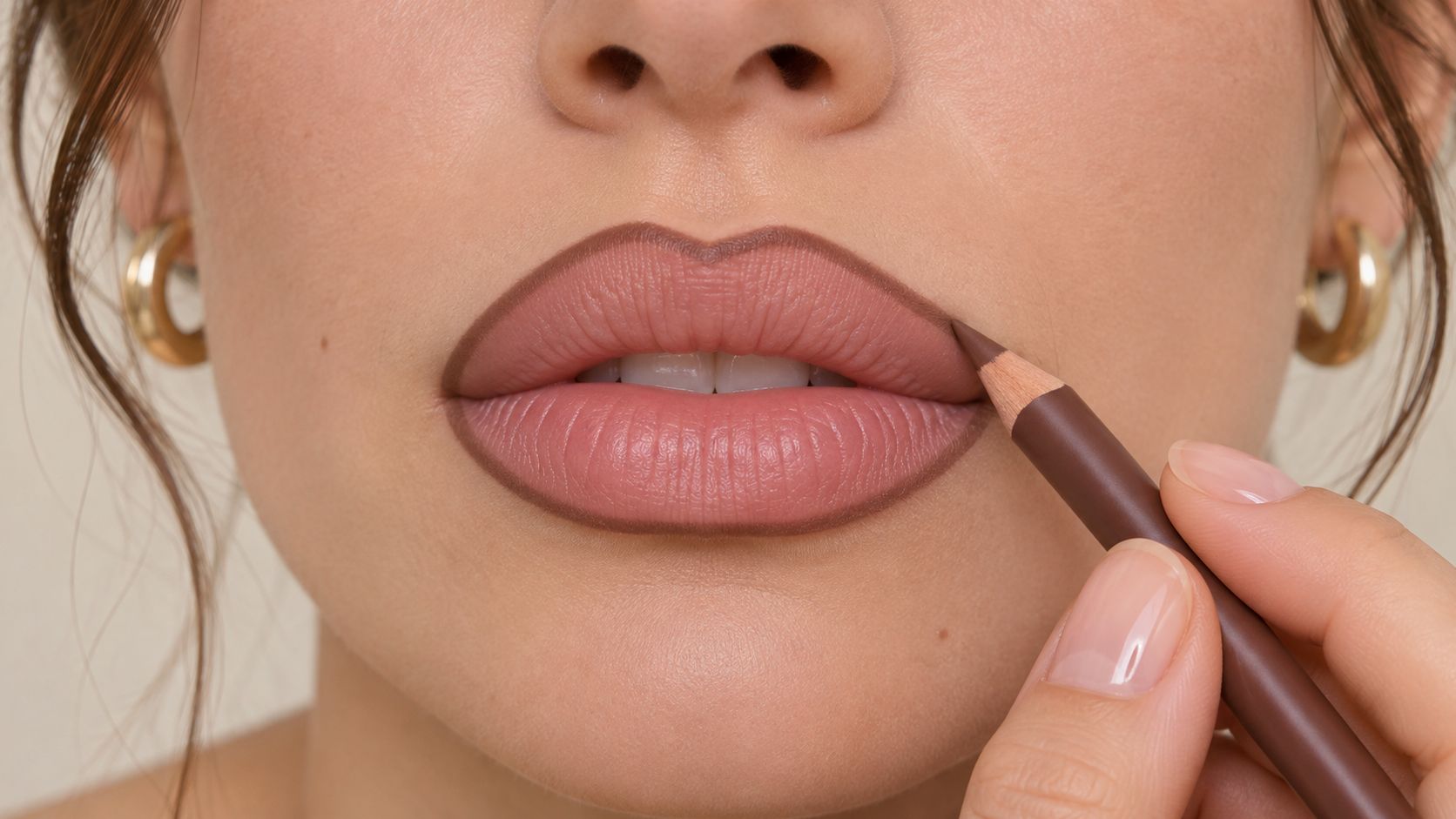
A precise border traces just outside your natural lip line and gives you the crisp 1990s outline. A softly diffused edge draws the line and blends it inward with a finger or a small brush so it reads as shadow. A full-lip base fills the entire lip under lipstick or gloss and turns the cool brown into a natural tint.
| Method | Where the color sits | Result |
|---|---|---|
| Precise border | Just outside the natural lip line | Crisp 1990s outline that can look stark with a deep shade |
| Softly diffused edge | Line blended inward with a finger or small brush | Shadow-like everyday definition |
| Full-lip base | Color filled across the lip under lipstick or gloss | Natural tint that suits pink, mauve and berry shades |
Two failure modes are worth knowing by name. Too much blue cast over pale lips looks gray, especially with a firm matte pencil and nothing layered on top. A cool brown under a mauve lipstick pushes the result purple, which reads deliberate on some faces and bruised on others.
The edge is where most looks fall apart, and this guide to applying lip liner properly covers the stroke direction and pressure that keep a line clean. Combine it with the five steps below and you'll stop fighting the pencil.
The five-step routine
- Start clean and lightly moisturized. A balm that has sunk in gives the pencil something to grip without dragging.
- Draw with light pressure and short strokes. Long strokes skip over the lip's natural ridges and leave gaps.
- Blend the edge inward within seconds. Do this before the film sets, while the pencil still moves.
- Blot once with a tissue. This presses the pigment down and shows you where the line will feather.
- Add lipstick or gloss to the center only. Keeping product off the border preserves the definition you just built.
Watching the blend happen is faster than reading about it, so see the edge work in motion once before you try it on yourself.
How Long a Cool Brown Liner Lasts and Why
Wear performance depends more on the film a pencil leaves than on the fact that it's brown. Formulation guidance for long-wear makeup describes the usual build: volatile ingredients, nonvolatile oils, waxes or structuring materials, and film-forming polymers. The volatile phase helps the pencil glide and then evaporates, and the remaining film anchors pigment to the lip surface.
Hard film-formers improve transfer resistance, while softer oils and structuring polymers preserve flexibility and reduce cracking. For a cool brown liner that creates a real trade-off. A rigid matte formula delivers sharper contouring and stronger wear but can emphasize dryness. A softer formula feels comfortable and may migrate or fade sooner.
Read the finish, not the claim: the pencil that survives a coffee cup and the pencil that flatters dry lips are usually two different pencils.
A wear test you can run at home
- Apply the liner to clean, lightly hydrated lips.
- Let it set until it no longer feels tacky.
- Drink water, blot with a tissue and check the edge for feathering.
- Inspect the vermilion edge. A skipping line suggests wax drag, and a blurred contour suggests too much emollience.
- Recheck after eating or several hours of wear.
Commercial testing measures abrasion and transfer by repeated rubbing or wiping under standardized pressure, so you can approximate the same idea with steady blotting instead of judging from one untouched swatch. A good result looks like a crisp edge, little transfer on the tissue and no cracking along the line.
Add one finish check. If the cool brown turns chalky or pastel once it sets, the film is too light for your lips. If a rigid matte line cracks or goes gray on dry lips, a softer cream or satin finish will serve you better than another long-wear pencil.
Cool Brown Lip Liners Worth Buying in the US
A dupe is only a dupe if you can buy it. Prioritize pencils with active listings across recognized US retailers, recheck stock before ordering, and skip anything that only appears through third-party sellers. Within that standard, two pencils cover the whole job: one to define what cool brown should look like, and one to do it for less.
| Liner | Shade to Look For | Where to Buy |
|---|---|---|
| Anastasia Beverly Hills Lip Liner (benchmark) | Cool Brown | Target |
| Maybelline Lifter Liner | Upstate | Amazon, Ulta, Target, Walmart, CVS, Walgreens |
Anastasia Beverly Hills Lip Liner in Cool Brown, the benchmark. Target's listing for the Anastasia Beverly Hills Lip Liner in Cool Brown showed the shade in stock, inside a brown lip liner category that returned 29 results. Treat this one as your reference swatch, since every other pencil gets judged against it rather than against its own name. Check the current price at the retailer before ordering, because pencil prices move with promotions.
Maybelline Lifter Liner in Upstate, the lower-cost option. Target's listing for the Maybelline Lifter Liner states that the product can be purchased online or in stores through Amazon, Ulta, Target, Walmart, CVS and Walgreens, which makes it the easier of the two to find on a normal shopping trip. The shade name says nothing about temperature, so swatch it beside the benchmark before you commit.
How to compare the pair in one sitting
Swatch both pencils side by side on your arm, then beside a rosy nude and again beside a peach lipstick. You're hunting for two specific failures: an orange halo from Upstate next to the rosy nude, and a gray cast from either pencil over pale lips. If Upstate holds neutral against the rosy nude, it's a genuine cheap cool brown for your mouth. If it warms up, it isn't one, whatever the listing says.
Stock and shade ranges change, and a discontinued shade can linger in a roundup for years. Recheck the retailer page for the exact shade before buying.
Cool Brown Lip Liner Questions Answered
Does a matte finish make a cool brown look ashy
A rigid matte film sharpens the gray or mauve cast of a cool brown, and it shows most on deep skin and on dry lips. A softer cream or satin finish looks less chalky but blurs the edge sooner. If the swatch already leans gray, choose the softer finish rather than a harder long-wear pencil. The extra wear isn't worth a gray mouth.
Can a cool brown liner work on warm undertones
Yes, when you use it as depth instead of as a full cool lip. Keep the pencil to a thin shadow at the outer lip, leave the center a peach, coral or warm nude, and the cool pigment reads as contour rather than temperature. Filling the whole lip with the same pencil on a warm complexion is what makes it look off.
How do I stop a budget liner from looking overlined
Stay on or just inside the natural line, and blend inward within seconds before the film sets. Cheaper pencils often carry more slip, which works in your favor here, because you get working time to soften the edge before it locks. A firm, fast-setting pencil is the harder tool to control.
What if the listing looks discontinued
Skip shades that only appear through third-party sellers or show as out of stock, and recheck a current US retailer page for the exact shade name. A pencil that's hard to find at a major retailer isn't a dupe you can recommend, however good the swatch looked on your arm.
Wrapping Up With Your Best Cool Brown Pick
Maybelline Lifter Liner in Upstate is the affordable pick, but only once a side-by-side daylight swatch matches Anastasia Beverly Hills Lip Liner in Cool Brown, which stays the reference shade sold at Target. If Upstate throws an orange halo beside a rosy nude, don't buy it as a cool brown. Keep the benchmark, or keep looking.
The rest comes down to four habits. Judge a brown beside your own lips and lipstick rather than by the word taupe or espresso on the barrel. Match depth to your complexion, roughly two shades deeper for a soft edge and three to four for a sharp one. Decide which of the three applications you want, because a precise border, a diffused edge and a full-lip base can make the same pencil look stark, soft or tinted. Then test the film before you commit, since wear comes from the formula rather than the color.
Do the boring part properly. Swatch both pencils in daylight, confirm the exact shade is in stock at a major US retailer such as Target, Ulta, Walmart, CVS, Walgreens or Amazon, and buy the one that looks like a shadow of your lip. If you want to see a taupe-leaning shade compared across undertones before you spend, the Finding Favourites article "What Is Undertone in Makeup?" covers that ground.
Finding Favourites exists to make this kind of comparison quicker: Stef consolidates her personal experience with the expertise and opinions of others into catered lists of the top beauty dupes across a variety of brands, from Charlotte Tilbury to NARS and Le Labo. If you're still narrowing your lip drawer, start with the lip liner and lipstick dupes built around the undertones you just tested. Head to Finding Favourites to browse dupes by brand and category, and sign up for the newsletter for new dupes and discount codes.