
The Truth About Bis Aminopropyl Dimethicone in Hair Products
You're probably here because you flipped over a conditioner bottle, saw Bis-Aminopropyl Dimethicone, and had one of two reactions. Either, “That sounds expensive, so maybe it works,” or, “That sounds like one of those ingredients the internet wants me to fear.”
The explanation is much less dramatic and far more useful. This ingredient is one of the reasons some conditioners make your hair feel instantly smoother, silkier, and more polished. It also explains why some products give that pricey salon slip even when the bottle came from the drugstore.
What Exactly Is Bis Aminopropyl Dimethicone
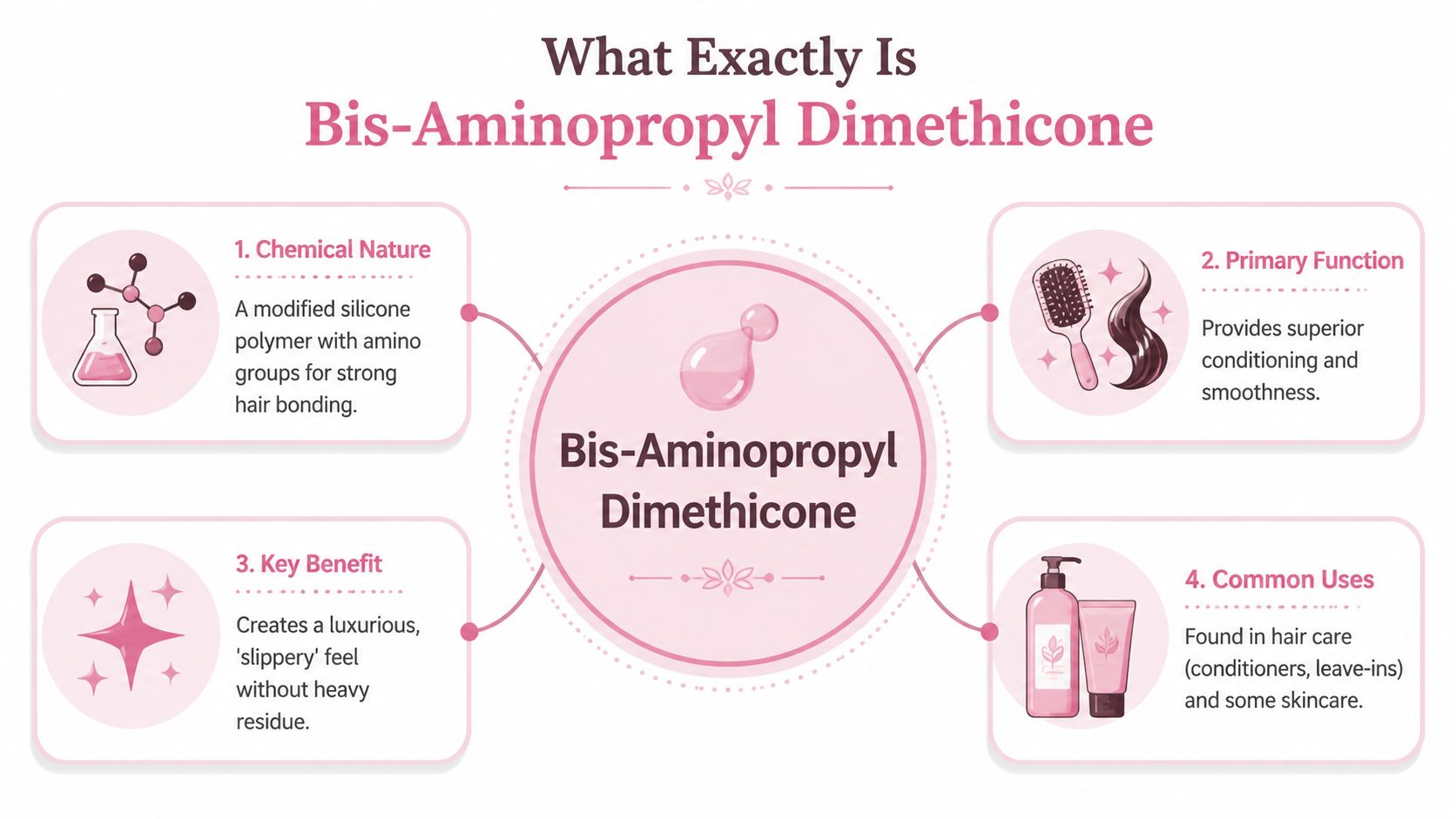
Long ingredient names make beauty products seem more mysterious than they really are. Bis-Aminopropyl Dimethicone is basically a silicone-based conditioning ingredient used mainly in hair products.
What makes it different from plain dimethicone is the amine functionality. In normal-person language, that means it's been modified so it sticks to hair more effectively. Industry descriptions say those amino groups increase substantivity to hair and improve conditioning efficiency even at low use levels, which is why formulators use it for conditioning, softening, improved combability, and frizz reduction in shampoos, conditioners, serums, and creams, as noted by this ingredient overview from ECHEMI.
This post may contain affiliate links, which means I may receive a commission if you purchase through my links, at no extra cost to you. Please read the disclosure policy for more information.
Why it feels different from basic silicone
If regular silicone is like a smooth topcoat, bis aminopropyl dimethicone is more like a smart smoothing layer. It's designed to adsorb onto negatively charged hair fibers, where it improves slip, combability, and manageability while leaving a thin conditioning film instead of a heavy waxy feel, according to Siltech technical data for this amino-functional silicone.
That's why people often notice a very specific result with products that use this kind of ingredient well:
- Wet detangling gets easier because strands slide past each other more smoothly.
- Frizz looks calmer because the hair surface feels more uniform.
- Dry hair feels softer longer instead of nice for five minutes and rough again later.
Practical rule: If a conditioner makes your hair feel “expensive” the second water hits it, a high-performance conditioning silicone is often part of the story.
Why luxury formulas love it
This isn't some obscure lab-only ingredient. Suppliers describe bis-aminopropyl dimethicone as a standard conditioning material for products meant to leave hair smoother, softer, and more controlled, especially when hair is porous, color-treated, or rough from heat styling.
That's also why you'll often spot this kind of ingredient in formulas aimed at “repair,” “smooth,” “anti-frizz,” or “gloss.” Brands are chasing that rinses-like-satin feeling. If you like browsing formulas that lean into that polished finish, it helps to compare product types and ingredient styles side by side, including resources like Karseell's best shampoo solutions that show how smoothing-focused wash-day systems are positioned.
The Good The Bad and The Buildup
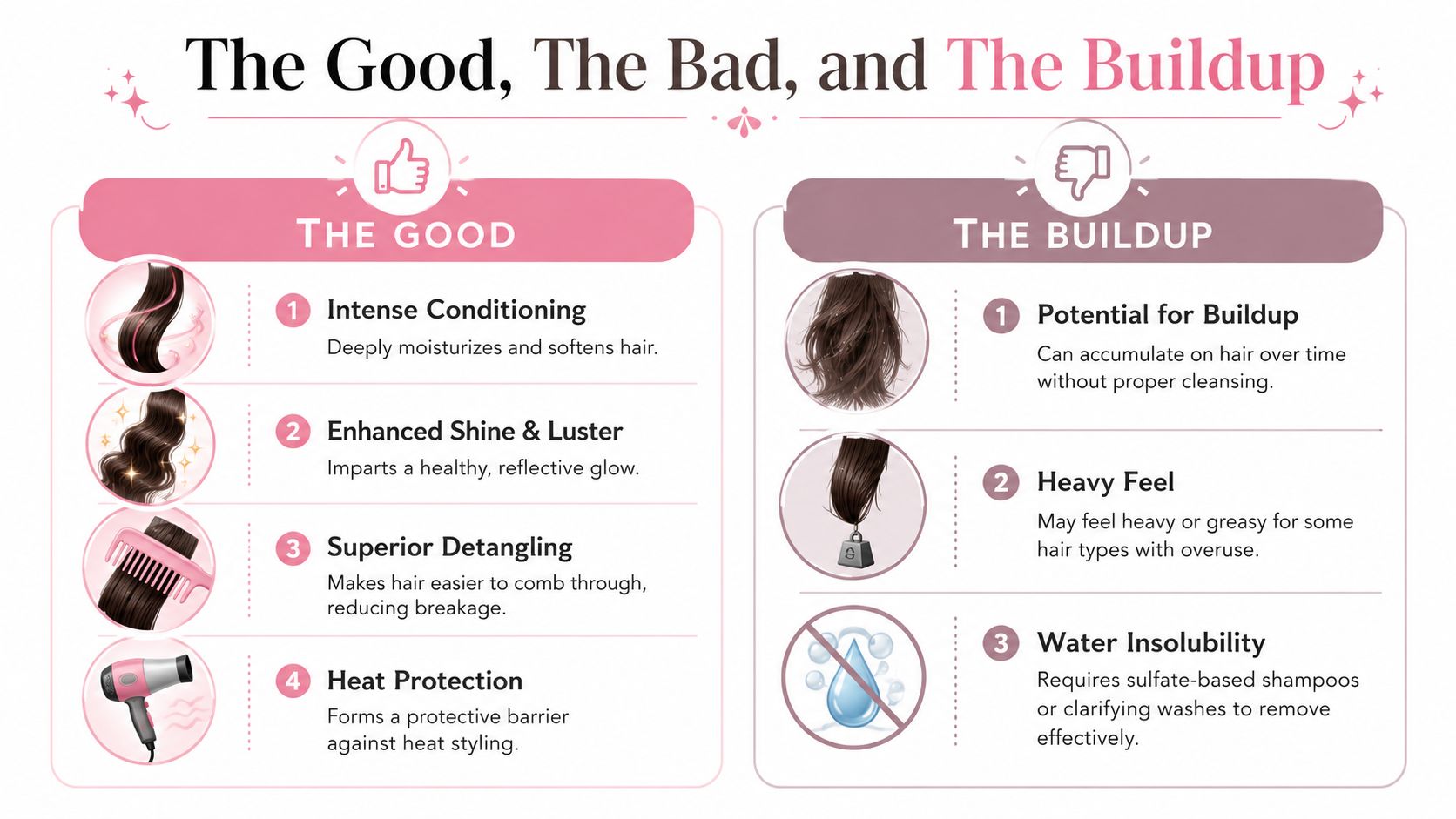
The best thing about bis aminopropyl dimethicone is also the thing that makes some people suspicious of it. It forms a film on hair.
That film can be amazing. It can also be too much for certain routines.
What people love about it
Hair that feels rough usually has more friction. Conditioners that reduce friction make hair easier to handle, and this ingredient is specifically valued for that.
The “good” side usually looks like this:
- Slip on wash day that helps a comb glide through tangles more easily
- Smoother-looking ends because the coating makes frayed areas feel more polished
- Frizz control that doesn't disappear the second humidity shows up
- A glossier finish because smoother hair reflects light better
If your hair is color-treated, bleached, heat-styled, or naturally porous, this kind of film can feel like instant relief. Hair doesn't need motivational speeches. It needs less drag.
Where the buildup concern comes from
The downside is simple. If you keep layering a film-forming ingredient onto hair without removing enough of it, some hair types start to feel coated.
One ingredient guide takes the stricter view and notes that it forms a film that isn't easily washed off with water alone, while another presents it as generally well tolerated across different product categories. The balanced takeaway from SpecialChem's discussion of amino-functional silicones is that the ingredient's value depends on the formula and your hair type. It can reduce frizz, add shine, and improve feel, but those same film-forming properties may read as residue on fine hair or in minimalist routines.
If your hair loves sleekness, this ingredient can feel like magic. If your hair gets limp fast, the same finish can feel like “why is my hair weirdly flat today?”
Who usually notices buildup first
Not everyone experiences buildup the same way. The first people to complain are usually those with:
| Hair situation | Likely reaction |
|---|---|
| Fine hair | Can feel weighed down faster |
| Low-product routines | Film is more noticeable |
| Heavy leave-in layering | Residue can show up sooner |
What about scalp health and sensitivity
This ingredient is mostly discussed in the context of hair shaft performance, not as a scalp treatment ingredient. So the practical question isn't really “Is it evil for the scalp?” It's more, “Does my routine leave too much residue near my roots?”
If you apply a silicone-heavy conditioner mainly from mid-length to ends, it typically won't be a concern. If you saturate the scalp with rich masks, oils, and leave-ins all at once, your scalp may feel less fresh. That's a routine issue more than a morality issue.
Where You Will Find This Silicone Superstar
Some ingredients are everywhere but don't do much. Bis aminopropyl dimethicone is the opposite. It tends to show up where brands want a product to feel immediately smoothing and noticeably polished.
Hair products where it makes the most sense
This ingredient is a natural fit for rinse-out conditioners, masks, smoothing creams, and anti-frizz stylers. Suppliers describe it as a silicone-based hair-conditioning ingredient used at a typical concentration of 0.5–5% and position it for long-lasting conditioning, frizz control, split-end sealing, and slip for damaged, porous, or color-treated hair, according to CDF Supplies' ingredient profile.
That tells you a lot about where to expect it. Not in a random “clean volume mist.” Definitely in formulas promising:
- Smoother blowouts
- Damage care
- Softer detangling
- Glossy lengths
- Humidity help
Why it shows up in luxe-feeling formulas
Brands love ingredients that make consumers notice something right away. This one gives sensory payoff. You feel it when rinsing, when combing, and when touching dry hair later.
That's why it overlaps so naturally with the kind of products people call “glass hair” products. If you like that mirror-smooth look, you'll probably also like browsing these Color Wow Dream Coat dupes for flawless glass hair, because the finish people chase there comes from the same broader category of smoothing, film-forming performance.
It can appear outside hair care too
You may also spot related silicones in primers, moisturizers, and sunscreen formulas because formulators like that silky spread and smoother surface feel. In those products, the goal isn't detangling, obviously. It's glide, blurring, and a more elegant finish on skin.
Still, hair is where this ingredient really earns its reputation.
5 Affordable Conditioners With That Luxe Silicone Slip
If you love the feel of a salon conditioner but not the bill that comes with it, this is the fun part. You do not need a luxury label to get that silky, low-friction, smooth-rinse effect.
Below are five affordable conditioners and masks that are widely available in the US and fit the same general brief: softening, slip, and that glossy conditioned feel.
Affordable Conditioner Dupes Comparison
| Product | Price Point | Best For |
|---|---|---|
| Aussie 3 Minute Miracle Smooth | Budget | Dry, tangled, frizz-prone hair |
| Aussie Moist Conditioner | Budget | Detangling and everyday softness |
| Herbal Essences Hello Hydration Conditioner | Budget | Thick, thirsty hair that wants slip |
| Pantene Miracle Rescue Deep Conditioner | Mid-budget | Damaged hair needing a polished feel |
| Dove Intensive Repair Conditioner | Budget | Smoother, softer everyday conditioning |
1. Aussie 3 Minute Miracle Smooth
This is one of the easiest picks if your hair goal is instant slip. It's the kind of product people reach for when they want their hair to feel less grabby in the shower and less puffy once dry.
Why it works as a smart buy:
- It behaves like a smoothing treatment, not a bare-minimum conditioner.
- It suits rough ends well because richer formulas tend to make damaged lengths feel more uniform.
- It gives that “detangled before I even touched a comb” feeling many people associate with pricier masks.
If your hair is fine, use less and keep it away from the roots. If your hair is dense, dry, or color-treated, this is the kind of budget product that can punch above its price category.
2. Aussie Moist Conditioner
This one has stayed popular for a reason. It's affordable, easy to find, and known for good slip.
The appeal here is simple. You can use it generously without feeling like every wash is costing you luxury-mask money. It's especially useful if your hair tangles easily and you want a conditioner that helps your fingers move through it with less resistance.
A practical reason people like this category of conditioner is that it delivers the “soft and coated enough” effect without forcing you into a full repair-system commitment.
A good budget conditioner doesn't need to imitate luxury branding. It just needs to make your hair easier to live with.
3. Herbal Essences Hello Hydration Conditioner
If you like a richer, creamier conditioner feel, this one is a classic drugstore direction to look in. It's best for people who want softness and a smoother rinse-out experience more than airy volume.
Why it stands out:
- It's often easy to find at major US retailers.
- It tends to work best for medium to thick hair or hair that runs dry.
- It gives that “my hair feels coated in a good way” result some people specifically want.
This is not the one I'd hand to someone chasing bounce at all costs. It's for softness lovers.
4. Pantene Miracle Rescue Deep Conditioner
Pantene is very good at making hair feel expensive without being expensive. This type of formula is usually where drugstore science shines.
What makes it a strong dupe-style buy is the overall result. Hair often feels more controlled, smoother through the mid-lengths, and easier to blow-dry into a polished shape. That's the exact lane where high-performance silicones earn their keep.
If your hair has been through bleach, color, heat, or aggressive brushing, this kind of conditioner tends to feel more rewarding than lightweight daily formulas.
5. Dove Intensive Repair Conditioner
This is the quiet overachiever of the list. It doesn't always get luxury-comparison hype, but Dove often does a really nice job with accessible conditioning formulas that make hair feel less rough fast.
Why I'd recommend it:
- Easy to find in the US
- Usually affordable enough for regular use
- A good option for people who want smoother hair without overthinking it
It's not the flashiest bottle in the aisle. It is, however, often the kind of formula that makes you step out of the shower and think, “Wait, why does my hair feel this nice?”
How to choose the right one
Pick based on hair behavior, not just marketing claims.
- Choose Aussie 3 Minute Miracle Smooth if detangling and anti-frizz are your top priorities.
- Choose Aussie Moist Conditioner if you want an easy everyday slip conditioner.
- Choose Hello Hydration if your hair likes richer formulas.
- Choose Pantene Miracle Rescue if your hair feels damaged and wants a more treatment-like result.
- Choose Dove Intensive Repair if you want a reliable all-rounder.
If you like comparing salon-like performance against wallet-friendly options, this roundup of dupes for It's a 10 is another useful place to browse.
How To Spot It and How To Wash It Out
Ingredient lists stop being intimidating once you know what you're scanning for. You don't need to decode every botanical extract. You just need to catch the ingredients that change how a product behaves.
How to find it on a label
Look for Bis-Aminopropyl Dimethicone in the ingredient list exactly as written, usually somewhere after water, fatty alcohols, and conditioning agents. You may also notice related silicone names nearby in other products, which is a clue the formula is aiming for smoothness and slip.
If ingredient labels still feel chaotic, a plain-English guide like Modern Holistic Living on ingredient labels can make the order and naming system much easier to follow.
A few quick clues help:
- If it's in a rinse-out conditioner, expect softness and easier detangling.
- If it's in a leave-in cream or serum, expect more surface smoothing and polish.
- If it appears high on the list, the smoothing effect may feel more noticeable.
How to keep buildup under control
This part is less complicated than social media makes it sound. If your hair starts feeling dull, coated, limp, or weirdly resistant to moisture, use a stronger cleanser than your usual ultra-gentle wash.
That doesn't mean you need to scrub your hair into sadness. It means you should have one shampoo in rotation that removes residue better than a co-wash.
Try this routine:
- Use your regular conditioner as normal if your hair likes the results.
- Watch your hair's feel, especially near the crown and through the ends.
- Wash with a more cleansing shampoo as needed when hair starts feeling coated.
- Apply rich products mostly mid-length to ends if your roots get flat easily.
If you prefer gentler cleansers most of the time, this guide to drugstore sulfate-free shampoo can help you build a routine with more flexibility between wash days.
Is It Safe A Look At The Regulations
This is the part people usually want a straight answer on. Yes, silicone conditioning ingredients in this family have been evaluated for cosmetic use.
A key historical reference point is the Cosmetic Ingredient Review assessment covering several silicone conditioning agents, including Aminopropyl Dimethicone and Amodimethicone. That panel concluded they were safe as used in cosmetic formulations, and noted that many functioned as conditioning agents at current concentrations of use of ≤15%, as summarized in the CIR-linked PubMed record.
That assessment also summarized toxicology support for related silicones, including no acute oral toxicity, no dermal absorption in clinical and animal studies for related silicones, and 90-day animal exposure studies up to 10% Dimethicone without adverse effect.
The practical takeaway is pretty calm. The ingredient category has a long cosmetic-use history, and the safety conversation is very different from the internet shorthand of “chemical name equals danger.”
Frequently Asked Questions
Is bis aminopropyl dimethicone the same as regular dimethicone
No. They're related, but they don't behave exactly the same way.
The important difference is that bis aminopropyl dimethicone is amino-functional, which is why formulators use it when they want more targeted conditioning and stronger hair substantivity than a simpler silicone can offer. That's the part that gives it the “smarter” smoothing reputation.
Is it Curly Girl Method approved
If you follow a strict Curly Girl Method, many versions of that routine avoid non-water-soluble silicones, so this ingredient often lands in the “not CG-approved” bucket.
In real life, a lot of curly-haired people still use products with this kind of silicone because they like the slip, reduced friction, and frizz control. The better question is whether your curls like it and whether your cleansing routine removes it well enough. Strict rule-followers may skip it. Practical curl routines often make room for it.
Is it bad for the environment
That question deserves more nuance than beauty discourse usually gives it. Silicone discussions often blur together concerns about washability, persistence, and personal preference.
If you're trying to understand how chemical safety frameworks think about substance assessment more broadly, EU chemical regulations support from ReachLex is a useful starting point for the regulatory side of the conversation. For everyday beauty shopping, the simplest answer is this: if environmental profile is a top priority for you, check brand positioning and ingredient philosophy. If hair performance is your top priority, this ingredient remains popular because it works well.
Can fine hair use it
Yes, but product format matters a lot. Fine hair usually does better with lighter conditioners or more careful placement from mid-length to ends.
If you have fine hair and hate that coated feeling, don't start with a heavy mask. Start with a lighter rinse-out conditioner and pay attention to how your ends feel after a few washes.
Does it actually repair split ends
Not permanently. No conditioner can fuse damaged hair back together forever.
What it can do is make split ends look and feel smoother temporarily, which is still useful if your goal is less frizz, easier styling, and a more polished finish between trims.
If you love finding beauty products that feel expensive without the luxury markup, Finding Favourites is worth bookmarking. It's packed with practical dupe guides that help you compare what's worth buying, especially when you want that polished, high-end result for less.
Bis aminopropyl dimethicone isn't a miracle and it isn't a villain. It's a high-performance conditioning silicone that gives hair that smooth, slippery, glossy feel people often associate with premium formulas. If you want the best affordable starting point, Aussie 3 Minute Miracle Smooth is the standout pick for that luxe, detangling slip on a budget, with Dove Intensive Repair close behind as the easiest everyday option.