5 Vegan Cushion Foundation Dupes Worth Trying
You're standing at the bathroom counter with a compact open, hoping for a base that looks like skin, slips into a bag, and doesn't rely on animal-derived ingredients. You want the cushion feel without paying a luxury price for a name, but a pretty compact and a vegan claim don't tell you whether the shade will work or the formula will stay even.
This post may contain affiliate links, which means I may receive a commission if you purchase through my links, at no extra cost to you. Please read the disclosure policy for more information.
The Compact Look Without the Guesswork
The useful search isn't for a miracle formula. It's for a cushion that releases evenly from its sponge, has a shade that looks believable on your skin, and comes with an ingredient list you can check before buying. Those are separate tests, and a product has to pass all of them to be a worthwhile swap.
A cushion foundation can be vegan, but its format doesn't make it so. The compact describes how the makeup is stored and applied. Vegan describes an ingredient policy. Cruelty-free describes an animal-testing policy. Treating those terms as synonyms is an easy way to buy a product that doesn't meet your priorities.
A commission disclosure belongs close to the recommendations, where readers can notice it, not tucked away on an obscure About page. That's why the disclosure appears beside the product discussion rather than hidden somewhere else.
Before choosing a dupe, it helps to know what the cushion sponge is meant to do, what a vegan claim can and can't tell you, and how formula behavior affects the application. Then you can judge the available products by the things you'll see on your face: coverage, finish, shade, and wear.
There's one important limit to the recommendations here. The information available for this article doesn't verify five cushion foundations as both vegan and currently available through US retailers, with a current ingredient declaration and responsible-company information to check. Rather than pass along an unconfirmed list, I'll show you how to assess a cushion and explain what must be verified before a product earns a place in a dupe roundup.
How a Cushion Foundation Delivers Makeup
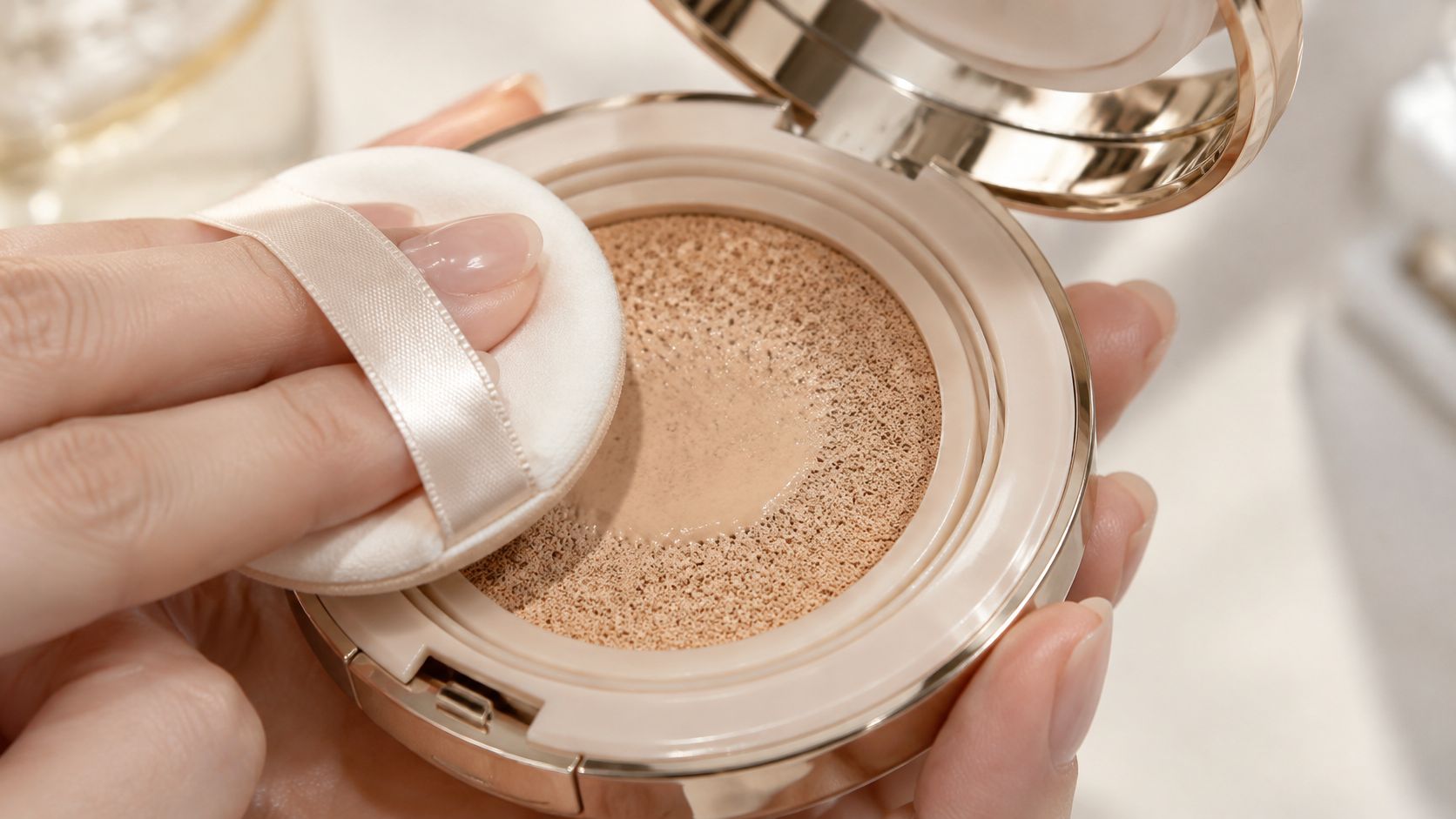
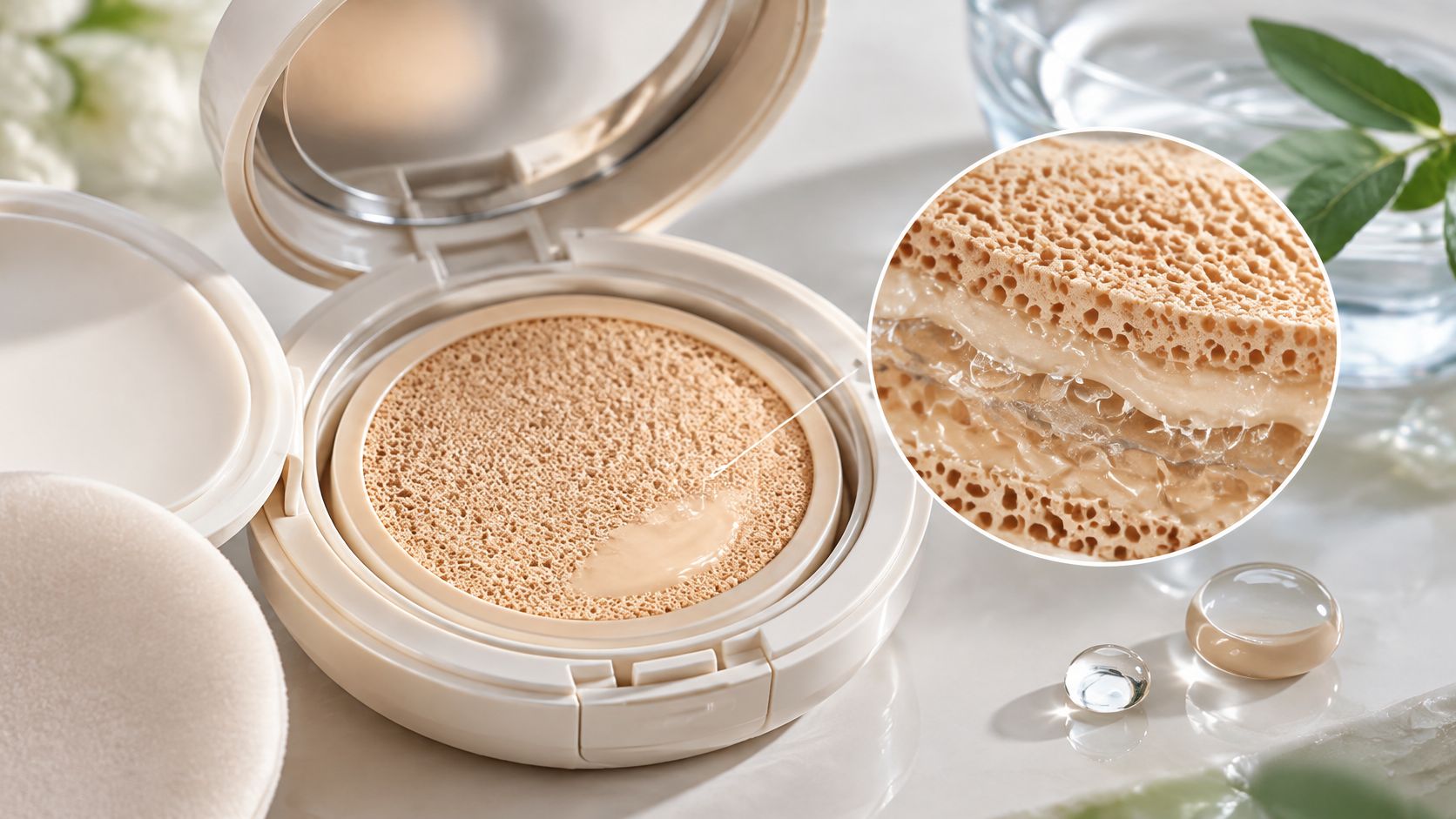
A cushion is a low-viscosity complexion formula held in a foam sponge inside a compact. Press the puff into the sponge and it picks up makeup for application. It's a portable delivery system, not a bottle of foundation poured into a pan.
The format began in South Korea. Amorepacific launched the IOPE Air Cushion in 2008, identifying it as the first cushion cosmetic. The company's development work used a polyurethane foam carrier with approximately 800,000 pores and included 3,600 sponge experiments exploring material, hardness, thickness, and pore size (Amorepacific's account of the cushion's development).
A reservoir with tiny exits
Think of the foam as a reservoir with many tiny exits. The formula must stay fluid enough to travel from sponge to puff, but not so thin that one press floods the puff with more product than you want. That balance is part of why two cushions with similar coverage claims can feel quite different in use.
The first cushion was designed to solve a practical problem: people wanted to reapply sun protection and makeup without carrying a glass bottle or disturbing the base already on their face. It combined coverage, sun protection, and portability, helping establish the multifunctional cushion format later associated with K-beauty. For a plain-language comparison of complexion products, see how BB cream differs from foundation.
Separate the format from the formula
Vegan describes the ingredient policy. Cushion describes the sponge-and-compact architecture. The same compact design can hold a vegan, non-vegan, or vegan-certified formula. Neither the puff nor the sponge tells you what the makeup contains.
That distinction matters when you shop. A Korean-style compact isn't automatically vegan, and a vegan label doesn't guarantee the texture or finish you want. Check the formula's ingredient information and the brand's explanation of any certification, then assess the compact as a piece of packaging and the makeup as a product in its own right.
Vegan Cruelty-Free and Certified Are Not the Same
Three separate claims get blurred together on compact packaging, so sort them before you pay. Cruelty-free covers animal testing. Vegan covers animal-derived ingredients and processing inputs. Certification is third-party verification of a defined standard. A formula can carry one claim and fail the other two, and the cushion sponge tells you nothing about any of them.
The EU's animal-testing rules show why these claims belong in separate columns. Animal testing for finished cosmetic products has been banned in the EU since 2004. A ban on testing cosmetic ingredients took effect on 11 March 2009, and a marketing ban became fully binding in 2013 for cosmetics containing ingredients tested on animals, wherever that testing occurred (European Commission Joint Research Centre FAQs). Sold in the EU signals a testing policy. It says nothing about beeswax in the pan.
Read the claim, then check the ingredients
To evaluate a vegan claim, scan for beeswax, carmine, collagen, gelatin, and lanolin. The Vegan Society's 2025 guidance takes a supply-chain view, requiring animal-derived ingredients and by-products to be excluded from the finished product and the supply chain, while treating animal-testing policy as a separate issue. So “vegan formula” and “vegan-certified” are different things. Certification verifies a product against a standard. A formula claim is the brand's word.
What a US label can tell you
In the United States, cosmetics, including imported products, must comply with the Federal Food, Drug, and Cosmetic Act, the Fair Packaging and Labeling Act, and applicable FDA regulations. Cosmetic products and claims generally don't receive premarket approval, so vegan isn't an FDA-certified status (FDA Cosmetics Labeling Guide).
Before you buy, check three things: a recognized vegan certification, a readable ingredient list, and the name and place of business of the responsible marketing firm. If that firm isn't the manufacturer or packer, the label may identify it as “Manufactured for” or “Distributed by” (FDA summary of cosmetic labeling requirements). While you're on the product page, check whether the compact accepts refills. A vegan pan in a single-use case still leaves you buying a fresh puff and plastic shell every round, and refills are where the affordable dupes earn their keep.
What the Formula Has to Survive in the Sponge
A vegan cushion is still a technically demanding, water-rich emulsion. Cushion formulas are commonly water-in-silicone or multiphase emulsions, stored in a porous urethane sponge inside an airtight compact. The sponge may contain up to 800,000 pores, and the formula has to move through it consistently without letting pigments settle, separating into phases, or delivering patchy color (research on cushion foundation formulation).
Adding more water can shift a formula from a thin liquid toward a thicker cream. That might change how it feels, but too much thickness can make the puff pick up and spread the product poorly. A lightweight first impression means little if the formula won't load evenly.
Plant-based doesn't guarantee better wear
Replacing animal-derived materials doesn't automatically reduce irritation or improve longevity. Emollients, film-formers, pigments, emulsifiers, preservatives, pH, and packaging all work together. If the formula pills, separates, or wears unevenly, “vegan” doesn't explain the problem.
A reported high-moisture cushion prototype offers a formulation benchmark, not a product recommendation. It used 99% naturally derived ingredients without silicone oils or PEG emulsifiers, relying on plant-derived oils, skin-feel powders, short-chain hydrocarbon oils, and polyglyceryl-10 pentaisostearate. The formula raised water content to 50% for a cooling, hydrating feel and reportedly maintained stable viscosity through three months of storage at 45°C (prototype details).
What to look for as a shopper
Look for evidence that a brand has considered heat stability, not just ingredient origin. A high-water formula may feel fresh, but it still depends on appropriate preservation and a compact lid that seals properly. Follow the product's shelf-life guidance, close it promptly after use, and keep unclean fingers away from the sponge.
If a cushion beads, separates, or leaves watery patches, treat that as a formulation or packaging problem. It isn't evidence that vegan makeup as a category can't perform. More advice on making complexion makeup last is in this guide to all-day foundation wear.
Shade Matching Application and Wear Fixes
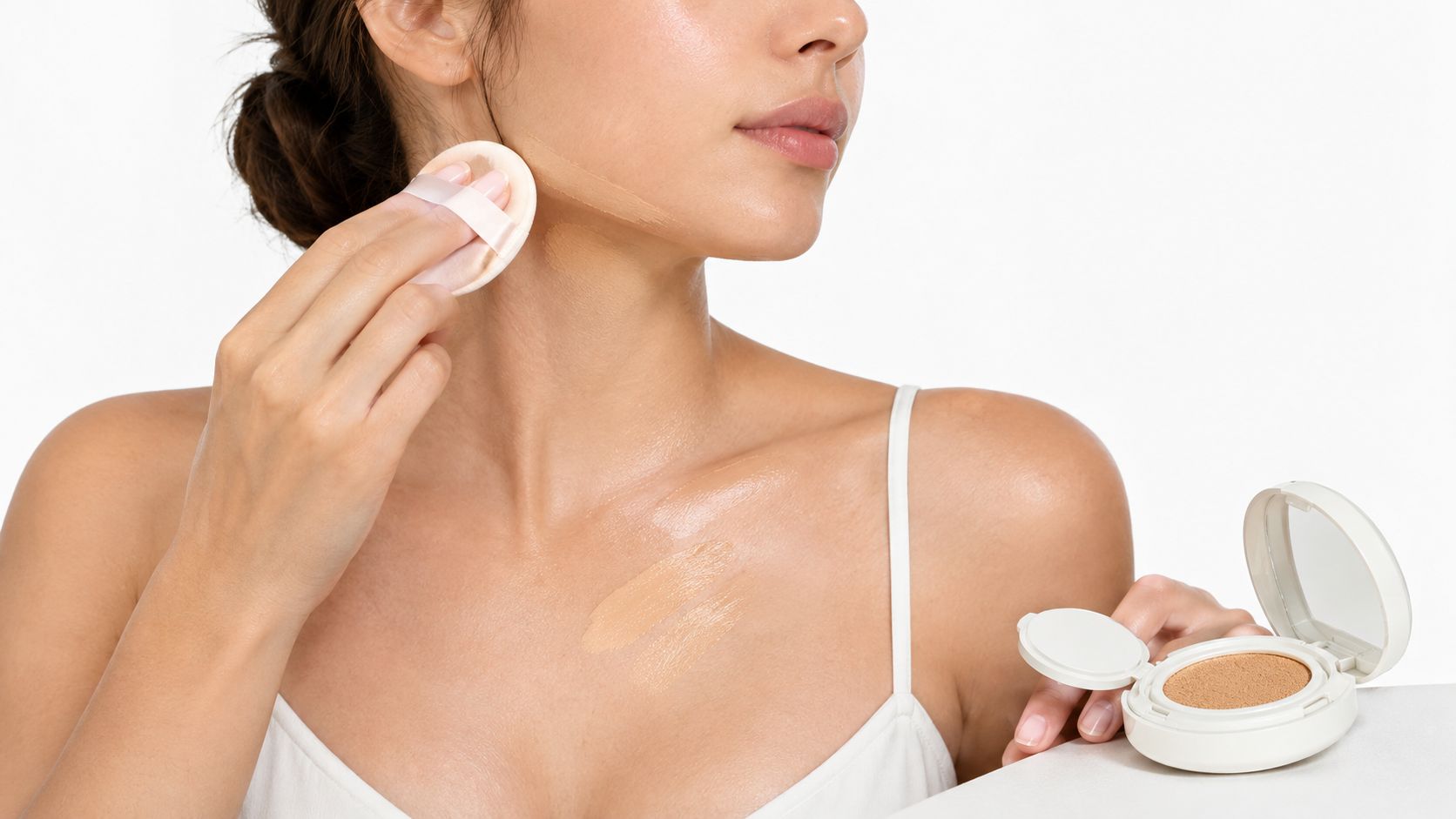
Start the shade test in daylight, at the jaw and chest, not on your wrist. A cushion can look lighter or deeper once the puff sheers it across the skin, so judge the applied layer rather than the product sitting on the puff. This foundation shade guide can help you compare undertone and depth.
Press, don't drag
Press the puff into the sponge, then use a press-and-roll motion to apply a thin layer. Dragging can disturb what's already on your face and spread the makeup unevenly. For redness or a spot, apply a second light press after the first layer has had time to set, instead of loading the puff with a lot of product at once.
For drier skin, use a thin layer of moisturizer underneath and go easy on powder. If your skin gets oily, keep the puff clean and use a lighter second press through the center of the face. Around fine lines, a barely loaded puff usually looks more natural than a heavy layer.
Here's a useful application demonstration to compare with your own technique:
Diagnose the result before adding more product
If the color turns warmer or darker, the shade may already be too warm, or the formula may not be sitting well over your moisturizer. Pilling often means you've applied too much product or rubbed it instead of pressing. Watery patches or sudden dark spots can mean the sponge is overloaded or the emulsion is separating.
Patchy product near the end of a compact's life is a reason to stop using it, not scrub harder or keep trying to revive it. If the makeup behaves unexpectedly, check the compact and formula before blaming your technique.
Wear check: After four hours, look at T-zone shine, fading around the nose, and transfer on a mask. Those are more useful observations than judging a fresh application alone.
Five Affordable Vegan Cushion Foundation Dupes
I wish this part could be five names and a buy link. It can't. Cushion lines get reformulated, shades get discontinued, and retailer listings go stale faster than compacts sell through. Recommending five "current" US vegan dupes I can't confirm against a package ingredient list and a live listing would be a guess dressed up as a shopping list, and you deserve better than that.
So here's the honest version: the checks a cushion has to pass before it earns a spot on my shortlist, plus how to run them yourself in a store aisle.
The five checks a dupe has to pass
| Check | Where to verify | Automatic fail |
|---|---|---|
| Vegan composition | Current package ingredient declaration | Carmine or cochineal, beeswax, lanolin, collagen, gelatin |
| Independent backup | Recognized vegan certification mark on the compact or box | "Vegan" appearing only in the retailer's description |
| Responsible company | "Manufactured for" or "Distributed by" line on the US label | No named marketing firm or place of business |
| Current availability | A live US retailer listing you can open today | Discontinued stock, region-locked releases, gray-market resellers |
| Formula behavior | A tester, or the first wear on your own skin | Caking when built up, uneven pickup on the puff |
Run any compact through that table and watch most dupe lists fall apart. A similar sponge and a lower price don't make something a dupe. The makeup inside has to behave.
When you do find a candidate, compare it like makeup, not packaging. Coverage should build without caking, the emulsion should load onto the puff evenly, and the finish should match what you wear. Check the shade in daylight, then give it a full day on your skin. As noted earlier, a finish comparison can sharpen your eye for complexion swaps, but no swatch photo answers the vegan question. Only the current ingredient declaration does, and a cruelty-free badge doesn't cover it.
Refills deserve the same skepticism. Refillable cushion packaging estimates suggest pods may support roughly 5 to 12 refill cycles and could cut packaging waste by 70 to 85 percent versus single-use formats, yet only 62 to 71 percent of purchasers complete refill cycles and 34 to 42 percent dispose of materials correctly through recycling or composting systems. A compact you buy once and never refill isn't automatically the lower-waste choice, and refills can be hard to source locally while the saturated sponge and leftover liquid complicate recycling. Buy into the refill system only if you'll use it.
The honest shortlist is the one you build yourself: a cushion that passes all five checks, wears well through a full day on your face, and earns the refill purchase. When a compact clears that bar at a drugstore price, that's the dupe worth telling your friends about.
Questions Shoppers Still Ask
Can two people share one cushion?
It's better not to. The sponge is a shared reservoir, so sharing raises hygiene and contamination concerns. Using a second puff doesn't make the saturated sponge clean.
Does an SPF number on a cushion replace dedicated sunscreen?
No. A cushion may include sun-protection actives, but applying makeup with a puff isn't the same habit as applying a measured sunscreen layer. Don't assume the compact alone meets your sun-protection routine.
What if the retailer says vegan but the carton ingredient list doesn't match?
Trust the current package ingredient declaration you can read at purchase. If the retailer listing and the box disagree, skip the product until the brand clarifies which information is current.
Can a refill pod from another brand fit my compact?
Don't assume so. The case, sponge shape, and formula thickness can vary by brand. Even if an unfamiliar pod clicks into place, it may apply patchily or leak.
The Best Dupe and Your Next Step
My honest answer: I'm not crowning a winner yet. The sponge-and-puff format says nothing about whether the formula inside is vegan, and I won't send you to a compact until its claims check out.
Run four checks before you buy:
- Read the ingredient declaration on the carton for your shade. Retailer listings go stale faster than packaging.
- Confirm the vegan claim covers this product, not just the line or the company.
- Check that the case and a refill pod are stocked at a US retailer you can reach.
- Compare the refill price to the starter case. The pod only pays off if you keep buying it.
Check four settles the refill question. Go refillable if you wear one shade through several cycles and can dispose of the spent pod locally. Pick a single compact you'll finish if you switch shades or finishes often.
If nothing passes all four checks, skip the format rather than settle. A verified vegan liquid with a finish you already like, the kind compared in the Hourglass dupes roundup noted earlier, beats a pretty compact you can't confirm.
Finding Favourites helps budget-conscious beauty shoppers compare affordable alternatives to luxury makeup by finish, texture, shade, and wear. Visit Finding Favourites for practical dupe guides, and sign up for the newsletter to get future recommendations and discount codes.