
5 Mousse Without Alcohol Dupes Worth Buying
You're standing in the hair-care aisle, holding a can that promises volume, and remembering the last mousse that left your ends feeling like straw by lunchtime. You want lift and definition, not a stiff fringe or another bottle you'll abandon after wash day. Mousse without alcohol is worth considering, but the front-label promise isn't enough to make it a good buy.
This post may contain affiliate links, which means I may receive a commission if you purchase through my links, at no extra cost to you. Please read the disclosure policy for more information.
Mousse Without Alcohol Starts With Your Hair
Start with the result you're trying to change. Perhaps your roots collapse while your lengths stay crunchy. Perhaps you like defined waves but hate the coated feeling left behind when you run your fingers through them.
Those are different shopping problems. Buying the strongest alcohol-free formula won't necessarily solve either of them.
My recommendation is to shop for the finish first, then check the ingredients. Decide whether you want airy roots, separated waves, or firmer control before you compare cans. Otherwise, it's easy to buy a formula that meets your ingredient preference but misses your styling goal.
Choose the finish you actually want
Think about what would make the product useful on an ordinary morning, not just immediately after styling.
- For volume: Look for roots that stay lifted without making the lengths feel coated.
- For waves: Prioritize separation and movement over maximum stiffness.
- For smoother styling: Judge whether the hair stays touchable after brushing.
- For a sensitive hairline: Treat skin comfort as a separate requirement, not something an alcohol-free claim guarantees.
If you're choosing between root lift and wave definition, Coil's guide to volumizing mousse is a useful companion to the ingredient check. Keep your desired shape in mind while comparing products.
Don't pay for the slogan
An alcohol-free formulation can provide hold through film-forming ingredients rather than ethanol. That makes the claim relevant, but it doesn't tell you how flexible, sticky, or easy to distribute the finished product will feel.
Shopping rule: Buy the formula that suits your hair, not the biggest alcohol-free lettering on the shelf.
For a budget shopper, an unsuccessful inexpensive mousse is still wasted money. I'd rather choose a modestly packaged formula with a suitable hold system than pay extra for soothing language without useful formulation detail.
That's the approach here: hair styling, label reading, and sensible spending. No dessert recipes, no luxury haul, and no assumption that removing an ingredient automatically improves everything else.
How Alcohol-Free Mousse Still Creates Hold
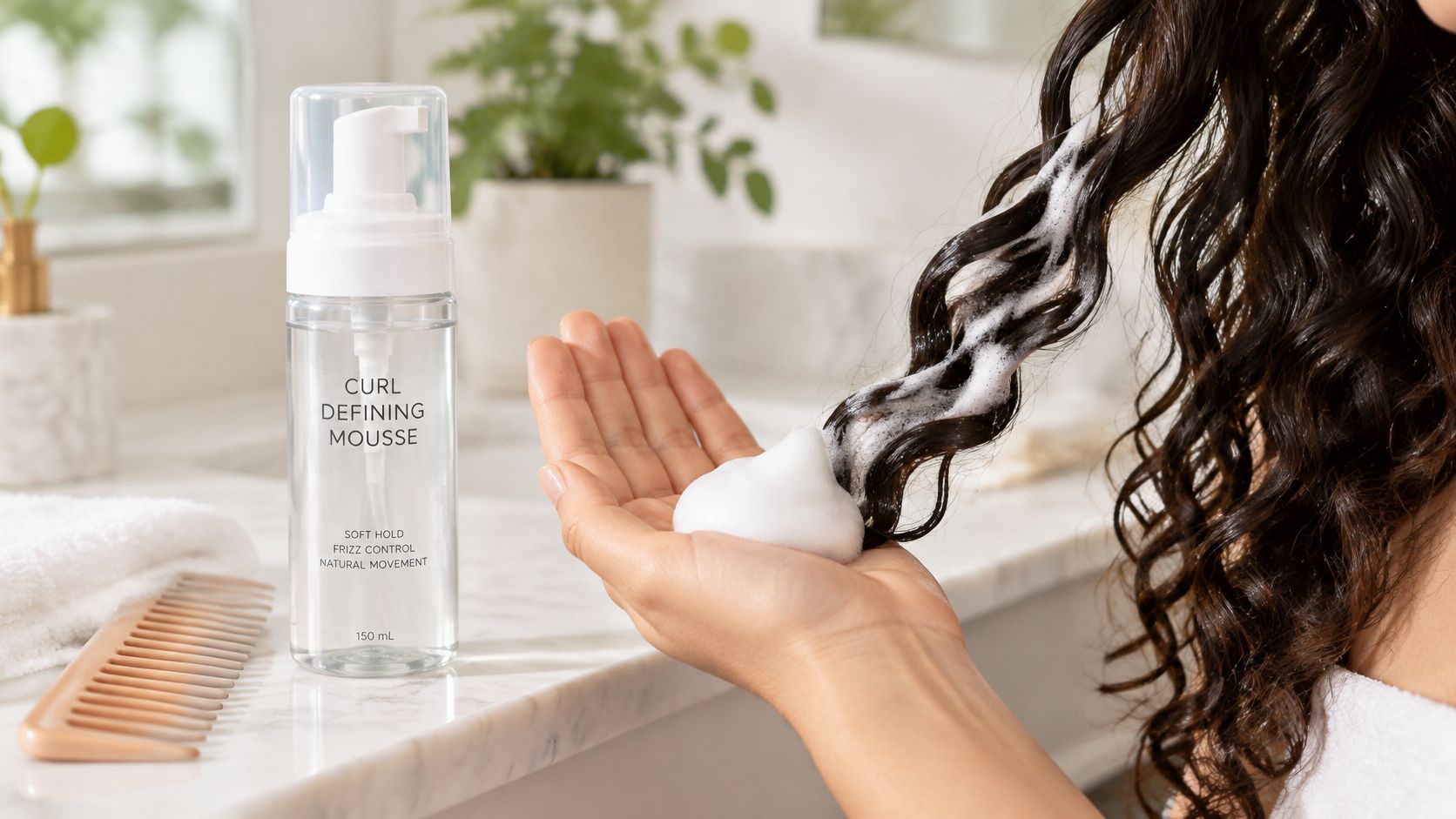
Think of mousse as a light net around the hair rather than a rigid outer shell. The foam helps distribute the product; the styling ingredients provide the support left behind as it dries.
Those jobs are separate. Foam volume isn't the same thing as styling strength, which is why an impressive handful of bubbles doesn't guarantee a lasting result.
Watch the application rather than judging the size of the dollop.
The polymer supplies the support
A documented alcohol-free approach uses a carboxylated polyurethane resin in an aqueous carrier, with optional secondary fixative polymers. The same patent specifies foam densities of at least 0.047 g/cc, including an approximate 0.047–0.060 g/cc range, illustrating how formulators balance foam structure with application in an alcohol-free hair-mousse formulation.
You don't need to memorize that range. Its practical meaning matters more: overly dense foam can feel heavy and spread unevenly, while foam that collapses too readily can be awkward to distribute before it disappears.
The useful label clues are the film-forming polymers, not merely the absence of Alcohol Denat.
A softer finish doesn't automatically mean the formula lacks support. The relevant question is whether the polymer film gives your hair enough cohesion while retaining the movement you want.
Judge the dried result
I'd assess mousse after the hair has dried, not while it's still pleasantly foamy in my palm. Check whether the roots hold their shape, whether the lengths separate easily, and whether touching the hair leaves an obvious coating.
Humidity resistance and flexibility also depend on the polymer system. Don't assume every alcohol-free mousse handles a damp commute equally well, and don't accept a humidity claim as proof of performance on your own hair.
If your hairstyle needs a separate finishing step, compare that job with the options in this budget hairspray guide. Choose each product for a clear purpose rather than piling on more mousse and hoping it will do everything.
Which Alcohols to Spot on the Label
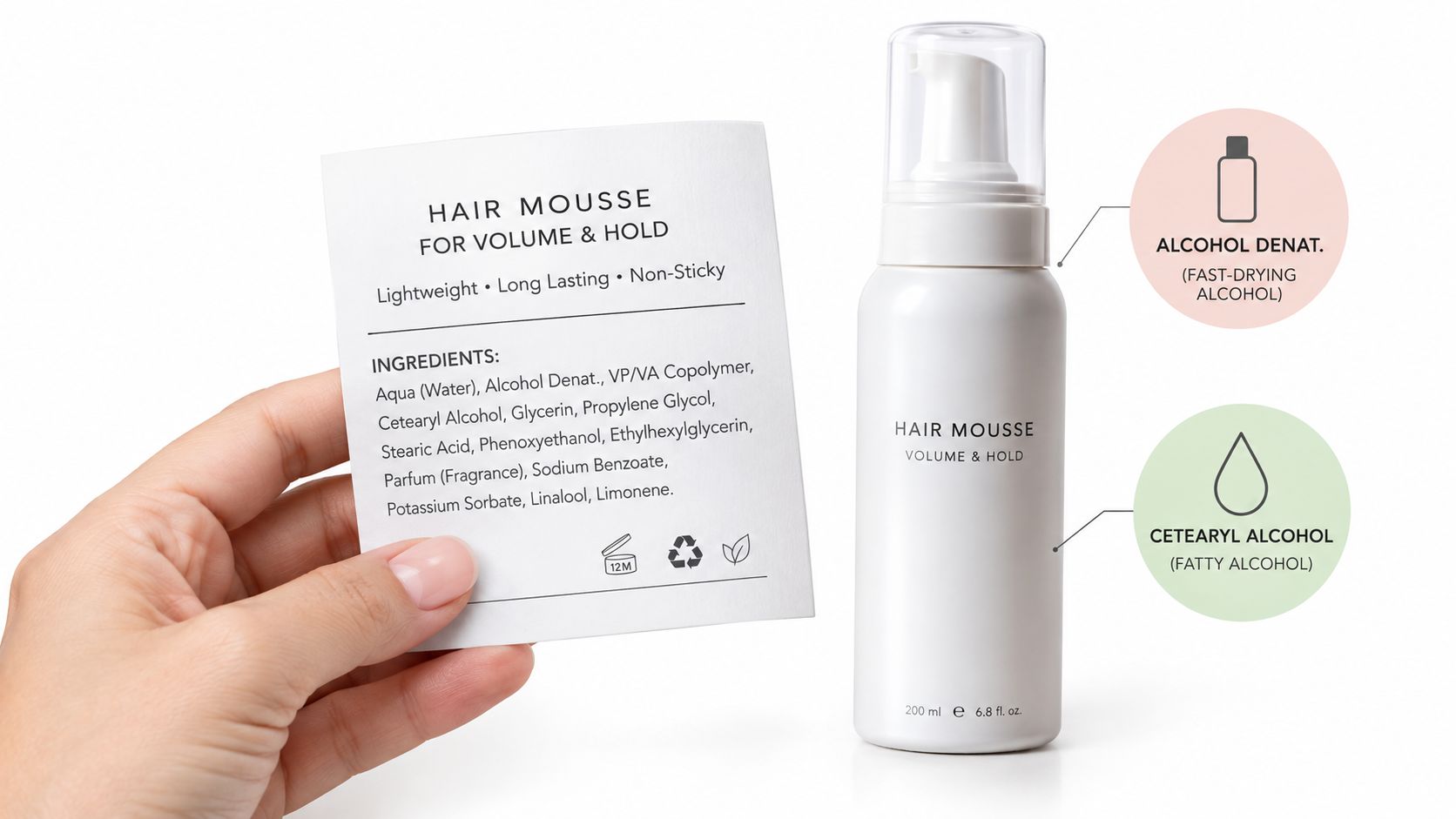
Turn the can around before putting it in your basket. Alcohol Denat. and ethanol are the names to investigate when your goal is avoiding ethanol-based styling formulas. Don't rely solely on the wording across the front.
Keep the ingredient list visible while you compare formulas.
Read past the alcohol claim
Don't treat every ingredient containing the word alcohol as interchangeable. If you see a name such as cetearyl alcohol, check what that ingredient does rather than assuming the formula contradicts its ethanol-free positioning.
For styling performance, give these names a second look:
- Polyurethane resin: A film-forming clue relevant to alcohol-free hold.
- PVP: A fixative name worth noting when comparing styling systems.
- VP/VA copolymer: Another useful identifier in a hold-focused label scan.
- Acrylates copolymer: A polymer name to consider alongside the rest of the formula.
- Polyquaterniums: A family of ingredients that deserves more attention than a front-label slogan.
The ingredient list still won't reveal everything. Seeing a familiar polymer doesn't establish its concentration or prove that the finished mousse will feel like your current favourite.
The supporting formula matters
A technical example combines water with ACUDYNE LT-120 hair-fixative polymer, adds AMP ULTRA PC 2000, and adjusts pH with citric acid. The accompanying formulation information places typical development levels around 1–4% styling polymer and 1–5% surfactant blend, and distinguishes hydrocarbon propellants such as butane, isobutane, and propane from nitrogen-supported nonflammable bag-on-valve formats in the ACUDYNE hair-fixative technical document.
Those are formulation examples, not a recipe or a shopping threshold. You can't calculate the right mousse from an ingredient list, and similar-looking lists can still produce different application experiences.
Use the video as an additional visual reference while keeping the label check separate from any performance judgment.
Before choosing, keep your final checklist short:
- Flexible hold: Does the finish suit the movement you want?
- Residue: Does the dried product leave an objectionable coating?
- Humidity behaviour: Does it maintain a useful shape in your conditions?
- Dispensing format: Is it a pump, aerosol, or bag-on-valve product?
Five Mousse Without Alcohol Dupes to Compare
A mousse dupe earns its place by matching the finish you want, not by wearing an “alcohol-free” label. At the drugstore, compare the hold ingredients, dried residue, and how much flexibility the formula leaves in humid weather. Here are five affordable US products to check against higher-end styling options. Confirm the current label and stock before you buy, since formulas and listings can change.
Affordable mousses to compare
-
John Frieda Volume Lift Air Whipped Foam
Compare this drugstore pick with premium volumizing mousses when you want lift without a heavy, stiff finish. Check the current ingredient panel for film-forming polymers, then judge whether the dried result gives your roots body without leaving the lengths coated. Don't assume the product is alcohol-free from its name or marketing. Verify the label first. -
Not Your Mother's Curl Talk Activating Mousse
For waves and curls, compare this affordable option with salon curl mousses that promise definition and flexible hold. Look for film-formers in the current formula and assess whether your hair keeps its shape while still moving. A curl-focused claim alone doesn't establish a match for a higher-priced product, so compare the finish and residue on your own hair. -
Herbal Essences Curl Boosting Mousse
This is another drugstore curl mousse to consider against premium products for defined, touchable waves. Give priority to documented humidity performance over broad promises about smoothness. Check the ingredient label for hold polymers, then see whether the finish stays flexible in the weather you face. The AMP Instant Texture Volumizer comparison can help if you're deciding whether a piecey texture product better suits the look you want. -
TRESemmé Flawless Curls Mousse
Compare it with higher-end curl formulas if your priority is shape and definition at a drugstore price. Read the current ingredient panel rather than relying on the product category. Then check whether the hold leaves curls defined without a residue or stiffness you dislike. Similar use is a reasonable reason to compare two products, not proof that they perform identically. -
Aussie Miracle Curls Mousse
Put this on your shortlist if you want an affordable curl mousse to compare with premium options for definition and hold. Focus on the dried feel and whether your hair remains manageable, especially if residue is your main concern. Verify the current formula before treating it as an alcohol-free choice or a close substitute for a specific luxury mousse.
These are practical comparison targets, not guaranteed one-to-one replacements. Rank them by the match you can assess: film-forming hold, a finish that doesn't leave objectionable residue, and flexibility in your usual humidity. For fine hair, prioritize lift without coated lengths. For waves and curls, prioritize definition that still feels movable.
Check the actual item before checkout
Product details and stock change. Google's product-search documentation identifies price and availability as details used in product presentations, so an old listing doesn't confirm what's currently on the shelf.
Check the exact product, size, seller, current ingredient panel, and availability together. If the label doesn't support the alcohol-free claim you're looking for, skip it, regardless of how close the product sounds to your favourite.
Styling Tips and How Finding Favourites Chooses
Start with damp hair and a conservative amount, following the product's directions. A golf-ball-shaped dollop can be an application reference for some foams, but don't treat that shape as a universal dose across dispensing systems.
Spread the foam between your palms before distributing it. I'd rather apply a light, even layer and reassess than start with saturated lengths.
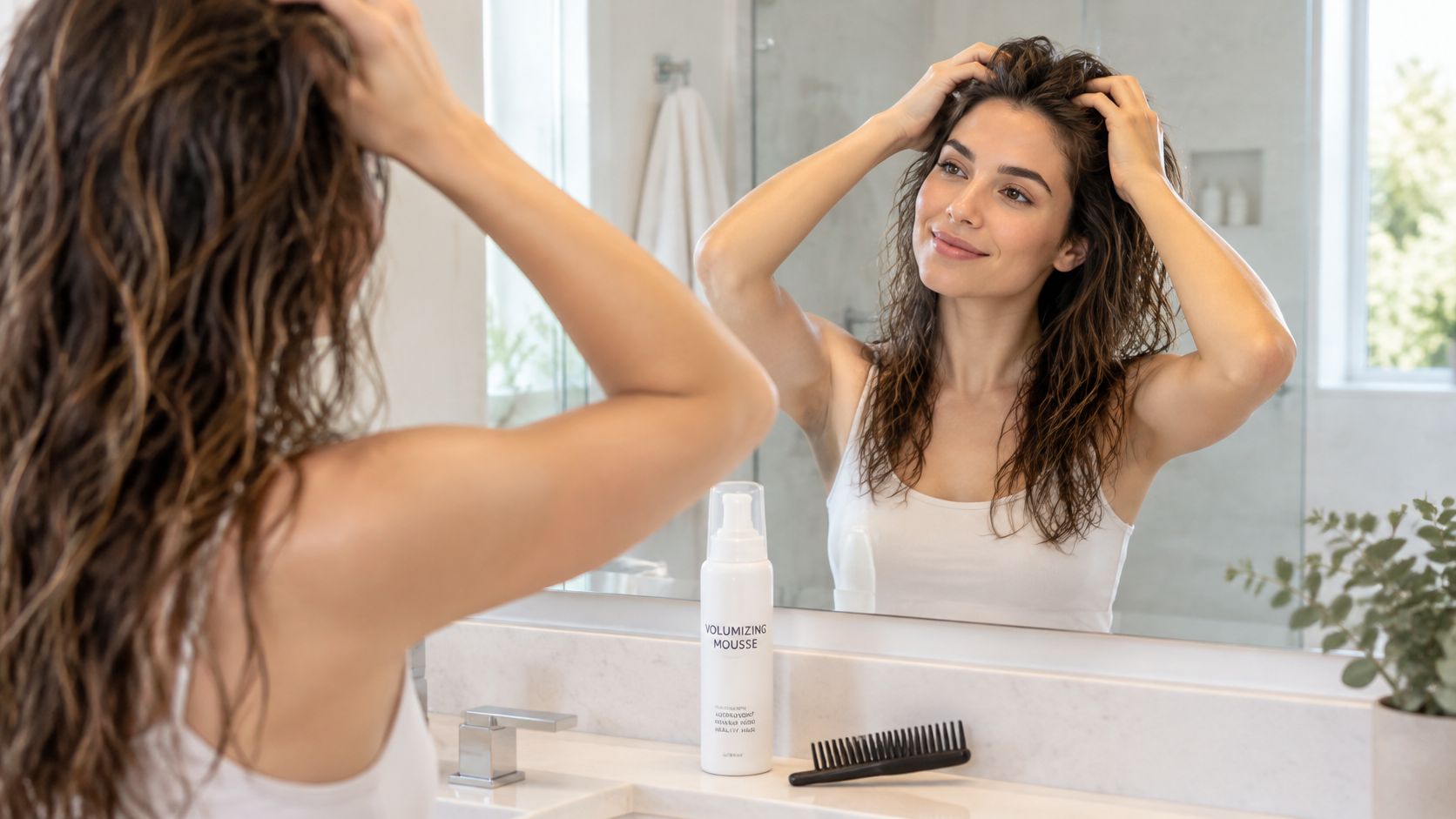
Aim for controlled placement rather than a blanket coating.
Adjust the placement to the problem
For fine hair that collapses, concentrate your trial around the area where you want lift. Use your fingers to position the roots, and avoid automatically dragging the full amount through the ends.
For waves, distribute the product through a small section and encourage the shape with your hands. If the dried finish feels firmer than you prefer, gently scrunch and assess the result before deciding to add another styling product.
For dry or colour-treated hair, make touchability part of the test. Don't keep layering a formula that gives an attractive shape but an unpleasant finish.
- Need more crown support: Try a targeted additional layer rather than recoating all the lengths.
- Want a smoother section: Use a brush where you want that finish instead of brushing every area identically.
- Changing dispensers: Reassess the amount rather than copying your old routine.
- Adding serum: Keep its job separate, using this guide to applying hair serum to think through placement.
Compare texture, finish, and wear
A fair budget comparison starts with similar conditions. Keep your wash routine and drying method as consistent as practical, and avoid changing several styling products at once.
Home-test principle: If you change the mousse, conditioner, serum, and drying technique together, you won't know which change produced the result.
Record what you can observe: ease of distribution, dried feel, visible residue, shape after ordinary activity, and the effort required to restyle. Don't call a product a dupe because it looks similar immediately after drying.
The best-value option is the one you'll use successfully without compensating for it with extra products. Cheap packaging is irrelevant; an expensive-looking bottle is equally irrelevant.
Extra Questions Before You Buy
Can alcohol-free mousse still feel drying?
Yes, an alcohol-free claim doesn't guarantee that you'll like the finished feel. A stiff coating can feel unpleasant, and a product that meets your alcohol preference can still be unsuitable for your skin.
Across repeated wears, watch for rough-feeling lengths, persistent tightness, itching, or a finish you keep trying to soften with additional products. Those observations are reasons to reassess, not proof that a particular ingredient caused the problem.
Is a pump automatically gentler than an aerosol?
No. Treat the package as an application feature, not a gentleness certificate.
The earlier formulation examples show why foam structure and styling ingredients matter independently of the dispenser. Choose the format you can control comfortably, then judge the actual formula and its directions.
How should I try mousse near a sensitive hairline?
Follow the manufacturer's testing instructions and keep your initial styling application away from irritated skin. Dispensing into your palms first can help you control placement rather than directing foam toward the face.
Don't deliberately test a product on an active rash or continue using it through discomfort. Persistent or recurring irritation deserves advice from a qualified clinician rather than another round of product experiments.
When should I recheck a dupe before reordering?
Check at every reorder. Confirm that you're buying the same product and size, inspect the current ingredient information, and make sure the listing represents available stock rather than an archived item.
Don't assume a familiar product photograph establishes an unchanged formula. If the retailer's details and the manufacturer's information conflict, ask for clarification before paying.
The Best Dupe and Your Next Step
There isn't a defensible named winner without verified current products. Declaring a mousse the best balance of flexible hold, low residue, affordability, and US availability would imply checks that haven't been completed.
My clearest recommendation is to begin with the flexible-hold shopping target, especially if your priority is movement rather than a rigid finish. That's a direction for comparison, not a claim that an unnamed formula has passed a product test.
Buy for an observable result
Take a photograph of your current product's ingredient panel and note the result you want to improve. At the shelf, compare the full formula, the intended hold, and the dispensing format before considering the alcohol-free wording.
Choose a candidate whose current listing supports your requirements. Then try a small, palm-distributed amount on a section of damp hair and assess the dried result before applying more everywhere.
- Keep it: The shape works, the finish feels comfortable, and you don't need extra products to compensate.
- Adjust it: Placement or amount seems responsible for an uneven result.
- Move on: The finish remains unpleasant or your skin reacts.
A useful mousse without alcohol should earn its place through performance, not reassurance on the can. Keep the purchase modest, the first application controlled, and the comparison honest.
Finding Favourites offers budget beauty comparisons focused on texture, finish, and wear, the same qualities worth checking before buying an alcohol-free mousse. Visit Finding Favourites for more affordable swaps, or join the newsletter for new dupe roundups and discount codes.