
Shade Matching Foundation Without the Guesswork
You're standing in the store, and the foundation looks like a perfect match against your hand. At home, it turns pale, pink, or orange the moment you step near a window. That doesn't mean you're bad at choosing makeup. Shade matching is tricky because your eyes are judging small colour differences under changing light, and the bottle's shade name can't tell you how the formula will look once it dries on your skin.
This post may contain affiliate links, which means I may receive a commission if you purchase through my links, at no extra cost to you. Please read the disclosure policy for more information.
Three Variables That Decide Your Match
A bottle's shade code can suggest depth, but it can't promise a perfect match. The three things to assess are depth, undertone, and finish. A foundation may be the right lightness yet still look grey or pink because its base colour doesn't agree with your skin, or appear uneven because the finish catches on dry patches.
Your eyes can be less reliable than you expect. In a published evaluation using samples from the PANTONE Skin Tone Guide, human observers were three times less accurate than an instrument at matching skin colours. They also tended to choose shades that were lighter and less reddish than the actual skin tone, which can contribute to a pale, grey, or overly pink result after application, according to the published cosmetic colour-matching evaluation.
Use this table as a starting point, not a substitute for testing a dried swatch on your own face.
| Variable | How to Read It | Wrong Pick Looks Like |
|---|---|---|
| Depth | Compare the swatch against the jaw in daylight, not the wrist | Face looks lighter or darker than the neck and chest |
| Undertone | Check the base colour after blending into the jaw | Grey, ashy, pink, or orange cast once the foundation sets |
| Finish | Judge matte, satin, or dewy, and how it settles into dry patches | Patchy, cakey, or greasy within an hour of wear |
Depth is how light or deep the shade appears. Undertone is the colour cast beneath that depth, while finish describes how the formula reflects light and wears on the skin. A close shade number doesn't guarantee that all three line up. Shade-matching systems have moved beyond a simple light-to-dark scale, but the useful test remains practical: choose the shade that looks like skin at the face-to-neck boundary, not the one whose label sounds right.
Matching rule: A real match passes on depth, undertone, and finish, not just the shade name.
Swatching on the Jaw in Your Light
The same swatch can look convincing in daylight and wrong under warm indoor bulbs. Put the colour where your face meets your neck, and judge it in more than one light. The history of foundation shade matching reflects how formulas have developed to account for depth and undertone, but no shade range can replace a careful test on your skin.
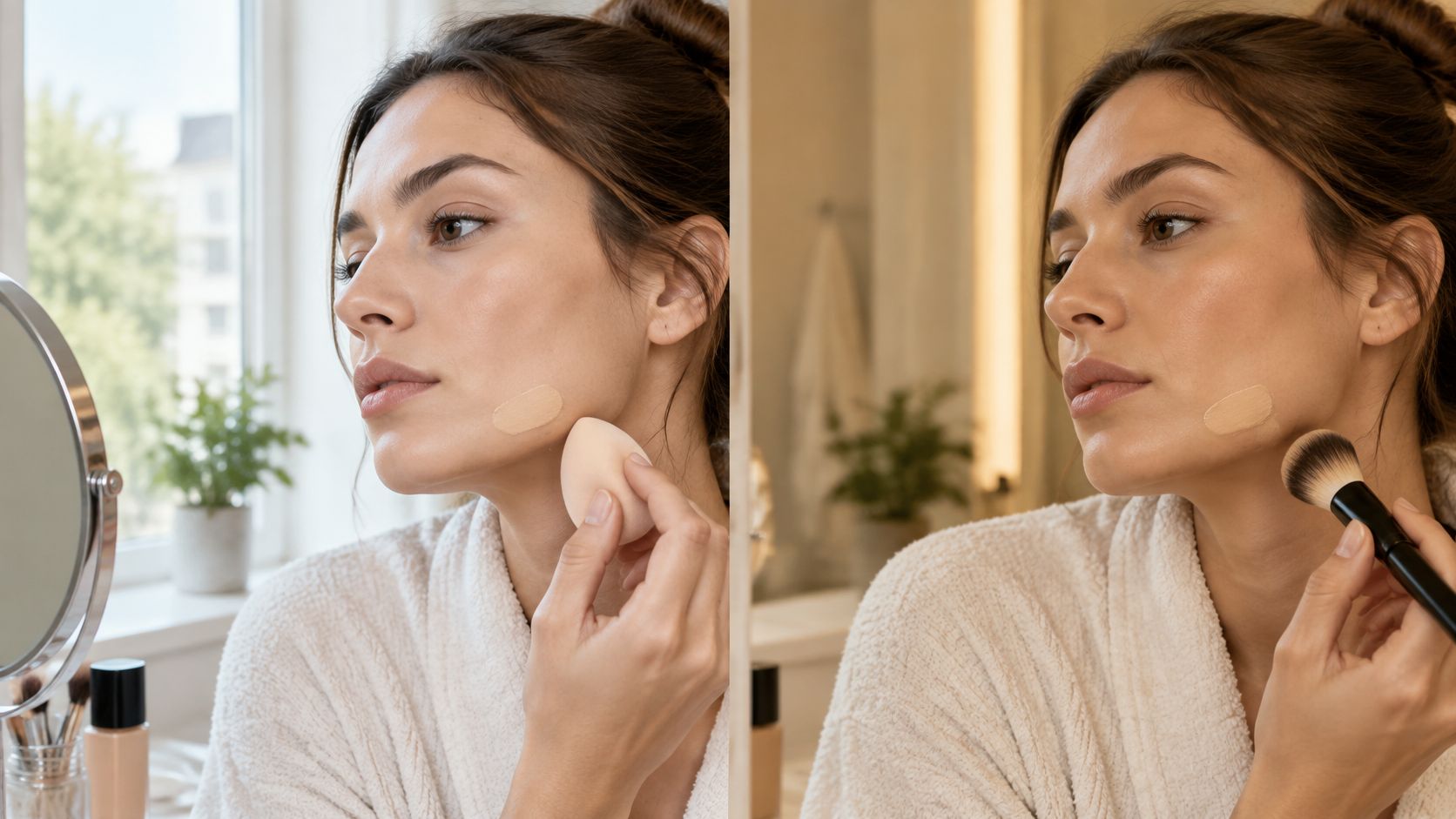
Use this six-step routine to compare candidates without turning your face into a row of full-coverage stripes:
- Choose two or three candidates. Pick your best estimate, one slightly lighter shade, and one slightly deeper shade. Comparing a small group makes the differences easier to see.
- Start with a clean jaw and cheek. Gently remove skincare or makeup residue so it doesn't interfere with the way the foundation sits or reads.
- Paint narrow vertical stripes. Apply each shade from the cheek down across the jawline and onto the neck. The right location shows whether the shade connects the two areas naturally.
- Let every stripe dry completely. Wet foundation can look different from the finished formula because drying may change its colour and opacity. A professional account of foundation matching on Black skin tones describes comparing candidates across facial areas and assessing dry colour, rather than relying on a wet swatch or a hand.
- Check in indirect daylight. Stand near a window without direct sun and look for the stripe that visually disappears into both jaw and neck. Don't judge the centre of the stripe alone; inspect its edges.
- Check another light and a photo. Look under your usual indoor lighting, then take a flash selfie to see whether a jawline edge or shadow appears. Warm bathroom bulbs can exaggerate yellow or orange, cool office lights may make a base look flat or ashy, and a phone can alter the image through automatic white balance.
Your wrist and hand aren't reliable stand-ins for your face. Skin can differ across body areas in both depth and undertone, so a wrist shade that seems right may miss at the jaw. Research-based matching methods standardize the facial area and allow the formula to dry before judging it, an approach worth borrowing for your own swatches.
Give the foundation 10 to 15 minutes after application, then reassess whether the colour has darkened or turned more orange. If it passes in daylight after it settles, keep it on your shortlist. If it only looks right in one light, compare it with the neighbouring shade instead of trying to talk yourself into a match.
The video below offers another view of how to apply and compare foundation shades.
| Lighting or Condition | What It Reveals | What to Check |
|---|---|---|
| Indirect daylight near a window | True base colour | Whether the stripe disappears into the jaw and neck |
| Warm bathroom light | Yellow or orange cast exaggerated | Whether the match looks too warm or too golden |
| Office LED lighting | Cool, grey, or green cast | Whether the formula goes ashy or flat |
| Flash selfie | Camera correction and shadows | Whether a visible line shows at the jawline |
| 10 to 15 minutes after application | Oxidation shift, often darker or more orange | Whether the colour has moved from the swatch |
When Undertone Labels Fail Olive and Redness-Prone Skin
“Warm,” “cool,” and “neutral” can sound like reliable categories, but brands don't use them consistently. They can also act like colour correctors: someone with facial redness, acne marks, or hyperpigmentation may find a neutral or warm foundation looks more natural, even if the surface of the skin appears red. Guidance from Wirecutter's foundation shade guide also points to the limits of simplifying undertone advice for olive and redness-prone skin.
Don't select a shade solely because it matches the reddest part of your face. Compare cheek, jaw, neck, and chest, then use the colour cast after the foundation sets to help diagnose what needs to change.
| Colour Cast | Likely Cause | Adjustment to Try |
|---|---|---|
| Pink or red | Formula reads too cool for the skin | Neutral or warm version at the same depth |
| Orange or yellow | Formula reads too warm | Neutral or cooler version at the same depth |
| Grey or ashy | Shade is too light or too cool | One shade deeper or warmer |
| Green | Pink-based formula on olive skin | Yellow- or olive-leaning neutral |
The location of the mismatch helps too. If a stripe makes a visible line where it meets the neck, its depth is off, so compare one shade lighter or deeper. If it blends on your cheek but looks wrong at the jaw, the undertone may be the issue rather than the depth.
Olive skin can be especially difficult to assess because a formula may appear different under different lights. If two affordable neighbouring shades each look close but neither fully disappears, mixing a small amount of each can give you a more natural result. For another way to think about your skin's underlying colour, read this guide to how to identify your undertone.
Shortlisting Online With Apps and Quizzes
You answer six questions, upload a selfie, and a shade name appears in seconds. That speed is useful, and it is also the trap. A quiz or scan can shrink a wall of options down to two or three candidates, yet it cannot show you how any of them will sit on your jaw once the formula dries. Use every digital match as a shortlist generator, and check the table to see where each method helps and where it misleads.
| Method | Best For | Main Risk |
|---|---|---|
| AI shade quiz | Shortlisting shades to test | Assumes controlled conditions and gives false certainty |
| Phone camera scan | Estimating a starting depth | Auto white balance and filters shift the reading |
| Brand shade finder | Matching within one brand's range | Compares only that brand's shades, not your skin in your light |
| In-store matching | Trying several formulas at once | Store lighting can flatter; recheck in daylight after |
| Sample or small size | Testing the full formula on your skin | Delivery takes days and sample sizes can run out |
Caution has evidence behind it. A 2025 Indonesian study of automated skin-tone classification used 963 facial images and reported 75.65% test accuracy under controlled lighting, compared with 60% for a colour-histogram baseline. Even a promising model trained in stable conditions leaves real uncertainty once you change the face, the formula, or the room.
To give a tool its best chance, use a photo without filters, keep the exposure consistent, and step away from strongly coloured or shadowy lighting. If the tool accepts a foundation that already matches you, enter it, because a known anchor is more reliable than a guess about your undertone. Then hold the suggested shade against your neck or chest rather than your wrist, and test the physical formula along your jawline once it arrives.
A quiz works like a filter on a search page: it narrows the shelf, and the bottle still has to prove itself on your skin. Because these tools deal in approximations, every online result stays provisional until a daylight swatch confirms it. Tools shortlist; a swatch decides. If a full-size purchase feels risky, order a sample or small size first and read the return conditions before you pay.
Budget Dupes That Pass the Three-Variable Test
Two bottles can sit side by side, one budget and one high-end, and look nearly identical in the tube. On skin they often tell a different story. A dupe earns its place only when depth, undertone, and finish all hold up on your jaw in daylight, the same three-variable check you would run on any foundation. Finish matters more than people expect: it works like the varnish on a painting, changing how light bounces, so the same colour reads flatter in matte and brighter in satin.
| Budget Formula | Strongest Variable | Watch For |
|---|---|---|
| L'Oréal Paris True Match Super-Blendable Foundation | Undertone | A matching shade name can still shift colour after dry-down |
| Maybelline Fit Me Matte + Poreless Foundation | Finish | Matte texture can catch on dry areas |
| e.l.f. Flawless Satin Foundation | Finish | A satin look won't compensate for a depth mismatch |
1. L'Oréal Paris True Match Super-Blendable Foundation. A practical first pick when undertone is your sticking point at a lower price. Swatch it beside the base you're replacing on the jaw, let both dry fully, then compare them. If the dupe reads pinker or more golden once set, the undertone fails no matter how close it looked wet.
2. Maybelline Fit Me Matte + Poreless Foundation. Worth testing when a matte result is the priority. Watch how it sits around dry patches, since a flatter finish exaggerates texture a dewier original may have softened. Warm indoor light also skews this kind of formula golden, so make the deciding check by a window.
3. e.l.f. Flawless Satin Foundation. The option for a satin, skin-like look. Check it across the jaw and into the neck after it dries. A pleasing finish can briefly disguise a depth that's a half-step off, and daylight exposes that faster than bathroom lighting ever will.
For more budget-friendly candidates, browse budget foundation recommendations. Judge each one on the same three variables, confirmed on the jaw after the formula sets.
Your Next Step Before Buying Full Size
A bottle swatch can only narrow the field. Buy full size when one shade disappears at the jaw-to-neck line in daylight and still looks clean after it sets; if the colour turns more orange or peach by the four-hour mark, read it as oxidation or too much warmth, and if it looks grey or pink against the neck, the depth or undertone is off.
- Shortlist two neighbouring shades. Compare one slightly lighter and one slightly deeper candidate rather than testing a crowd of similar options.
- Swatch both in indirect daylight. Check where each stripe crosses from jaw to neck, then look again after about 10 to 15 minutes.
- Try a sample or the smallest size available. That lets you test the actual formula without committing to a full bottle first.
- Wear it for a full day. Recheck around the four-hour mark, when you can see how the shade has settled and whether oxidation has changed its appearance.
- Read the return policy before buying full size. Keep the packaging and receipt details so you can follow the seller's return conditions if the colour misses.
If one shade passes only under one light, test its neighbour instead of settling for a number on the bottle. If you sometimes swap foundation for a zinc-based tinted cream, judge that product on its own and keep it separate from your foundation decision; you can browse zinc-based tinted cream separately. For foundation itself, the pass signal is simple: no visible edge after a full day.
Shade Matching Questions Answered
Does my shade change with tanning or the seasons, and when should I re-match? Yes, your skin can shift in depth as it tans or fades. Recheck when your face and neck look noticeably different from the shade you currently wear, rather than relying on a past match.
What if I fall between two shades? Can I mix them? Test both on your jaw, and mix neighbouring shades if neither disappears on its own. A small blend can match your depth and undertone more closely than forcing one shade to work.
Do acne marks or hyperpigmentation change which shade I should buy? They can change what you see on the surface, so don't choose a foundation solely to match the reddest or darkest patch. Compare your jaw, neck, and chest, and consider a neutral or warm option if a pinker formula makes surface redness look stronger. For concealer placement and shade choices, see this guide to shade matching concealer.
How many shades will I have to compare? A 2025 market report says liquid foundations typically offer an average of 45 to 55 shades, compared with 25 to 35 for cream foundations and 15 to 22 for powder foundations, according to the inclusive-shade foundation market report. Powder shoppers may have fewer options to bracket, so test the closest candidates carefully rather than relying on a shade label.
The best dupe in this comparison is L'Oréal Paris True Match Super-Blendable Foundation, as a starting point for comparing undertones at a more accessible price. But your best match is the one that gets the depth, undertone, and finish right together. Swatch it on the jaw in daylight, let it set, and choose the formula that disappears into both face and neck.
Finding Favourites brings together affordable beauty alternatives and practical comparisons to help you shop with more confidence. Explore Finding Favourites for budget-friendly makeup dupes and guides that make it easier to compare shade, finish, and wear before you buy.