
Hyaluronic Acid vs Glycerin: Which Hydrates Better?
Which ingredient would you bet on in a fight: the one that holds many times its weight in water, or the one that costs a few cents a bottle and rarely gets its own ad campaign? Most shoppers pick the first without hesitating, then wonder why their face still feels tight an hour after a "hydrating" serum. The gap in that thinking is that labels sell ingredients while formulas decide results, and the cheaper humectant wins more often than the premium one would like you to believe. The measured comparisons reveal how hyaluronic acid vs glycerin stack up, where each one earns its place, and how to spend as little as possible getting both jobs done.
This post may contain affiliate links, which means I may receive a commission if you purchase through my links, at no extra cost to you. Please read the disclosure policy for more information.
What Hyaluronic Acid and Glycerin Actually Do
Both are humectants, meaning they attract water and hold it in the upper layers of your skin. The difference is that glycerin is a small, water-soluble polyol that binds water dependably and shows up in drugstore moisturizers because it's cheap and it works, while hyaluronic acid is a naturally occurring polysaccharide whose performance swings with its molecular size, its percentage, and whatever the formulator built around it.
That distinction is the whole shopping decision. A basic glycerin cream and a serum with a luxury price tag can both put "hydration" on the front of the box, and the cheaper bottle isn't automatically the weaker product. The same word hides very different formulas.
The assumption worth dismantling is the one most of us absorbed from marketing: that HA is the premium hydrator and glycerin is the filler that makes a cream feel nice. Neither half holds up. Glycerin has decades of clinical use behind it and a mechanism that reaches deeper into the epidermis than most forms of HA can, and HA ranges from useful to nearly inert depending on how it's made.
If your skin feels tight and rough rather than dry, that's dehydration rather than dryness, and a routine built around products for dehydrated skin addresses the humectant step before you spend a cent on a serum. Put the two ingredients side by side on the measures that matter and the picture changes depending on what you're paying for.
Hyaluronic Acid vs Glycerin at a Glance and in the Data
| Criterion | Glycerin | Hyaluronic acid |
|---|---|---|
| Molecular structure | Small, water-soluble polyol | Naturally occurring polysaccharide |
| Molecular size | Single small molecule | About 5 to 1,770 kDa in topical studies |
| Hydration in head-to-head test | Greater and longer-lasting than HA alone at 30 minutes and 6 hours | Lower than glycerin alone at 30 minutes and 6 hours |
| Short-term water retention | Occlusive-like for about 2 hours at a 25% solution, then saturates | Depends on molecular weight and concentration |
| Typical cost | Low, common drugstore ingredient | Varies widely, serums often cost more |
| Needs a sealing layer | Yes, pairs best with silicone or other occlusives | Yes, same as glycerin |
What Molecular Weight and Percentage Change
Calling a product "hyaluronic acid" tells you almost nothing, because HA isn't one ingredient but a size range. A 2025 review of HA and glycerin in topical formulas reports studies using HA from roughly 5 to 1,770 kilodaltons, and in one of the comparisons it cites, lower-molecular-weight forms generally produced greater measured hydration increases than heavier ones. Same ingredient name. Different behavior.
Concentration matters just as much. That review found high-molecular-weight HA at 0.1% to 0.5% produced significant moisturization in vivo, with measurable changes from as early as 1 hour and continuing over 28 to 60 days. Glycerin rarely gets this treatment because it doesn't need it. It's assessed as a straightforward humectant rather than broken into molecular-weight fractions, and that boring consistency is exactly the appeal.
Buying rule: if an HA serum names neither a molecular weight nor a percentage, you're paying for the word on the front, not for a measured dose.
The Head-to-Head Record
The cleanest test I've found compared creams built on glycerin, HA, silicone oil, or combinations of them. Glycerin alone produced greater hydration and longer-lasting moisture than HA alone at both 30 minutes and 6 hours, according to the controlled human-skin cream comparison. Glycerin plus silicone oil ranked highest for hydration and delivered the greatest, longest-lasting drop in transepidermal water loss, with HA plus silicone second. HA on its own came last on water loss.
Combination formulas do work, which is why the ingredient-name argument misses the point. A fluid containing 1% HA and 5% glycerin showed 21% greater hydration than an untreated site after 24 hours, with TEWL of 13±4 versus 16±6 arbitrary units in controls (p=0.049), and after tape-stripping it cut TEWL by 52% at 1 hour, 32% at 8 hours and 48% at 24 hours, per the randomized, assessor-blinded trial summary. That product also contained Centella asiatica extract and caprylic glycerides, so you can't hand the credit to either humectant alone. It was a formula that worked, not an ingredient.
My verdict, after all of that: glycerin is the dependable humectant for the money, and HA is worth paying extra for only when the label states its molecular weight and its percentage. A glycerin cream with a decent occlusive behind it will beat a vague HA serum nine times out of ten.
How to Layer HA and Glycerin Without Wasting Either
Glycerin has a time limit, and it matters more than most comparisons admit. A 25% glycerin-in-water treatment behaved like mineral oil for the first two hours, cutting water loss as an occlusive would. Then it saturated. By four hours the glycerin-tissue combination had absorbed all the water it could hold, and at six hours the TEWL rate was nearly twice that of untreated skin, per the moisturizer evaluation in the Journal of the Society of Cosmetic Chemists. Glycerin buys you time. It doesn't buy you a barrier.
Here's the order that closes that gap, and why each step exists.
- Cleanse and stop before your skin is fully dry. Pat once and move on while it's still slightly damp. Both humectants need water to grab, and the water on your skin is a more reliable source than the air in a heated bedroom.
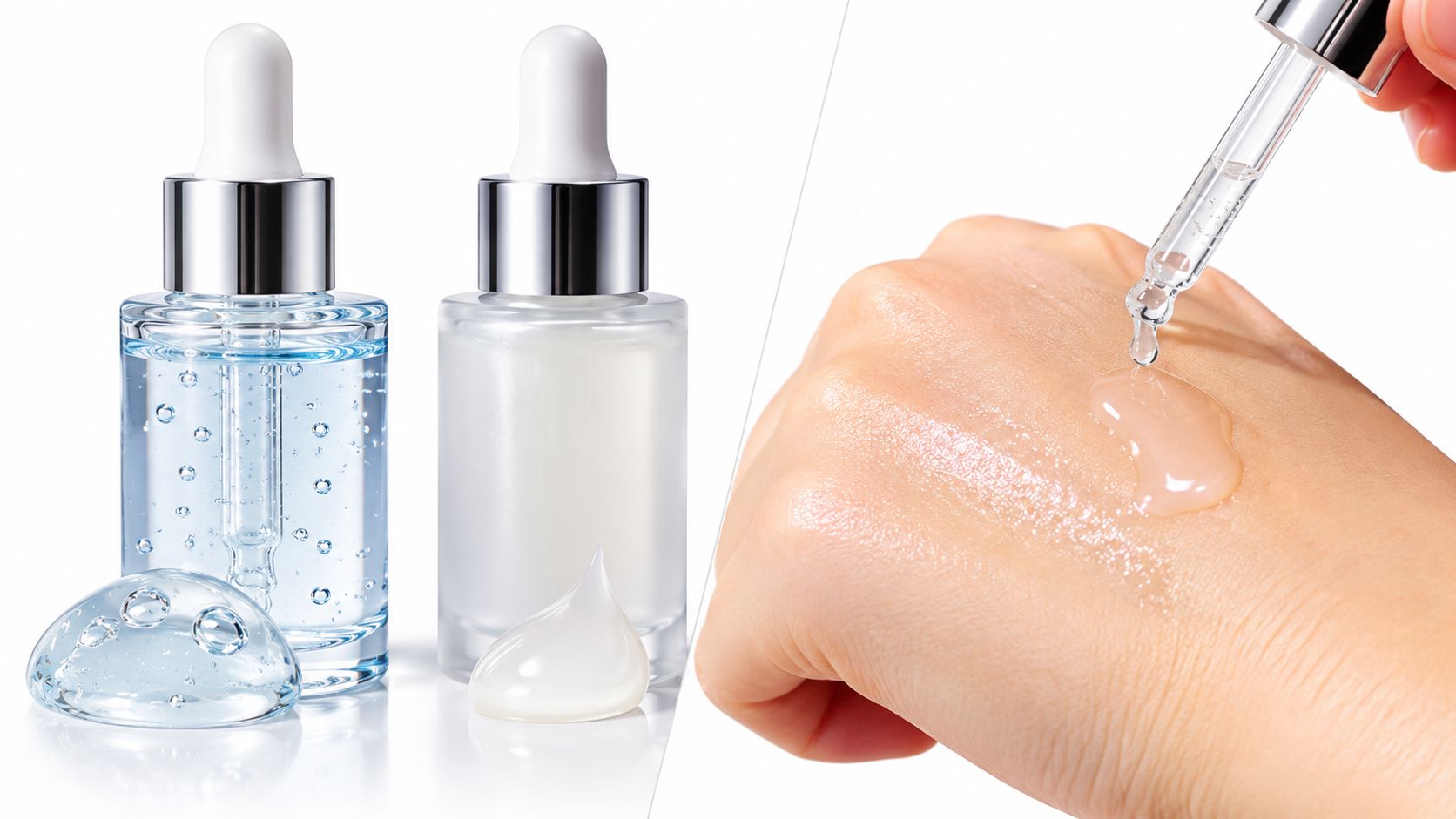
- Apply the HA serum first, patted rather than rubbed. It's the thinnest, most water-based layer, so it goes on before anything creamier can block it. Two or three drops is plenty. If you want the detail on drop count and hand pressure, this walkthrough on how to use hyaluronic acid covers the finer points.
- Follow immediately with a glycerin moisturizer. This is the layer that does the water-binding work while the HA film holds surface moisture. Don't wait for the serum to "absorb" completely; damp-on-damp is the point.
- Seal it with something that forms a film. Dimethicone, petrolatum, or a cream with ceramides. This is the step people skip, and it's the step that stops the six-hour rebound. On dry days and every night, treat it as required.
- Finish with sunscreen in the morning. Not because it hydrates, but because a compromised barrier plus UV is a slower recovery, and the whole routine exists to keep that barrier intact.
The common slip is applying a humectant to bone-dry skin in dry air. It feels like nothing happens, so people add more product instead of adding a sealant.
Damp skin isn't a nice-to-have tip. It's the mechanism working as designed.
You'll know it's working when skin feels supple within 30 minutes of applying and still comfortable by morning, without a second layer of cream at midnight.
Which Ingredient Fits Your Skin and Climate
Start with the condition, not the price tag. In a 2026 comparative analysis, a glycerol-only treatment raised corneometer-measured hydration by 31% ± 11% versus control (p < 0.001), while a formulation built on a cohesive polydensified matrix of HA and glycerol raised hydration by 10% ± 11% (p < 0.05), as reported in the Journal of Cosmetic Dermatology analysis. The tested materials and delivery systems differ, and the HA product was an advanced matrix rather than a simple serum, so read those numbers as a signal about cost per result rather than a knockout.
| Skin type or condition | Better starting point | Why |
|---|---|---|
| Dry or tight skin | Glycerin-rich moisturizer | Reliable water binding at lower cost per use |
| Oily or acne-prone skin | Lightweight HA serum under a gel moisturizer | Lighter finish that feels less heavy |
| Sensitive or damaged barrier | Glycerin cream with emollients | Barrier support matters more than a serum |
| Mature skin | Glycerin cream plus an HA serum | Layers hydration with film-forming support |
| Dry climate or low indoor humidity | Glycerin plus a sealing moisturizer | Humectants need an occlusive to hold water |
| Tight budget | Glycerin-based moisturizer | Most humectant performance for the price |
Where the Barrier, Not the Humidity, Is the Problem
Glycerin earns its place in clinical settings too. In a randomized, double-blind, crossover trial of a glycerin and coconut oil cream used over two weeks by workers with occupational hand dermatitis, the treatment was associated with a 20% decrease in Hand Eczema Severity Index scores and TEWL and a 20% increase in skin capacitance by day 14, according to the Scientific Reports trial. The authors linked part of that effect to aquaporin-3, a water-channel protein in the basal epidermis. That's a real reason to keep glycerin in the routine rather than treating it as the budget compromise.
If your skin reacts to everything, pair a glycerin cream with a barrier ingredient instead of stacking two humectant serums. Our roundup of beta-glucan skin care products covers options that soothe without adding another active.
Before you buy anything, ask one question of the formula: does it stop tightness without stickiness, pilling, or reapplication by mid-afternoon? Everything else is marketing. My decision rule is simple. Start with a glycerin-containing moisturizer, then add an HA serum only if your skin still feels thirsty by 3pm.
Five Budget Dupes That Match Premium Glycerin and HA Products
| Product | Dupe for | Best for |
|---|---|---|
| The Ordinary Hyaluronic Acid 2% + B5 | Premium HA serum | Layering under moisturizer |
| CeraVe Hydrating Hyaluronic Acid Serum | Premium HA serum | Dry skin wanting an HA serum |
| Neutrogena Hydro Boost Water Gel | Premium gel-texture HA product | Oily or normal skin wanting a light texture |
| CeraVe Moisturizing Cream | Premium glycerin cream | Dry skin needing a daily base |
| Vanicream Moisturizing Cream | Premium glycerin cream | Sensitive skin |
- The Ordinary Hyaluronic Acid 2% + B5. The stand-in for a premium HA serum, and the rare budget option that puts its percentage on the label. It's thin enough to sit under any moisturizer, which makes it the cheap way to find out whether HA does anything for your skin at all.
- CeraVe Hydrating Hyaluronic Acid Serum. Also a dupe for a premium HA serum, aimed at dry skin that wants a dedicated HA layer. Give it a cream on top and it behaves like a much more expensive pairing.
- Neutrogena Hydro Boost Water Gel. Matches a premium gel-texture HA product. If you're oily or normal and humid weather makes creams feel like a mask, this is the light-finish route to the same humectant work.
- CeraVe Moisturizing Cream. The dupe for a premium glycerin cream, and the one I'd buy first. Glycerin with ceramides gives dry skin a daily base that doubles as the sealing step, so one jar covers two jobs in the routine.
- Vanicream Moisturizing Cream. The other premium glycerin cream substitute, built on a glycerin base with a deliberately short ingredient list. Sensitive skin that reacts to fragrances and botanical extracts is the reason this one exists.
Prices move around by retailer, so check the current shelf price rather than trusting a number you saw last month. We also keep lists of dupes under $10, dupes under $25 and dupes under $50 if you want to filter by budget before you start comparing formulas. If you'd rather begin with a serum, our guide to the best affordable hyaluronic acid serum narrows the field by formula and price.
Comparing on paper: position on the ingredient list tells you relative amount. A stated percentage tells you dose. Only one of those is a number you can actually use.
To judge any dupe against its premium match, check two things. Where glycerin or HA sits high in the ingredient list, and whether the label states a percentage. A premium cream whose glycerin appears after the fragrance has less humectant in it than a $15 jar whose glycerin appears third.
Frequently Asked Questions About HA and Glycerin
Can you use HA and glycerin together?
Yes, and there's no reason not to. They handle different parts of the same job, so layering an HA serum under a glycerin moisturizer covers more ground than doubling up on either one.
Does glycerin make skin sticky?
At high percentages in humid weather, it can feel tacky for the first few minutes. A lighter gel texture, or a moisturizer where glycerin sits mid-list rather than first, solves it without giving up the humectant.
Which HA concentration should you look for?
Look for a label that names both the molecular weight and the percentage. A serum that lists neither is asking you to buy on faith, and HA performance shifts so much with size that the name alone means little.
Is glycerin safe for sensitive skin?
It's generally well tolerated and shows up as the base of many sensitive-skin moisturizers for that reason. Patch test anything new anyway, especially if your barrier is currently compromised.
Wrap Up and Your Best Budget Pick
For most budget shoppers, CeraVe Moisturizing Cream is the best value on this list. Glycerin paired with ceramides gives you a dependable hydration base plus the sealing step in one jar, and an affordable HA serum is worth adding only when your skin still feels thirsty by afternoon or the label specifies the HA weight and percentage.
The four things worth remembering:
- Glycerin is the dependable one. It's inexpensive, clinically well studied, and beats HA alone in direct hydration comparisons.
- HA performance depends on size and formula. Molecular weight and percentage decide whether you're buying a humectant or a nice texture.
- Both need a sealing partner. Neither is an occlusive, and glycerin's effect in particular fades within hours without one.
- Skin type and climate pick the winner. Oily skin in humidity and dry skin in winter are not the same shopping trip.
Your next step costs nothing. Pull out the moisturizer you're using now, find where glycerin sits on the ingredient list, and decide whether you need a serum or just a better sealant. If your skin is still tight by mid-afternoon with glycerin near the top, that's your cue to add the HA layer.
Finding Favourites exists for exactly this kind of decision, where a $12 jar and a $70 serum are competing for the same shelf space and the ingredient list is the only honest referee. We publish dupe roundups for skincare, makeup and fragrance, organised by category and by budget tiers, so you can compare formulas before you compare price tags and stop paying for the word on the front of the bottle. Head over to Finding Favourites to browse the skincare dupes and find your next affordable swap.