
Best Concealer for Olive Skin: 5 Drugstore Picks That Work
Why does a concealer that looked perfect in the store mirror turn grey under your eyes by lunch? Olive skin is usually the reason, and switching brands rarely fixes it. Almost every shade chart sorts concealers by depth alone, light, medium, tan, deep, and treats olive as a footnote.
Depth tells you how light or dark a shade is. It says nothing about the muted green or grey cast sitting underneath, and that cast decides whether a concealer disappears into your skin or flakes off it like paint.
This post may contain affiliate links, which means I may receive a commission if you purchase through my links, at no extra cost to you. Please read the disclosure policy for more information.
Match Your Olive Undertone to the Right Shade Family
A concealer looks ashy, purple or sallow on olive skin when it misses the green-grey base underneath. The fix isn't a heavier formula or a darker shade. It's matching depth and undertone as two separate decisions, then choosing the shade family that keeps both intact.
Vogue's guide to determining skin undertone puts it well: olive is best treated as a surface-color characteristic rather than a single undertone category. It commonly shows up as a muted green, gray-green or yellow-green cast, it can appear at any depth from fair to deep, and it can sit over warm, cool or neutral bases. That's why two people who both call themselves olive can need completely different concealers.
Picture the two halves separately. Depth gets you into the right neighborhood. Undertone gets you the right house. A shade that is technically your depth but leans strongly pink will read purple or ashy against the green component, and a heavily saturated yellow will exaggerate sallowness instead of covering it.
The shade lookup, depth by depth
Find your depth row first. The middle column is what to ask for at the counter, and the right column is what to put back on the shelf.
| Olive Depth | Shade Direction to Choose | Shade Direction to Avoid |
|---|---|---|
| Fair olive | Light neutral-olive or faintly yellow | Pink or bright ivory |
| Light-medium olive | Neutral-olive, yellow-olive as backup | Pink-beige or peachy |
| Medium olive | Yellow-olive or neutral-olive | Vivid golden or rosy |
| Tan olive | Warm-neutral olive | Ashy grey |
| Deep olive | Deep neutral-olive with mild yellow | Ashy grey or purple |
Fair olives usually fail because the lightest shades in a line are built pink or bright ivory, which turns chalky. Medium and tan olives get plenty of "golden" options, but many are more orange than olive. Deep olives are the most underserved: adding darkness isn't the same as adding the right undertone, and a red-brown shade stays visible at the jaw even when the depth is correct.
When you sit between two rows
Plenty of readers land between light-medium and medium, or between tan and deep. Don't force a label. Test one shade from each of the two rows against your jaw and keep the one that looks slightly more muted and less saturated against the skin.
Practical rule: between two shades, the more muted one wins. Extra saturation is what turns a near-match into a visible stripe.
That gives you something concrete to say in store, for example "a muted neutral-olive, not a golden one," rather than a vague request for "something for olive skin" that leaves the associate guessing.
Find Your Olive Undertone in Three Checks
Your depth row only narrows the field. The green cast can sit over a warm, cool or neutral base, and that base decides which side of the row you buy from, so run three quick checks at home before you shop. They take two minutes and they're more reliable than squinting at your face in a hallway mirror.
| Check | Leans warm | Leans cool |
|---|---|---|
| Wrist veins | Look green | Look blue or purple |
| Jewellery | Gold flatters | Silver flatters |
| Daylight jaw tint | Yellow shows | Pink or grey shows |
Wrist veins, in daylight. Turn your inner wrist toward a window. Veins that read green point to a warm base, blue or purple veins point to a cool base, and a mix of both points to neutral. Indoor bulbs distort this badly, so do it near natural light.
Jewellery you wear. Gold that flatters your skin points warm, silver that flatters points cool, and both working equally points to neutral. Use the metal you reach for without thinking, not the one you wish suited you.
Jaw tint in plain daylight. Look at the jaw and lower cheek with no makeup and no filter. A yellow tint showing through points warm, while a pink or grey tint points cool.
Score the three checks and go with the group that gets the most votes. A result can fall between groups, and that's useful information rather than a failure: note which way you lean instead of forcing yourself into a tidy box. Our walkthrough on how to identify your undertone goes deeper if two of your answers disagree.
Take that lean back to the lookup table and it becomes your shade direction. Then confirm the whole thing on your skin, which is what the next step is for.
How to Test Concealer Shades on Olive Skin in Daylight
A counter test under warm bulbs tells you almost nothing, because warm light flattens the grey and yellow that decide an olive match. Do the test yourself, in daylight, and let the formula dry before you judge it. Here's the routine I'd walk anyone through.
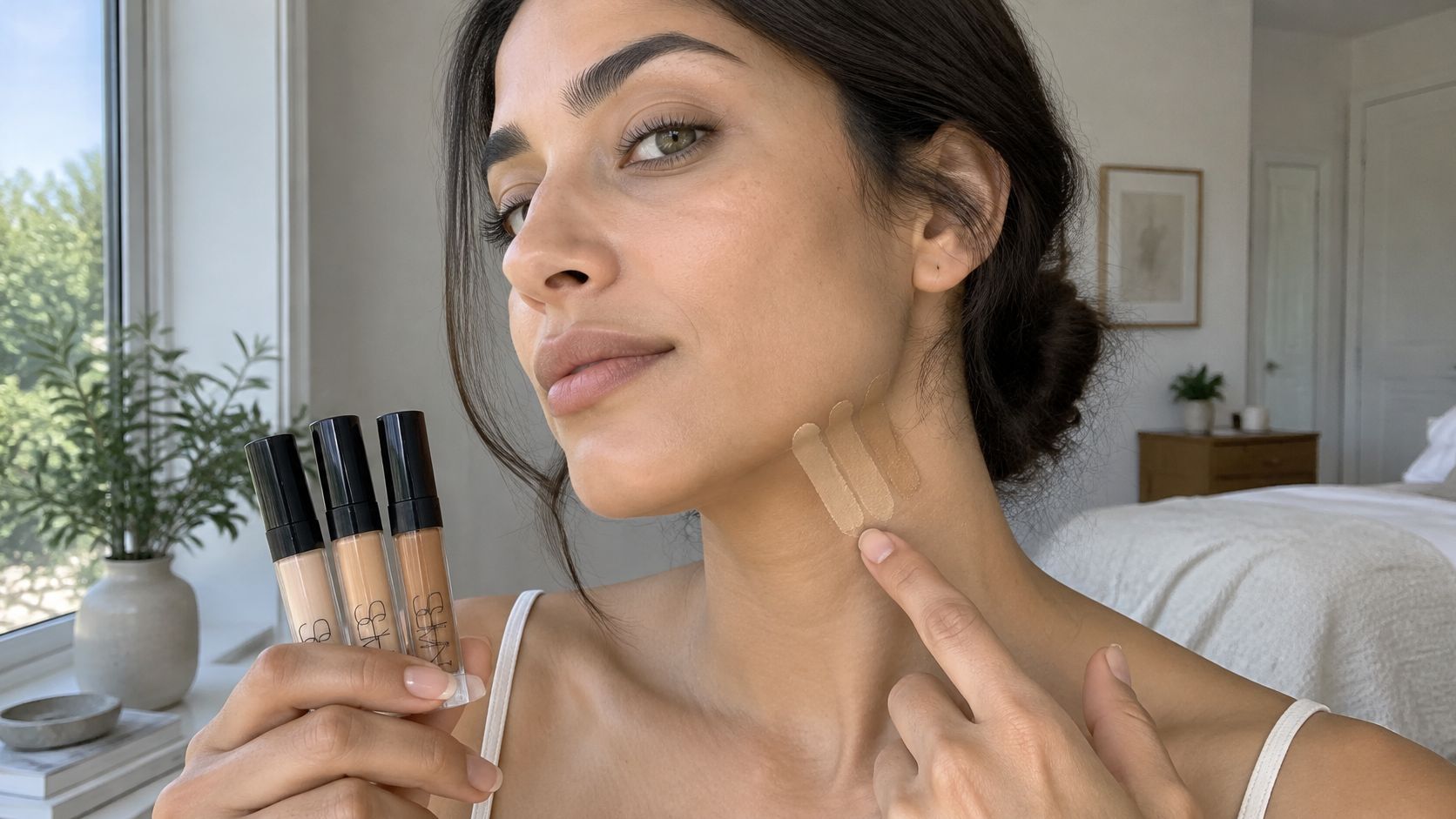
- Pull two or three shades from your row. Choose adjacent shades, not three unrelated colors, because you're narrowing a shortlist rather than starting a search from scratch.
- Stripe them narrow, from cheek to neck. Draw one thin line of each starting at the lower cheek, crossing the jaw, and finishing on the neck. Wide blobs hide the edges where mismatches show.
- Stand at a window. Indirect daylight only, never direct sun and never a warm bulb. If the only mirror is in a yellow-lit bathroom, take a hand mirror to the window instead.
- Wait two to three minutes. Wet concealer reads lighter and more saturated than dry concealer, so give the formula time to settle before you decide anything.
- Judge against the jaw. The jaw is the transition zone between face and neck, which makes it the strictest test on your face. A shade that vanishes there will work everywhere.
- Check the neck, then eliminate. If a stripe turns ashy or pink on the neck, cut it even when the cheek looks fine. Many olive readers have surface redness on the cheeks that flatters the wrong shade.
- Name a first choice and a backup. Write both down, including the shade name and the finish. Store lighting and a different associate next visit will otherwise reset your memory.
- Re-check your favourite after four hours. Formulas can shift as they dry and mix with your skincare, so look again at the dried finish before you commit to a full tube.
The most common slip is testing on the back of the hand. Hand skin is usually a shade or two lighter than the jaw and far less olive, so it flatters shades that fail on your face. The second slip is judging while the stripe is still wet. Our guide to a proper shade match for concealer covers the same sequence in more detail if you want a second pass.
Walk out with two shade names: your closest face match and one step lighter for under the eyes. That pair solves most olive concealer problems before formula even enters the conversation.
Why Pink Shades Fail and How to Fix Under-Eye Shades
You've done the test, bought the shade, and it still looks purple or grey by mid-afternoon. That's the most common complaint I hear from olive readers, and it usually isn't a depth problem. It's pigment.
Think of olive skin as a thin, muted green-grey film laid over your face. A concealer carrying too much pink or orange sits on top of that film rather than blending into it, so the eye reads a purple patch or a warm stripe. The shade can be exactly your depth and still lose, because depth and color direction are different measurements.
The pigment cause behind the grey
Pigment concentration and pigment type control how a concealer behaves, not just the shade name on the label. Labtree's guide to manufacturing concealer explains the mechanics: titanium dioxide contributes opacity and light reflectance, while iron oxides, usually listed as CI 77491, CI 77492 and CI 77499 on the ingredients, adjust the color across beige-to-brown ranges.
That has a direct consequence for olive skin. A highly opaque formula masks discoloration well, but it also hides more of your skin's muted green-grey character, which makes an off undertone more conspicuous rather than less. Dense pigment with a pink balance reads like a flat mask. A thinner layer keeps some natural variation showing through and forgives a small mismatch.
Four rules that fix most failures
Use the smallest amount that does the job. Build coverage in passes instead of loading the wand. A dot pressed into a blemish covers more convincingly than a swipe dragged over it.
Press, don't drag. Patting keeps the product on the spot you targeted. Dragging pushes it across the surrounding skin and shears the pigment into a wider, paler patch.
Keep layers thin. Stacking high-coverage products flattens the face and produces a grey cast. Two thin layers beat one thick one almost every time.
Judge the dried finish in neutral daylight. The shade you see wet isn't the shade you'll wear at 3 p.m. Oxidation shifts the film, and only a dry-down check catches it.
Check the formula on your jaw, not your hand, and check it twice: once wet, once four hours later.
Correcting under-eye darkness without a warm patch
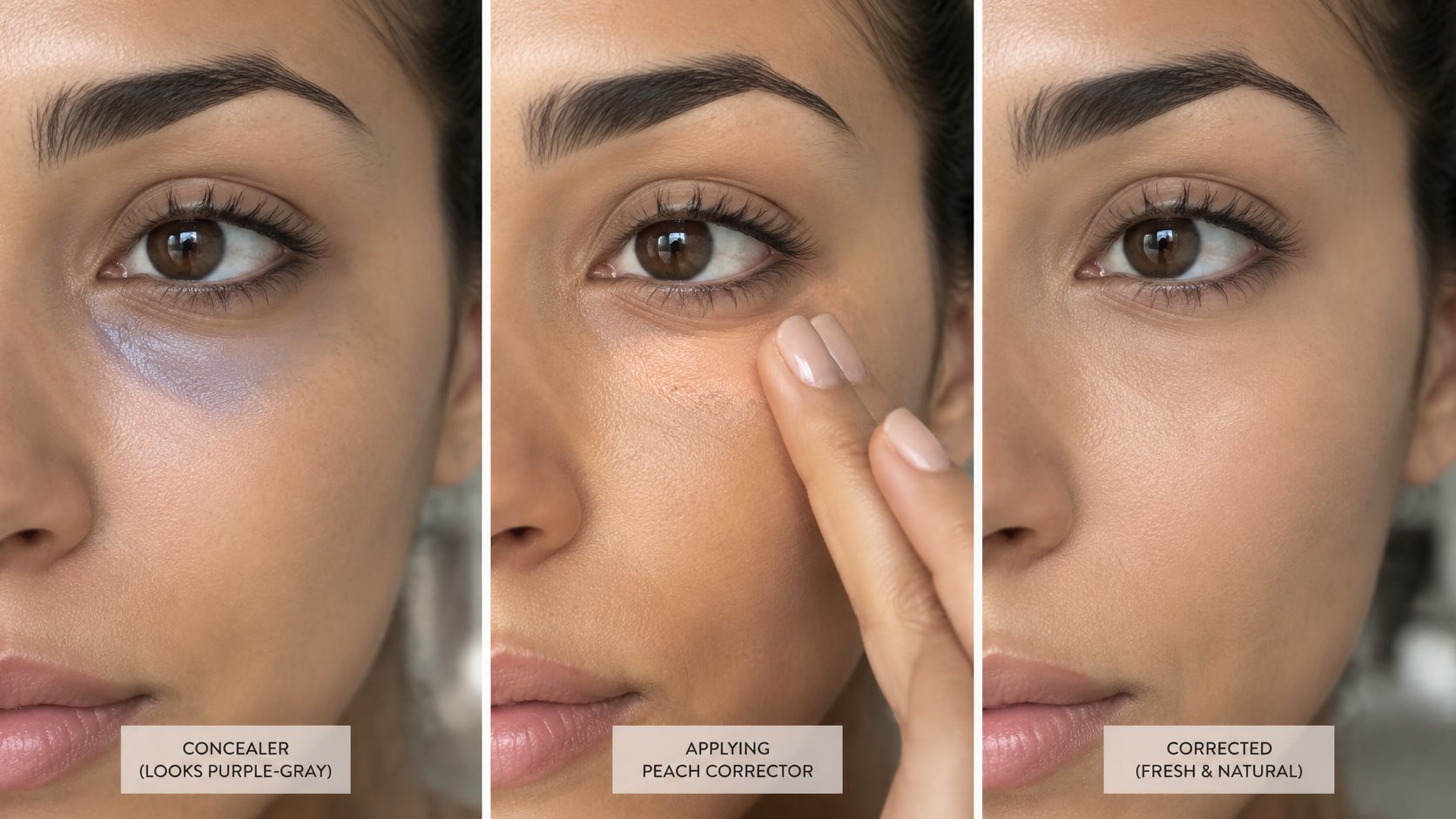
Blue-purple darkness under the eyes needs color correction, but the correction should be modest. A subtly peach or apricot modifier can neutralize the darkness when it's sheered out thin and overlaid with an olive-compatible concealer at your own depth.
A strongly orange corrector used alone is the mistake. Against olive skin it leaves a visible warm patch that no amount of concealer fully covers, and it looks worse in daylight than the darkness did.
For spots and blemishes, skip correction entirely and go straight for the closest muted match, which is usually neutral-olive or yellow-olive rather than vivid golden. If nothing in the line is muted enough, mix a tiny amount of green or olive-adjusting pigment into a compatible concealer. That's more predictable than buying a much darker shade and hoping it blends in.
The practical result is a two-shade kit: your face and spot shade at true depth, plus one shade lighter for under the eyes. If dark circles are your main concern, our roundup of the best drugstore concealer for dark circles keeps the same logic.
Five Drugstore Concealers That Suit Olive Skin
Budget shoppers get the thinnest advice here. A 2026 complexion audit found that many brands remain concentrated in warm-to-neutral undertones, leaving cool, olive and red undertones less represented, according to the Chromallogy complexion brand audit. Most "best concealer" lists then repeat the shade count without saying whether the product oxidises or which depth it suits.
That's the key question: which affordable concealer stays olive-compatible after oxidation, powdering and a full day of wear, and for which depth? A HiveTried analysis of buyer reports counted 212 reports about concealer for olive skin gathered between September 2009 and September 2026, which tells you how long readers have been asking it without a clean answer.
| Concealer | Depth Range | Olive Fit Note |
|---|---|---|
| NYX Professional Makeup Concealer Jar | Medium to deep | Full coverage; test for neutral-olive |
| L'Oréal Paris Infallible Full Wear Concealer | Light to medium | Matte; check for oxidation |
| Maybelline New York Instant Age Rewind Eraser | Light to medium | Use one shade lighter under eyes |
| Revlon ColorStay Concealer | Light to deep | Long wear; check yellow-olive shades |
| e.l.f. Camo Concealer | Light to deep | Budget full coverage; press, don't drag |
Start with the table, then read the notes, because the depth range decides whether a pick is even worth testing on you.
- NYX Professional Makeup Concealer Jar suits medium to deep olive best, since the pot format builds full coverage without needing a second product for spots. Swatch the neutral-olive end of the range rather than the warmest shade, and confirm it at the jaw before buying. On fair skin it tends to be too deep.
- L'Oréal Paris Infallible Full Wear Concealer is the one to test on light to medium olive, with a matte finish that grips well on oily skin. Matte formulas are the most likely to shift as they set, so wear it for four hours before you trust the match.
- Maybelline New York Instant Age Rewind Eraser earns its place for under-eye use on light to medium olive, applied with the sponge tip and tapped out with a fingertip. Choose a shade one step lighter than your face match, never two.
- Revlon ColorStay Concealer covers light to deep olive with long wear, which makes it the pick for anyone who needs the product to survive a full shift. Spend your time on the yellow-olive shades and walk past anything rosy.
- e.l.f. Camo Concealer is the budget full-coverage option across light to deep, and the formula rewards patience. Press it in with a fingertip or a small dense brush, and don't drag.
Two of these, one at depth for spots and one lighter for under the eyes, cover almost every olive reader. Brands that build an olive family across several depths are doing the retail version of building a cohesive beauty brand: the point isn't a token shade, it's that the range holds together.
Product links in this list are affiliate links, and this post earns a commission if you buy through them, at no extra cost to you. Disclosure sits next to the picks on purpose, since the FTC's endorsement guides treat commissions as a material connection readers should be able to notice without hunting for it.
Olive Skin Concealer Questions and Final Pick
Does concealer oxidise on olive skin?
Often, yes. Formulas can shift warmer or deeper as they dry and settle into the skin, and the change shows up more starkly against a muted base. Judge the shade four hours after application and buy the one that stays muted, not the one that looks perfect wet.
Should I go darker than my foundation?
Usually not. Pick one muted shade lighter at your own depth in neutral-olive, or the same depth if your dark circles are mild. Go darker only if you have deep olive skin with strong dark circles and you've watched the deeper shade stay muted in daylight all day.
Are drugstore concealers as good?
Often, yes, and the gap is smaller than the price difference suggests. What separates a good match from a bad one is whether the undertone is checked on the jaw in daylight, not the number on the price tag. A budget pot that sits correctly beats a luxury tube that turns pink by noon.
How do I know my undertone?
Run the three checks: wrist veins, jewellery, and jaw tint in daylight, then count the votes. If two of the three point the same way, treat that as your lean and confirm it with the jaw stripe test before you buy. A split result means you're likely neutral, which narrows the shade family rather than widening it.
Your buying plan in four moves
- Find your depth row in the lookup table and note the shade direction it gives you.
- Add your undertone lean from the three checks, so you know whether to ask for neutral-olive or yellow-olive.
- Run the jaw and neck stripe test on two muted shades in daylight, then re-check the winner after four hours.
- Add a lighter shade only if you want under-eye brightening, and buy the best-fitting pick from the drugstore list.
That's the whole method: match depth and undertone separately, skip pink and vivid golden tones, test on the jaw and neck in daylight rather than under store bulbs, and look again at the finish hours later, because a concealer that oxidises will undo a good match.
The best pick for most olive readers is the NYX Professional Makeup Concealer Jar in a neutral-olive shade, provided it passes the daylight test. It gives you the coverage to handle both spots and under-eyes at a drugstore price, and its neutral-olive end is muted enough not to fight the green-grey base. Fair olives should size down or look elsewhere in the range, since the pot runs deep on pale skin.
Finding Favourites exists for exactly this kind of shopping problem: we pull together hands-on testing and community feedback into clear dupe roundups, so you can find the affordable product that works instead of guessing at a counter. If this guide saved you a return, browse our Finding Favourites concealer and drugstore dupes by brand, from Charlotte Tilbury to NARS, and sign up for the newsletter for new dupes and discount codes before your next restock.