
5 Ordinary Copper Peptides Dupes Worth Buying in 2026
If a serum prints the words "copper peptides" on the front of the box, does that mean it contains the ingredient researchers studied? Most of the time, nobody checks. The front label is a category name, the back label is a list, and the two rarely match in the way shoppers assume. Copper peptides have become one of the most searched skincare ingredients at the same time as the human evidence behind them has stayed thin, small and product-specific.
That gap is worth taking seriously before you spend anything. The Ordinary's Multi-Peptide + Copper Peptides 1% is a real formula with a real ingredient behind it, and the research on that ingredient is more interesting than most marketing admits. But the research is not the same thing as proof that this serum, at this strength, in this base, changes your skin. This is a look at what the studies measured, what a cheaper bottle can realistically match, and five US-available alternatives that list the ingredient.
This post may contain affiliate links, which means I may receive a commission if you purchase through my links, at no extra cost to you. Please read the disclosure policy for more information.
| Dupe pick | Copper Tripeptide-1 listed |
|---|---|
| COSRX The 6 Peptide Skin Booster Serum | Yes |
| Biossance Squalane + Copper Peptide Rapid Plumping Serum | Yes |
| Isomers Copper P Concentrate | Yes |
| Skin Biology Super GHK Copper Serum | Yes |
| Garden of Wisdom Copper Peptide Serum | Yes |
What Ordinary Copper Peptides Are and What They Contain
A shopper picks up two bottles. The first says "peptide complex" in gold foil. The second lists Copper Tripeptide-1 halfway down a column of small print. Only one of them tells her something she can verify.
Copper peptides is a category name, not an ingredient. The Ordinary's ingredient glossary gives the formal INCI name for copper peptide as Copper Tripeptide-1 and explains that copper peptides occur naturally in the body and are involved in processes within skin that support skin structure, according to the brand's own ingredient glossary. In research papers the same molecule usually appears as GHK-Cu, the copper complex of glycyl-L-histidyl-L-lysine, which is a chain of three amino acids (glycine, histidine and lysine) wrapped around a copper ion.
Think of the peptide as the vehicle and the copper as the cargo. The three amino acids form a shape that holds copper tightly enough to carry it through a formulation and loosely enough to release it once it reaches skin tissue. A serum that lists "peptides" without naming which ones may contain no copper at all.
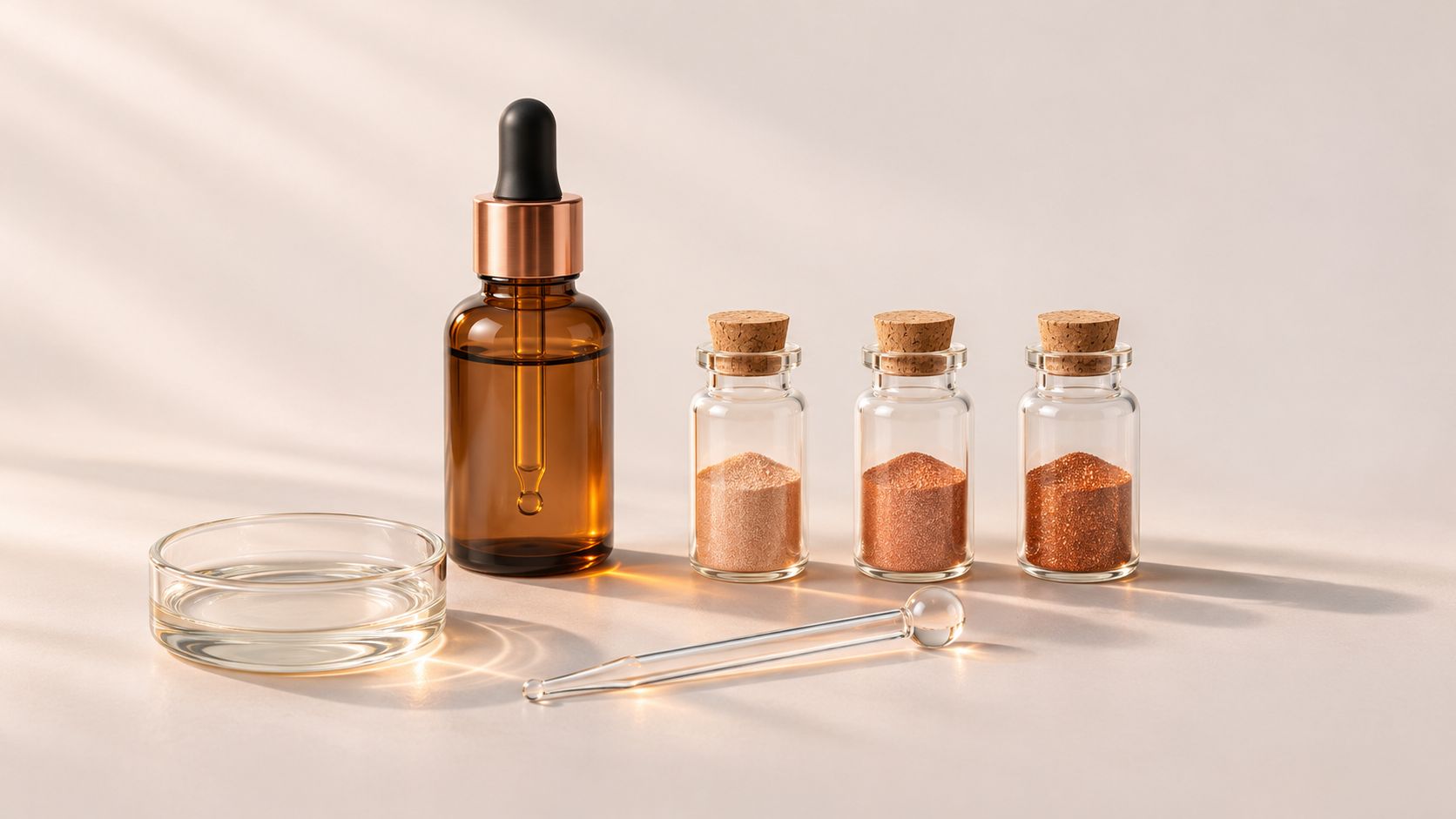
The naming is also the whole basis for comparing dupes. A label naming Copper Tripeptide-1 gives you a verifiable point of comparison; a label that says "peptide complex" gives you a marketing claim. The Ordinary copper peptides serum itself is a water-based formula that carries Copper Tripeptide-1 alongside several other peptides, ferment lysate, humectants and hyaluronic acid derivatives, which means it's a hydrating multi-ingredient serum with copper peptide in it rather than a copper peptide treatment with a bit of water added.
Read the list, not the front. Ingredients appear in descending order of concentration, so a copper peptide listed above the humectants sits in a very different quantity from one listed after the preservative.
Peptides stretch well beyond skincare, and peptides for wellness and recovery covers the clinical side of that field if you want the wider context for why a three-amino-acid chain attracts this much money and attention.
What the Research Measured and What It Cannot Prove
The copper peptide file holds several kinds of evidence, and they don't answer the same question. A penetration study tells you whether a molecule crosses skin. A cream trial tells you what happened to a group of women using one specific product. A market report tells you what people are buying. Reading them as one blended story is how "copper peptides work" becomes a belief instead of a conclusion.
Layer one, whether the molecule reaches the skin
A foundational human-skin penetration study published in 2010 tested GHK-Cu ex vivo on dermatomed human skin. After 48 hours, 136.2 ± 17.5 micrograms of copper per square centimetre had permeated through a 1-square-centimetre skin sample, while a further 97 ± 6.6 micrograms per square centimetre remained retained in the tissue as a depot, with a measured permeability coefficient of 2.43 ± 0.51 × 10^-4 centimetres per hour, as reported in the 2010 skin penetration study.
Two things follow. Topical GHK-Cu can move through human skin tissue under laboratory conditions, and a substantial amount stays in the skin rather than passing straight through it. What the study investigated was potential anti-inflammatory delivery, not wrinkle reduction, and its ex vivo design means it cannot stand in for a living face.
Layer two, what the small human trials reported
The clinical record is a set of small studies with different formulas and endpoints, summarized on Peptifact's GHK-Cu results page. In a one-month thigh study, collagen production increased in 70% of women using a GHK-Cu cream, against 50% using a vitamin-C cream and 40% using a retinoic-acid cream. A 12-week facial study of 67 women aged 50 to 59 with mild to advanced photodamage reported improvements in laxity, clarity, firmness, fine lines, coarse wrinkles, mottled pigmentation, skin density and thickness. A randomized, double-blind study of 40 women aged 40 to 65 found wrinkle volume fell 24.1% with a GHK-Cu lipid-nanocarrier serum versus 15.0% with its serum base, and 25.8% versus 20.0% against a Matrixyl 3000 product.
| Study | Key result | Limit |
|---|---|---|
| Ex vivo human skin penetration (2010) | 136.2 ± 17.5 µg/cm² permeated over 48 hours; 97 ± 6.6 µg/cm² retained in skin | Lab skin sample, not living faces |
| One-month thigh study | Collagen production rose in 70% of women using GHK-Cu cream, vs 50% with vitamin C and 40% with retinoic acid | Small group, cream rather than serum |
| 12-week facial study | 67 women aged 50 to 59 with mild to advanced photodamage improved across several measures | Product-specific, no equivalent comparator |
| 8-week randomised double-blind study | 40 women aged 40 to 65, wrinkle volume down 24.1% with GHK-Cu serum vs 15.0% with its base | Lipid-nanocarrier formula, not The Ordinary's serum |
| 2024 research tracking | 9 GHK-Cu publications in total, of which 1 was a human clinical study, 6 were preclinical and 2 were reviews or meta-analyses | Human evidence remains thin |
That last row comes from Peptide Library's GHK-Cu research tracker, and it frames the whole file. In 2024, the entire published output on this molecule amounted to nine papers, one of which involved people.
The gap between a published study and the bottle on your shelf
None of those studies tested The Ordinary's finished serum. The product page supplies an ingredient list and usage directions but no product-specific, controlled human trial showing that the finished serum improves wrinkles or elasticity, as The Ordinary's product page itself sets out. That leaves a practical question shoppers can't easily answer: if your skin improves, can you attribute it to copper peptides?
A multi-peptide water-based serum can make skin feel smoother through hydration and film-forming ingredients alone, before any peptide signalling enters the picture. Before-and-after photos can't separate those effects, and neither can a review written by someone who changed three products at once. The commercial stakes make the thinness of the human data more striking, not less: the global copper tripeptide-1 market was valued at $110.0 million in 2025, according to DataIntelo's copper tripeptide-1 market report, against a single human clinical publication in the same period.
Ask of any claim: which exact formula, at what concentration, over what timeframe, and against what comparator? If a page can't answer all four, it's describing a mechanism, not a result.
The same standard applies outside skincare. Anyone weighing whether peptide therapy actually works runs into the identical variables: the molecule, the amount delivered, how long it's given and what it's measured against. Formula variation is why our guide to Korean peptide serums looks so different from a Western peptide launch even when both name the same peptide families.
Safety Limits and Who Should Skip Copper Peptides
Dose is the first safety question, and consumer serums don't answer it. Human dermal-fibroblast studies found measurable responses at nanomolar concentrations, with roughly 1 to 10 nM associated with stimulation of collagen and glycosaminoglycan synthesis, according to a review of copper peptide fibroblast research. At 0.01, 1 and 100 nM, experiments also showed increased elastin and collagen production.
The pattern is more interesting than "boosts collagen". TIMP-1 expression rose across the tested concentrations, while lower concentrations increased MMP-1 and MMP-2 expression. That's coordinated extracellular-matrix remodelling, with synthesis and turnover being regulated together, not a blunt shutdown of collagen-degrading enzymes. In practice, a product's percentage can't be interpreted without knowing the peptide's molecular form, purity, stability, vehicle and delivered concentration. Delivery systems such as liposomes or microneedles change penetration and wound-healing outcomes too, so results from those formats shouldn't be assumed for a conventional serum.
Who should be cautious:
- Sensitive or reactive skin: patch test first, and stop if irritation persists rather than pushing through.
- Broken, sunburned or irritated skin: wait until the barrier has recovered before applying anything active.
- Pregnant or nursing, or managing a copper-related medical condition: check with a clinician before starting.
The step-by-step section below sets out the full patch-test routine. One framing point matters more than any of it: no single serum reverses photodamage on its own, so read your results against your whole routine rather than against the bottle. Our roundup of affordable skincare for sensitive skin is a useful starting point if your skin reacts easily, and the Neutralyze patch testing guide explains how to run a proper test before committing.
How to Use a Copper Peptide Serum Step by Step
The routine matters as much as the bottle. A copper peptide serum applied to a stripped barrier, layered under three actives, will tell you nothing about whether it suits your skin.
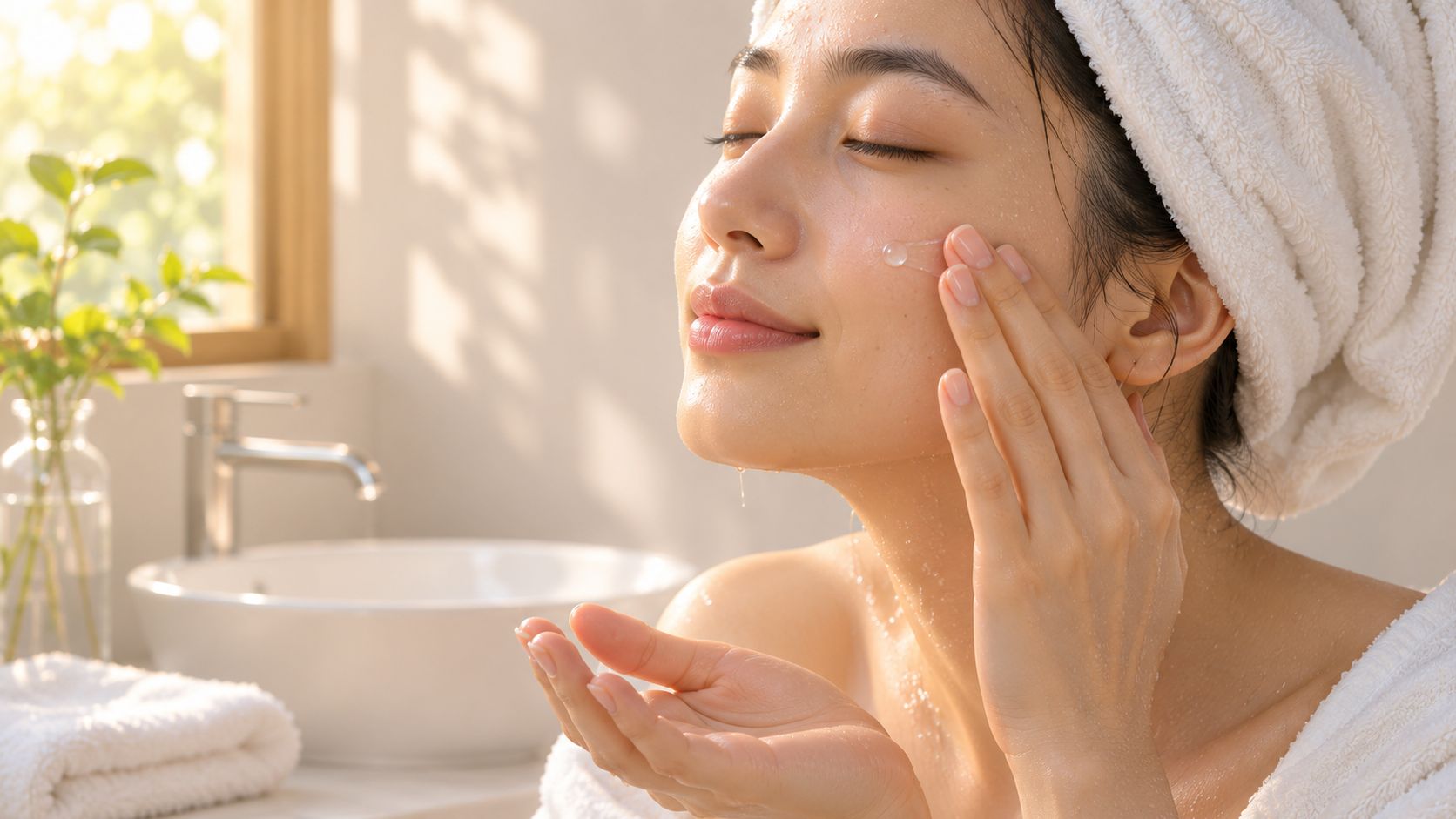
- Cleanse gently with lukewarm water. Use a non-stripping cleanser, because stripped skin absorbs irritants more readily and reacts to products it would otherwise tolerate.
- Decide damp or dry by the label. Some peptide serums spread better on slightly damp skin; others are formulated for dry skin. Follow the directions rather than a general rule.
- Patch test for three days. Apply to the inner arm or behind the jaw, not the face, since any new serum can irritate and a small area is easier to abandon.
- Apply a thin layer and press it in. Rubbing creates drag and wastes product. Pressing moves the serum across the surface evenly without pulling at skin.
Here's how the full routine fits together, including where a serum belongs relative to cleanser, moisturiser and SPF:
- Wait one to two minutes. Let the serum settle before the next layer, otherwise a rich moisturiser can dilute it across the face.
- Apply moisturiser, then SPF in the morning. Broad-spectrum SPF 30 or higher is the step that protects against new photodamage, and no peptide replaces it.
- Use it nightly, or as directed, for eight to twelve weeks. That's the window used in the 8-week and 12-week studies, so judging at day ten tells you nothing useful.
- Take weekly photos in the same light. Same time of day, same window, same camera position. Memory is a poor judge of gradual change.
Adding actives: introduce one new active at a time. If stinging or redness lasts beyond a few days, reduce frequency rather than adding a second product to fix the first.
Many copper peptide serums, The Ordinary's included, direct you to keep them away from direct acids and strong retinoids in the same routine, so alternating nights is often the simplest arrangement. A routine that fits feels unremarkable: no persistent redness, skin that's comfortable, and visible movement in the photos across the trial window. If you're rebuilding from scratch, this guide to how to build a skincare routine covers the order of steps in more detail.
Affordable Copper Peptide Dupes Worth Buying in 2026
The at-a-glance table at the top of this post lists all five picks. Each one is widely available in the US, currently sold rather than discontinued, and lists Copper Tripeptide-1 on its ingredient list. Prices move, so check the live listing before you buy; the comparison here is on ingredient and formula, not on today's discount.
| Dupe pick | Copper peptide in ingredient list |
|---|---|
| COSRX The 6 Peptide Skin Booster Serum | Copper Tripeptide-1 |
| Biossance Squalane + Copper Peptide Rapid Plumping Serum | Copper Tripeptide-1 |
| Isomers Copper P Concentrate | Copper Tripeptide-1 |
| Skin Biology Super GHK Copper Serum | Copper Tripeptide-1 |
| Garden of Wisdom Copper Peptide Serum | Copper Tripeptide-1 |
COSRX The 6 Peptide Skin Booster Serum is a large-format, water-thin essence-serum that layers under almost anything. Copper Tripeptide-1 sits among five other peptides, fairly low in the ingredient order, so treat the copper content as a supporting player rather than the headline. The texture is closest to a fluid serum of the five and the price per millilitre is the lowest, which is why it wins on value. The trade-off is the same as every dupe here: there's no product-specific human trial showing this finished bottle reduces wrinkles.
Biossance Squalane + Copper Peptide Rapid Plumping Serum is a squalane-rich, milky-gel formula with Copper Tripeptide-1 listed mid-table, below the squalane and humectants. It's the closest match on cushioned texture and the best of the five for dry or dehydrated skin. It's also the most expensive pick in this list, and the emollient finish can feel heavy on oily skin in summer.
Isomers Copper P Concentrate is a water-based concentrate with the copper peptide listed early, and its thin slip is the nearest thing here to the original's fast-absorbing feel. What it lacks is the supporting cast: fewer humectants, no hyaluronic-acid blend doing the hydrating work alongside the peptide. It's sold mainly through the brand's own site, so you won't find it on a shelf to smell first.
Skin Biology Super GHK Copper Serum comes from the company that did much of the early commercialisation work on this peptide, and it names the copper peptide near the top of a short ingredient list. The formula is watery rather than elegant. The bigger caveat is the surrounding brand language, which runs considerably ahead of the published human evidence, so read the ingredient list and ignore the claims page.
Garden of Wisdom Copper Peptide Serum is the simplest formula of the five: a short water-based list with the copper peptide near the top and little else competing for space in the base. That makes it useful if you already layer several hydrating products and want the peptide without another humectant-heavy serum. Against the original, it behaves more like a single-ingredient serum, so expect less immediate smoothing.
Two serums can both list Copper Tripeptide-1 and deliver different amounts of copper to skin. A dupe's copper peptide percentage is usually undisclosed, so treat "contains copper peptides" as a yes or no answer rather than a dose.
Before you buy any of them, run this checklist:
- Confirm the exact name. Copper Tripeptide-1, not "peptide complex" or "copper ferment".
- Check the position. Near the top of the list means more of it than an entry after the preservative.
- Compare the base. Glycerin, butylene glycol and hyaluronic-acid derivatives carry the hydration effect that makes a serum feel like it's working.
- Watch for fragrance. Skip it if your skin reacts easily.
The strongest match on ingredient and value is COSRX The 6 Peptide Skin Booster Serum. If texture matters more than budget, Biossance is the closer sensory swap.
Frequently Asked Questions About Copper Peptides
Is Copper Tripeptide-1 the same as GHK-Cu
Yes. GHK-Cu is the research name for the copper complex of glycyl-L-histidyl-L-lysine, and Copper Tripeptide-1 is the INCI name printed on labels. When a study refers to GHK-Cu, it's describing the same molecule you're looking for in an ingredient list.
Can I use copper peptides with retinol
Many people use them in separate routines or on alternate nights, and that's the safer starting point. Introduce one active at a time and reduce frequency if stinging lasts more than a few days. If the label tells you to separate the serum from retinoids and strong acids, follow the label.
How long before I see a difference
Plan on eight to twelve weeks, the assessment window used in the studies. Judge it with weekly photos taken in consistent light rather than by feel, because gradual hydration changes are easy to misremember in either direction.
Do copper peptides replace moisturiser or sunscreen
No. A copper peptide serum is one layer inside a routine, and daily SPF 30 or higher remains the step that protects against new photodamage. Retinoids and vitamin C still carry stronger evidence for photoaging than any peptide.
Is a cheaper dupe as good as The Ordinary's serum
A dupe matches on ingredient only when Copper Tripeptide-1 appears on its label, and beyond that nobody can show it delivers the same dose or the same results. The finished product evidence doesn't exist for the original either. Compare ingredient lists and texture, not percentages.
Why the Best Dupe Wins and What to Do Next
COSRX The 6 Peptide Skin Booster Serum takes the win because it lists Copper Tripeptide-1, uses a fluid multi-peptide water base that sits closest to the original in structure, and costs the least per bottle of the five. It doesn't prove it does more than The Ordinary's serum. It proves you can buy the same named ingredient in a comparable format for less.
The short version of everything above: copper peptides on a label means Copper Tripeptide-1, and nothing else. The research is interesting but comes mostly from small studies and from formats that don't match a standard serum. Give any copper peptide product eight to twelve weeks alongside daily SPF before you judge it. Judge dupes by the ingredient list, not the claims.
Your next step is small. Check the current ingredient list on the bottle you're considering, patch test it for three days, and set a review date at eight weeks with weekly photos. If you want more swaps to weigh alongside it, our roundup of the best Drunk Elephant dupes is the natural next read.
Finding Favourites exists for exactly this kind of decision: the ten minutes of ingredient checking that saves you from guessing at the checkout. We publish dupe roundups across drugstore, makeup, skincare and fragrance categories, with the texture, finish and formulation details that decide whether a cheaper bottle is really a swap. Start with the skincare dupes at Finding Favourites and keep a running list of the labels you've verified.