
5 Multi-Peptide Eye Serum Dupes Under $25
The most popular advice about multi-peptide eye serum is also the least useful: buy the bottle with the longest peptide list. A complicated ingredient panel doesn't guarantee smoother under-eyes, and a comfortable cream can be a smarter purchase than a watery serum with impressive marketing. Buy for the problem you have, not the number of peptides on the box.
This post may contain affiliate links, which means I may receive a commission if you purchase through my links, at no extra cost to you. Please read the disclosure policy for more information.
Why Peptide Count Is a Weak Shopping Signal
A multi-peptide eye serum is a lightweight leave-on treatment for the skin around the eyes that combines more than one peptide. Formulas often include humectants, caffeine, or niacinamide and are marketed for fine lines, crepey texture, puffiness, and dullness.
That's a lot to ask of one bottle. The eye area is delicate, moves whenever you blink or smile, and can look tired for completely different reasons. Surface dryness, expression lines, pigmentation, and shadows from facial anatomy aren't interchangeable concerns.
Match the texture to the complaint
If concealer catches on dry patches, prioritize moisture and barrier comfort. If your under-eyes feel comfortable but look puffy in the morning, a lighter caffeine treatment makes more sense. Neither choice needs the most elaborate peptide blend.
The Ordinary Multi-Peptide Eye Serum is the reference point for this comparison. But a useful dupe doesn't have to reproduce its ingredient list or watery texture exactly. It should deliver the everyday result you're buying it for, at a price you're comfortable paying.
Shopping rule: A dupe should match your concern, not just the wording on the original bottle.
The five alternatives below cover different jobs: cushioning dry skin, adding lightweight hydration, and freshening the appearance of morning puffiness. They're functional alternatives, not proven clinical equivalents.
Prices move by retailer, and formulas can change. Treat the listed price bands as shopping guidance rather than guaranteed current offers, and check the actual package before buying. The comparison is useful only if you separate an affordable substitute from an identical formula.
Five Drugstore Dupes Compared
A long peptide list does not make an eye serum a better buy. These five alternatives serve different needs, and the comparison is more useful when you match the texture and focus to what you want from the product.
Five multi-peptide eye serum dupes
| Dupe | Best for | Typical US price |
|---|---|---|
| CeraVe Skin Renewing Eye Cream | Dry, crepey under-eyes | About $15–$20 |
| e.l.f. SKIN Holy Hydration Eye Cream | Tight, dehydrated skin | About $8–$12 |
| Good Molecules Yerba Mate Wake Up Eye Gel | Morning puffiness | About $6–$10 |
| The INKEY List Caffeine Eye Cream | Puffiness and dullness | About $10–$15 |
| L'Oréal Revitalift Derm Intensives Eye Serum | Plumping and fine lines | About $20–$25 |
Prices vary by retailer and size, so check the listing before buying. Marketplace sellers may also list different sizes or prices.
The five picks and their trade-offs
CeraVe Skin Renewing Eye Cream
Best overall dupe for dry-looking fine lines. Its cream format is a practical choice when under-eyes feel papery or makeup looks rough over them.
The peptide-and-ceramide positioning makes this CeraVe product worth considering. Check the current carton rather than assuming its claims apply to other CeraVe eye creams. It offers everyday comfort and smoothness, not the same texture as The Ordinary serum.
e.l.f. SKIN Holy Hydration Eye Cream
The comfort-first budget pick. Choose its soft cream texture when tightness and dehydration matter more than a treatment-focused feel.
A moisturizing base can make an eye routine feel complete without a large spend. Check the current ingredient list for peptide content, and don't expect the same blend or delivery as the reference serum.
Good Molecules Yerba Mate Wake Up Eye Gel
The lightweight morning option. Its gel format suits anyone who dislikes rich cream under concealer or prefers a fresher feel around the orbital area.
This is a puffiness-focused alternative, not a stand-in for a peptide complex. If dry, crepey texture is your main concern, you may want moisturizer over the gel.
The INKEY List Caffeine Eye Cream
The better fit when puffiness leads your shopping list. Despite its name, it's a lightweight cream rather than a gel.
Its caffeine-led positioning doesn't rule out peptides. Check the current label for Matrixyl-style peptide ingredients, and assess the whole formula instead of treating caffeine and peptides as competing categories.
L'Oréal Paris Revitalift Derm Intensives Eye Serum with 1.5% Hyaluronic Acid
The slip-and-plump option. Choose this fluid serum if you enjoy a lightweight treatment and want dehydration lines to look less pronounced.
Its hyaluronic-acid positioning makes it a hydration-led swap, not a peptide twin. Skip the applicator if you won't enjoy using it, and apply without pressing or dragging across delicate skin.
Choose CeraVe for dryness, not as a universal pick. A lighter product is the smarter buy if richer creams feel heavy and you stop using them. Whichever formula you choose, keep it out of the waterline and away from the lash roots.
How Peptides Work and How to Read the Label
Peptides are short chains of amino acids. In skincare, some are used as signals associated with the skin's supporting structure; they don't physically lift loose skin.
The ingredient names matter more than a molecular-looking bottle.
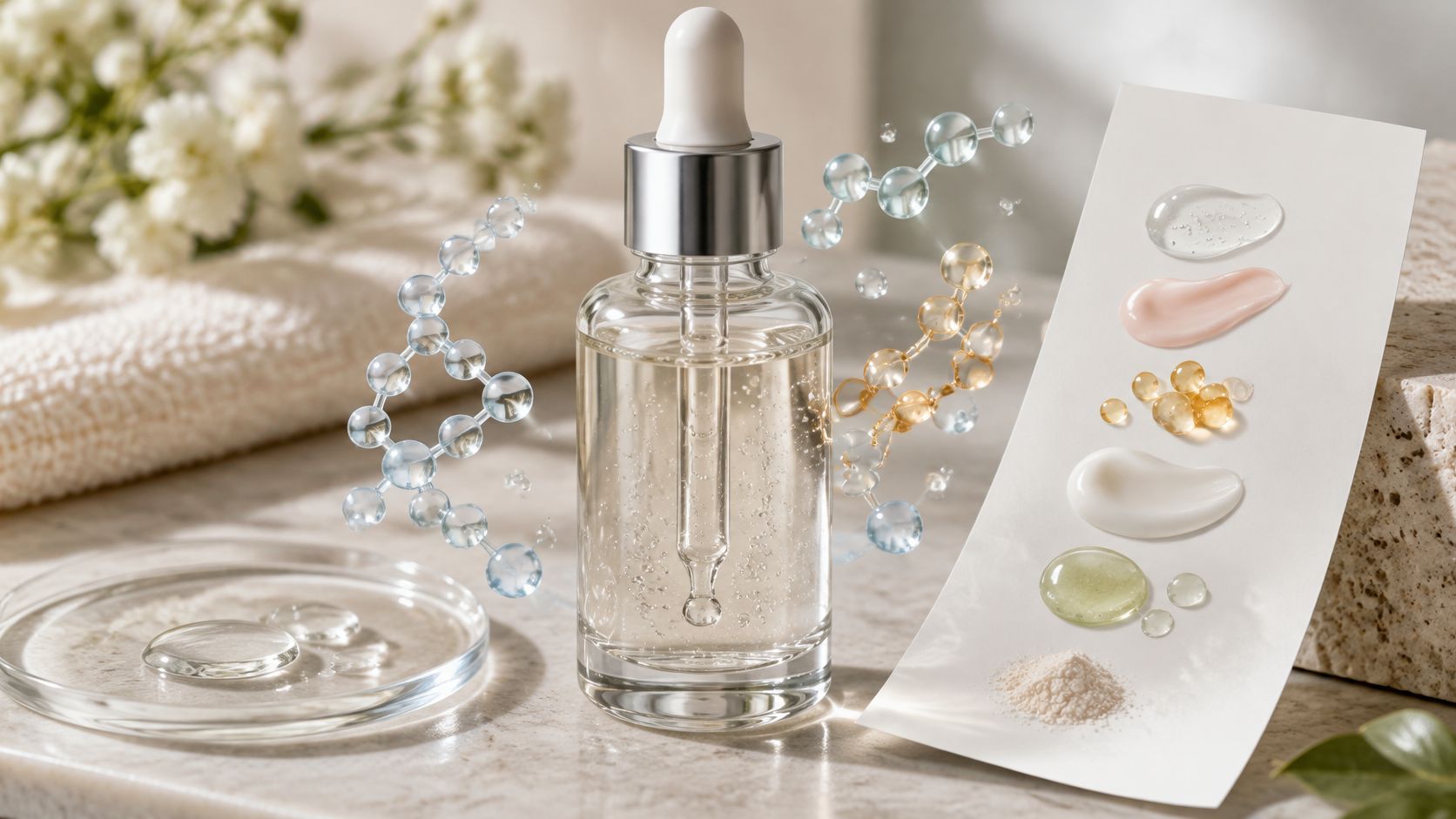
Signal peptides, including palmitoyl tripeptide-1 and palmitoyl tetrapeptide-7 in Matrixyl-style blends, are associated with collagen-related signaling. Acetyl hexapeptide-8, often called Argireline, is marketed for expression-line appearance, while Eyeliss-type complexes are positioned around puffiness and dark circles.
Those families aren't interchangeable. A familiar trade name doesn't tell you how much active peptide is present, how stable it is, or how effectively the finished product delivers it.
A review of peptide delivery and cosmetic efficacy describes a 12-week, double-blind, placebo-controlled split-face study in which a moisturizer containing 3 parts per million palmitoyl-KTTKS significantly reduced fine lines and wrinkles. That's a useful correction to percentage chasing: a small concentration can matter in a well-built formula, while a prominent percentage alone proves little.
The label checks worth doing
Find the named peptide. Read the full INCI ingredient list rather than relying on the front-panel phrase peptide complex. A trade-name blend and its individual ingredients may be presented differently.
Inspect the moisturizing base. Look for glycerin, hyaluronic acid, ceramides, or panthenol. These help explain why skin may feel smoother before any gradual treatment effect could reasonably be judged.
Scan for ingredients your skin dislikes. Fragrance, essential oils, drying alcohol, strong acids, and even necessary preservatives can affect tolerability. Your own irritation history matters more than a gentle claim.
Consider the packaging. Prefer an opaque tube or airless pump when choosing between otherwise comparable formulas. Packaging isn't proof of efficacy, but it deserves attention alongside the ingredient list.
Compare price per usable amount. Divide the checkout price by the labeled contents, then consider how much product you can dispense cleanly without waste. A cheap jar isn't automatically better value than a controlled-dose tube.
For another label-focused comparison, our Korean peptide serum guide can help you look beyond the headline ingredient.
Keep the same critical eye when watching application demonstrations.
When to skip a new serum
Don't introduce an eye treatment onto cracked, actively inflamed, or recently resurfaced skin. After laser treatment, microneedling, or injections, follow your treating clinician's aftercare instructions rather than assuming peptides are automatically suitable.
A cosmetic peptide safety review discusses an assessment reporting no irritation in healthy volunteers at concentrations up to 28%, but moderate irritation in people with dermatitis. That isn't a recommended concentration or a guarantee about any finished eye cream.
Patch-test on the outer cheek or behind the ear, never along the eyelid margin. Persistent burning, swelling, or a rash means stop.
What the Eye Serum Studies Actually Measured
A longer peptide list does not prove a better eye serum. The studies below show why: results vary by formula and method, and several findings come from small or uncontrolled trials. Judge a product by its moisturizing effect and by consistent photos over 8 to 12 weeks, not by the number of peptides on the label.
A controlled trial of a finished product can show whether that formula performed better than a comparator. An uncontrolled before-and-after study cannot separate the peptide effects from the product base, application, or ordinary measurement variation.
What the eye serum studies measured
| Study | Peptide or product | Key result |
|---|---|---|
| 2026 systematic review | Topical neurocosmetic peptides | 11 studies, 412 participants across 7 randomized controlled trials, 3 prospective observational studies, and 1 uncontrolled trial, according to the systematic review. |
| Multi-peptide serum, 12 weeks | Multi-peptide serum | Within that review: 56 participants; 100% fine-line responders and 67% deeper-wrinkle responders; p < 0.001 versus placebo. |
| Dual-peptide formula, 12 weeks | AHP-8 with Syn-Ake | Within that review: 35%–69% improvement in static wrinkles and 10%–13% reduction in dynamic wrinkle depth; participant count not specified in the summary. |
| Open-label study, 28 days | Argireline, Matrixyl 3000, Eyeliss | 32 women aged 20–45; significant reductions in wrinkle number, depth, and volume, but no placebo arm and no significant overall periocular hydration or elasticity change, in the multi-peptide serum study. |
| Open-label, twice-daily application | KP1 eye cream | 20 women aged 45–60; 10.7% less dark-circle pigmentation and 19.2% less average crow's-feet roughness versus baseline, described in the eye-formulation clinical review. |
| 12 weeks, twice daily | OS-01 peptide eye formulation | In the same clinical review: 22 participants; water loss decreased 17.33%, hydration increased 32.49%, firmness improved 10.19%, and elasticity increased 25.58% versus baseline. |
| 12 weeks, double-blind split-face | Palmitoyl-KTTKS at 3 ppm | Significant fine-line and wrinkle reduction versus placebo; participant count not specified in the summary. |
| In vitro penetration test | Acetyl hexapeptide-8 | Showed limited skin penetration in a laboratory test. This was a delivery test, not a clinical wrinkle result. |
What those results do and don't mean
A responder rate isn't the percentage of wrinkles erased. It counts participants who met a study's improvement criterion. That does not mean every participant became wrinkle-free.
Statistical significance also doesn't tell you whether a change will be noticeable in your mirror. Check what the study measured and whether it compared the formula with a control.
Promising short-term cosmetic changes aren't proof that every multi-peptide eye serum remodels wrinkles.
The uncontrolled multi-peptide study is useful for setting limits on what the findings can support. Its results justify further investigation, but they cannot isolate peptide-specific effects from the rest of the formula or the application routine.
The study also does not establish that hydration caused the wrinkle changes. Researchers found no significant overall hydration change, so the narrower conclusion is that the study couldn't establish what caused the wrinkle improvements.
For your own comparison, focus on moisture and repeatable photos rather than advertising-style snapshots. Take pictures under similar lighting and at the same angle, then compare them after 8 to 12 weeks.
These findings do not transfer automatically to budget alternatives. Different concentrations, product bases, packaging, and measurement methods make direct comparisons unreliable.
Ignore before-and-after ads that omit sample size, controls, and the exact formula tested. A named peptide gives you a reason to inspect the evidence, not proof that a finished product works.
How to Work It Into a Daily Routine
Keep the routine simple enough that you'll follow it. You don't need a separate brightening serum, peptide serum, caffeine gel, and rich cream crowded around the same small area.
Morning application
Cleanse gently. Use a non-stripping wash, or rinse if that suits your skin. Avoid scrubbing away yesterday's makeup with a rough cloth.
Pat on a small amount. Distribute the product along the orbital bone, away from the lash line. Start sparingly and follow the product's directions rather than assuming more will work faster.
Add moisturizer only if needed. A watery serum may need a plain moisturizer over it; a cushioning eye cream may already feel sufficient. If layering feels sticky, reduce the amount instead of adding another product.
Finish with broad-spectrum sunscreen. Choose a sunscreen you can comfortably use around the orbital area while keeping it out of your eyes. A mineral formula or eye-area-tested stick may be easier for some people to tolerate, but neither is automatically sting-proof.
For hydration layering, our guide to using hyaluronic acid explains how to fit a humectant step into a moisturizing routine.
Evening application
Remove sunscreen and makeup without pulling at the skin. Apply your chosen eye product to clean skin, then leave it alone rather than repeatedly massaging the area.
If you already use a facial retinoid, keep it away from the eyelids unless its directions and your clinician's advice support that use. Use the peptide product as the eye step, or simplify to alternate evenings if your routine becomes uncomfortable. Don't stack strong exfoliating acids on the lids.
Make the photo test fair
The review discussing the KP1 eye-contour trial supports assessing different outcomes separately and reassessing after approximately 8–12 weeks. Its findings are a benchmark for measured cosmetic change, not a promise about your purchase.
Take a baseline photograph, another during the routine, and a final photograph at the end of your trial. Use the same window light, camera position, expression, and makeup-free skin each time.
Keep the comparison honest: Don't compare a smiling, dry-skinned baseline with a relaxed photograph taken immediately after applying cream.
Judge comfort, makeup wear, puffiness, and lines separately. Peptides won't correct every cause of darkness or swelling, including vascular visibility, anatomical shadows, fat-pad changes, allergies, or fluid retention.
If you can't see a worthwhile difference by the end of the trial, stop automatically repurchasing. Put the money toward the sunscreen and moisturizer you already know you'll use.
Questions Shoppers Ask Before Buying
Can a multi-peptide eye serum replace retinol?
No, it isn't an evidence-equivalent replacement. Retinoids have a more established anti-aging record, while peptides are an optional cosmetic step for people who want a different approach or don't tolerate retinoid products well.
That doesn't make peptides useless. It means you should choose them for comfort and a realistic improvement in appearance, not expect retinoid-like results without the possibility of irritation. You can use the categories within the same weekly routine without layering everything onto the eyelids at once.
Is it useful in your twenties?
Only if you're addressing an actual concern, such as dryness, temporary puffiness, or early creasing. You don't need a peptide eye serum just because you've reached a particular birthday.
For prevention, prioritize consistent sun protection. If your existing moisturizer keeps the area comfortable, buying a separate eye treatment is optional rather than a missing skincare essential.
Can contact-lens wearers use one?
Contact lenses don't automatically rule out an eye-area skincare product, but suitability depends on the formula and your eyes. Apply to clean, dry skin away from the lid margin, wash your hands before handling lenses, and prevent product from getting into the eye.
Ask an eye-care professional if you're unsure, particularly if you have dry-eye symptoms or an existing eye condition. Persistent stinging, watering, or blurred vision isn't something to work through.
When is a gel a better dupe than a cream?
Choose a gel when you prefer a weightless finish, have oilier skin around the orbital area, or mainly want a morning product. Choose a cream when the area feels tight and makeup emphasizes dry texture.
Our best drugstore eye cream guide offers another way to compare texture-led options without treating every eye concern as a peptide deficiency.
What if my skin is sensitive?
Choose according to your known triggers, not a blanket sensitive-skin claim. A fragrance-free product can still disagree with your skin, and an expensive serum isn't necessarily safer.
Don't introduce a new treatment during an eyelid dermatitis flare. If products repeatedly cause redness or swelling, get the cause assessed rather than cycling through more affordable alternatives and hoping the next one will be different.
CeraVe Is the Best Overall Dupe for Dry Under-Eyes
CeraVe Skin Renewing Eye Cream is the best overall functional dupe for dry under-eyes where fine lines look more pronounced. For that concern, a comfortable cream is a smarter buy than a serum selected for its peptide count. A longer ingredient list does not prove better results.
Keep the product names straight. Skin Renewing Eye Cream and Eye Repair Cream are different products, so a recommendation for one does not confirm the peptide content of the other. Check the current Skin Renewing carton for its peptide and ceramide ingredients before buying, since formulas and labels can change.
Choose the alternative that earns its place
For comfort-first use, e.l.f. is the budget-minded choice. Good Molecules and The INKEY List suit shoppers who prefer a lighter morning treatment, while L'Oréal offers the slip of a hydrating serum.
Ingredient similarity is only one consideration. Choose a formula you can apply comfortably and use consistently, then judge whether it adds anything to your routine beyond a basic moisturizer.
If you're comparing CeraVe products, you can shop CeraVe cream for dark circles to view the Eye Repair Cream listing. It is not the Skin Renewing recommendation, so compare the product names and ingredient lists before buying.
Spend on the routine, not the promise
Finding Favourites focuses on affordable beauty dupes, including skincare and drugstore alternatives. Its 5 Best Supergoop! Unseen Sunscreen Dupes From The Drugstore guide is relevant if you're looking for a budget-friendly sun-protection swap instead of adding another optional treatment.
Start with CeraVe Skin Renewing if dryness is making your under-eyes look crepey. Check the carton and buy the smallest available size from a trustworthy retailer. Skip a pricier multi-peptide serum unless you prefer its texture or see a result you value. Use photos taken under similar conditions over eight to twelve weeks to assess change; moisturization and consistency matter more than a crowded peptide list.