
5 Best Drugstore Hydrating Serum Picks for Every Budget
The most popular advice is also the least useful: buy the drugstore hydrating serum with the biggest percentage on the front and wait for plump skin. That shortcut ignores the part that decides results. Ingredient order, barrier support, and what you layer on top matter more than a front label claim or a low price.
Ingredients to Prioritize for Your Skin Type
A drugstore hydrating serum is a light, water-based cosmetic designed to add moisture. The right formula depends on what your skin needs: humectants draw in water, while barrier-supporting ingredients help limit moisture loss. A serum is one layer in a routine, and dry skin often needs moisturizer on top.
This post may contain affiliate links, which means I may receive a commission if you purchase through my links, at no extra cost to you. Please read the disclosure policy for more information.
Use the table to narrow your search to a couple of ingredients, then check the formula for potential irritants. The best match is not always the richest or cheapest option.
| Skin Type | Look For | Avoid or Check |
|---|---|---|
| Dry or dehydrated | Hyaluronic acid, glycerin, ceramides | Heavy fragrance if skin stings |
| Oily or combination | Hyaluronic acid and glycerin in a light gel-serum | Heavy oils that feel greasy |
| Sensitive or eczema-prone | Fragrance-free glycerin and ceramides | Essential oils, alcohol-heavy formulas, strong actives |
| Mature | Multi-weight hyaluronic acid, glycerin, ceramides | Expecting visible change in under 4 weeks |
| Acne-prone | Lightweight hyaluronic acid and glycerin | Comedogenic butters and heavy occlusives |
For reactive skin, start with a simple formula and avoid ingredients that tend to sting or irritate. The guide to affordable skincare for sensitive skin offers more ideas for choosing gentle products. Hydration can improve the feel of dryness, but it will not change pigment. Treat uneven tone as a separate concern from choosing a hydrating serum, and explore options for uneven skin tone.
What the table is really telling you
Hyaluronic acid, glycerin, and ceramides serve different purposes. Hyaluronic acid and glycerin are humectants that draw in water; ceramides support the skin barrier and help retain moisture. A lightweight gel-serum may suit oily or combination skin, while dry, tight-feeling skin may need a moisturizer over a humectant-focused serum.
Fragrance deserves extra attention if your skin is sensitive. Essential oils and alcohol-heavy formulas can also be poor fits for reactive skin, while rich oils or butters may feel uncomfortable on oily or acne-prone skin. Your skin's response matters more than a product's claims.
Practical rule: Choose the ingredients that suit your skin first, then compare prices. A low-cost serum is not a good buy if it leaves your skin feeling tight or irritated.
The ingredient match helps narrow your options. The next check is whether those ingredients appear meaningfully in the formula and whether the rest of the product suits your skin.
How to Read a Drugstore Serum Label
The back of the bottle answers the key questions before any marketing does. Front labels sell a feeling. Ingredient lists show the vehicle, the humectant system, and whether a headline ingredient is doing much work.
Six checks before you buy
Find the full ingredient list. The FDA cosmetics labeling regulations state that U.S. cosmetic labels must provide an ingredient declaration when a product is sold at retail to consumers, including in stores or online, in descending order of predominance. If a listing hides the full list, skip it until you can see it.
Read the first five ingredients. They make up the largest share of the formula. For a hydrating serum, water and a humectant such as glycerin or a hyaluronic acid form should lead. If alcohol or fragrance sits near the top and your skin is sensitive, that's a warning.
Locate hyaluronic acid or ceramides. Position matters. If the ingredient in the product name appears after preservatives near the end, expect only a small amount. Ingredients present at 1% or less may be listed in any order after ingredients above 1%, so the tail of the list can't prove exact strength.
Check for fragrance and essential oils. Words such as fragrance, parfum, limonene, or named essential oils signal irritation risk for sensitive or barrier-impaired skin. They don't improve hydration. Fragrance-free is the safer default if products often sting you.
Compare the claim wording. Hydrates, dewy, and plump-looking are cosmetic claims. Treats eczema or heals a condition is different territory. Don't let drug-like language convince you a cosmetic serum has been proven to treat disease.
Confirm the exact size and version. Brands reformulate and sell region-specific versions. Match the size, packaging, and full list to the bottle you are buying, because a changed ingredient order means it isn't the same formula you read about.
Say two serums both name hyaluronic acid on the front. One lists water, glycerin, then sodium hyaluronate in its first five. The other lists water, alcohol, fragrance, then hyaluronic acid near the end. They aren't equivalent, even if the second costs more and looks more premium.
Your shortlist rule
Keep two serums that share the same lead ingredients and fit your skin-type row. Compare texture, fragrance, and price per bottle from there. I would not call anything a dupe just because both boxes mention hyaluronic acid, glycerin, or niacinamide. The complete list and its order are stronger evidence.
Hyaluronic Acid, Glycerin and Ceramides Explained
Glycerin and hyaluronic acid draw water into the upper layers of skin. Ceramides are skin-identical lipids that help reduce water loss through the barrier. A serum can provide humectants, but it does not necessarily replace the barrier support of a moisturizer. Judge the formula by its ingredients and their order, not by a prominent claim on the bottle.
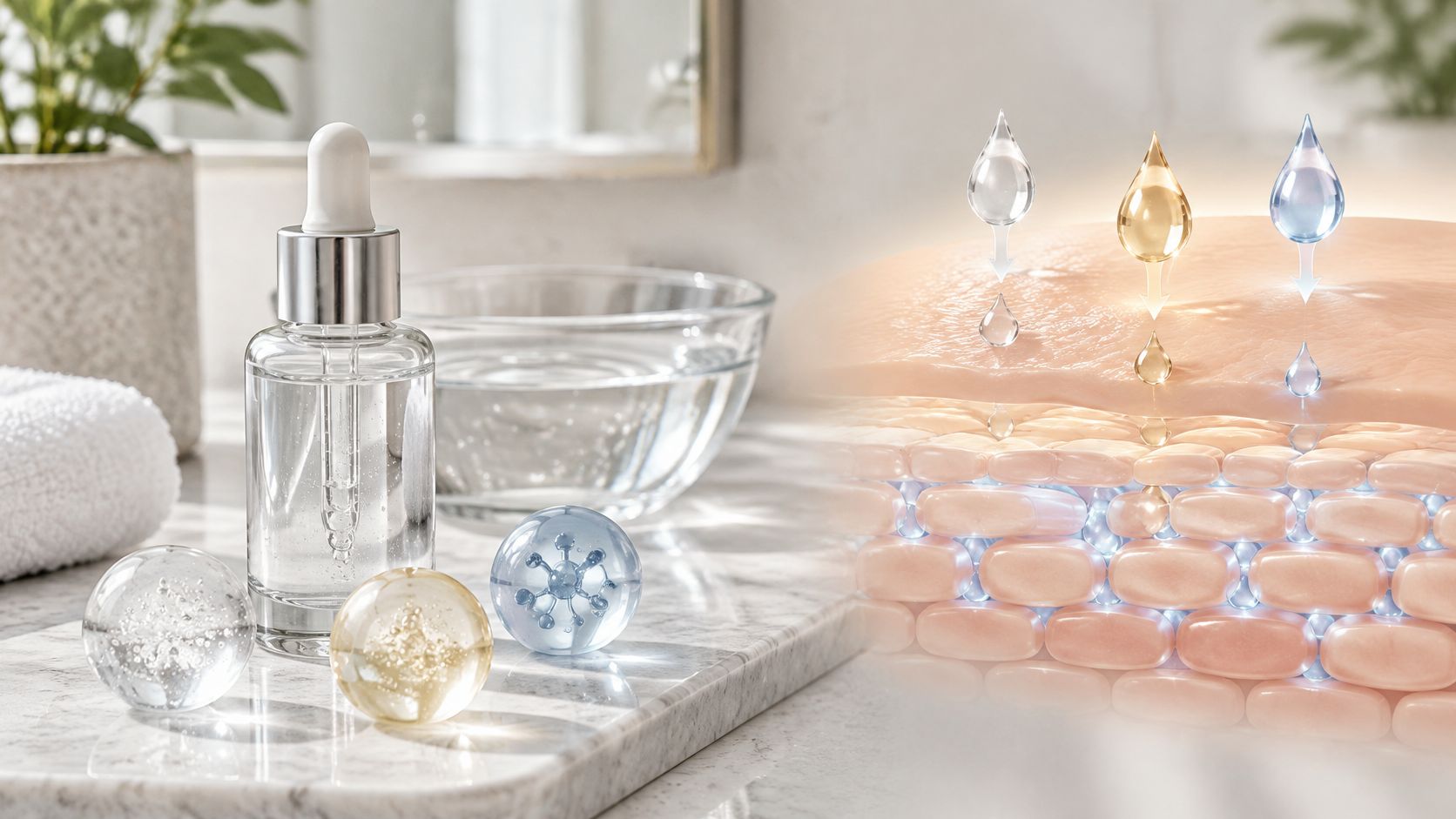
Hyaluronic acid and molecular weight
High-molecular-weight hyaluronic acid, approximately 1,200 to 2,000 kDa, mainly forms a surface film that attracts and retains water in the upper stratum corneum. Lower-weight forms can penetrate farther into the stratum corneum and epidermis, according to a review of topical hyaluronic acid studies. The review reports moisturization from high-molecular-weight HA at concentrations around 0.1 to 0.5%, with effects observed as early as one hour and maintained over roughly 28 to 60 days.
Those findings describe studied formulas, not every serum with hyaluronic acid on its label. The label may not disclose the molecular weight or concentration, and the ingredient's position gives only a rough indication of how much is present. Formulas listing several HA forms may offer different kinds of surface hydration, but the rest of the formula still matters. For practical guidance on application, see how to use hyaluronic acid.
Glycerin and ceramides
Glycerin is an effective, widely used humectant. It draws water into the upper skin layers and helps a gel spread smoothly. If it appears near the beginning of the ingredient list, it is likely a substantial part of the formula. A serum does not need a flashy percentage claim to make glycerin useful.
Ceramides are lipids in the stratum corneum that help organize its intercellular layers and reduce transepidermal water loss. In a 28-day randomized controlled study of adults with moderate eczema, a ceramide-dominant lipid moisturizer improved TEWL and skin hydration over time, while placebo measurements stayed the same or worsened, according to research in The Journal of Dermatology. That supports the role of barrier lipids, rather than just a temporary soft feeling.
The video below gives a visual refresher on layering water-based products before cream.
| Ingredient | Main Role | Evidence From the Research |
|---|---|---|
| High-molecular-weight hyaluronic acid | Forms a surface film that holds water in the upper skin layer | Roughly 0.1-0.5% reported to moisturize for about 28-60 days |
| Lower-weight hyaluronic acid | Can penetrate farther into the stratum corneum and epidermis | Penetrates farther than high-molecular-weight forms |
| Glycerin | Humectant that draws water into the skin | Common humectant; judge its prominence by its position in the ingredient list |
| Ceramides | Lipids that help reduce transepidermal water loss | 28-day eczema study reported improved water loss and hydration against placebo |
Humectants draw water into the skin, while ceramides support the barrier. For dry skin, a hydrating serum is usually one layer of the routine, with moisturizer on top.
Serum or Moisturizer? How to Layer for Dry Skin
A cheap serum can be less useful than an inexpensive moisturizer that contains humectants plus barrier lipids, especially for eczema-prone, winter-dry, or over-exfoliated skin. That's the trade-off roundups often skip. If your barrier is leaking water, adding more water without sealing it won't hold.
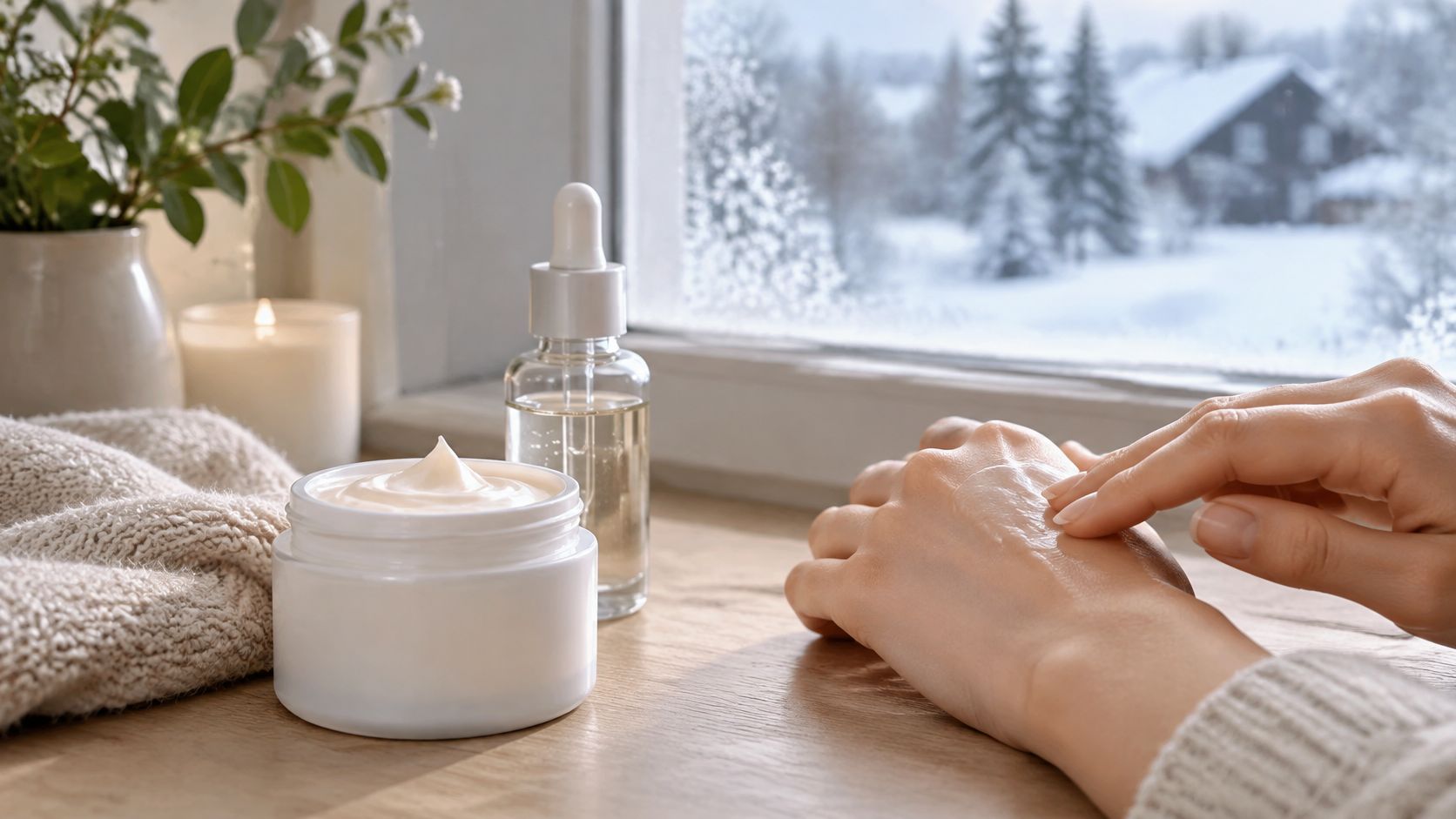
This image captures the winter routine problem well, dry air, frequent washing, and skin that needs a seal after any watery layer.
A simple layering routine
- Cleanse gently. Use a gentle, fragrance-free cleanser and lukewarm water. Don't scrub dry patches to make serum absorb better.
- Apply to slightly damp skin. Press in two to three drops of serum for about one minute. Damp skin gives humectants water to hold.
- Wait until tacky. Give it about one minute so the next layer doesn't pill.
- Seal with ceramide moisturizer. Apply it over the whole face and neck. This is the step dry skin shouldn't skip.
- Finish with sunscreen in the morning. Serum and moisturizer go underneath, sunscreen stays last.
Humectants pull water in but can let it evaporate without a cream on top, particularly in heated indoor air. If you're unsure about product roles, read what is the difference between serum and moisturizer before adding another bottle. For broader dry-skin habits such as bathing and triggers, see skin health advice from Vitamin Planet.
Adjust by skin type
Oily skin may skip a rich night cream if a gel moisturizer is enough and skin doesn't feel tight by bedtime. Dry skin should keep the cream at night, even if the serum feels slippery at first. Combination skin can apply cream mainly to cheeks and use a lighter layer on the T-zone.
Test value over two weeks. A serum is adding something if skin feels comfortable a few hours after application, makeup sits better on dry patches, and tightness doesn't return quickly. If you're comfortable only for twenty minutes, the seal is too light or the serum isn't earning its place.
5 Best Drugstore Hydrating Serum Picks for Every Budget
Price tier is a filter, not a verdict. Sort these five hydrating serums the same way the site sorts other dupes, under $10, under $25, and under $50, then judge the bottle by label, ingredient order, and barrier support. A cheaper humectant gel can beat a pricier one if glycerin or hyaluronic acid sits high and you still seal it with moisturizer. A higher tier only earns the spend when the label adds barrier lipids or a texture your skin will keep on.
| Serum | Best For | Price Tier |
|---|---|---|
| The Ordinary Hyaluronic Acid 2% + B5 | Dry skin on a tight budget | Under $10 |
| CeraVe Hydrating Hyaluronic Acid Serum | Everyday dryness | Under $25 |
| Neutrogena Hydro Boost Hyaluronic Acid Serum | Normal to dry skin | Under $25 |
| BYOMA Hydrating Serum | Sensitive skin that stings easily | Under $25 |
| Vichy Mineral 89 Hyaluronic Acid Serum | Mature or dry skin | Under $50 |
The five picks in price order
1. The Ordinary Hyaluronic Acid 2% + B5. This is the under $10 humectant pick: hyaluronic acid plus B5, with little else to distract you. Buy it for straightforward water-binding on a tight budget. Skip it if you hate a slightly tacky finish, or if the label shows you need ceramides in the same bottle. It will not replace a cream.
2. CeraVe Hydrating Hyaluronic Acid Serum. This cream-serum style suits everyday dryness because humectants sit alongside barrier lipids. Buy it if watery gels disappear too fast. Skip it if you want an invisible layer under makeup and prefer a thinner gel. Read the order: lipids near the top of the supporting ingredients are the reason to choose this over a plain HA gel.
3. Neutrogena Hydro Boost Hyaluronic Acid Serum. A light gel for normal to dry skin when you want easy layering. Confirm the current formula on the label, because versions change, and check whether fragrance appears before you commit. Buy it for a thin, fast layer. Skip it if scent, or a strongly scented line, bothers your skin. Texture is the trade-off, not a stronger barrier than the ceramide options.
4. BYOMA Hydrating Serum. This is the fragrance-free ceramide pick when stinging is the main problem. Still read the ingredient list for fragrance and your own triggers before checkout. Buy it for barrier support in a light serum. Skip it if you need a rich occlusive finish. Ceramides help hold water in, but dry skin still wants cream on top.
5. Vichy Mineral 89 Hyaluronic Acid Serum. Use the under $50 tier when the label shows more than one hyaluronic acid form and you want a refined gel for mature or dry skin. Buy it for layering without heaviness. Skip it if a glycerin-led budget gel already keeps you comfortable. The step up is mainly texture and formulation polish, not a license to drop moisturizer.
Match the row to what the label lists, then start with the cheapest pick that fits. I would not pay for a higher tier just to feel finished. On dry skin, all five still work better with moisturizer over them.
Common Serum Mistakes and How to Avoid Them
A cheap serum doesn't fix everything. The most common mistake is expecting overnight change, then layering more products when skin looks the same after three days. Hydration comfort can improve quickly, but texture and persistent tightness need a fairer window.
- Expecting overnight change: Judge comfort over 2 to 4 weeks, not one application, unless irritation appears.
- Skipping moisturizer on dry skin: A watery serum alone lets moisture escape, especially overnight.
- Using fragrance or essential oils on damaged skin: Sensitive or barrier-impaired skin doesn't need scent while it's already reactive.
- Stacking too many actives: Don't combine more than three active products while testing a new serum, or you won't know what caused a reaction.
- Over-exfoliating first: Scrubs and strong acids before serum increase stinging and make hydration look worse.
Patch test and stop signs
Apply a small amount to the jawline for three to five days before using it on your full face. Keep the rest of your routine unchanged during that test. Mild tackiness is normal. Burning isn't something to push through.
One claim trap matters here. The FDA cosmetics labeling guidance distinguishes cosmetic claims from drug claims, and claims that a serum treats eczema or heals a skin condition require substantially greater regulatory care, so use the label steps and don't treat similar packaging as proof of the same effect.
Stop the product if you get burning, persistent redness, or worsening tightness after a few uses. See a dermatologist if symptoms continue. A serum rarely fixes a damaged barrier by itself, and adding more hydration layers to irritated skin can make the problem harder to read.
Common Questions About Drugstore Hydrating Serums
Can a drugstore serum replace moisturizer
Usually not on dry or sensitive skin. The serum adds water, and moisturizer helps keep it in. Very oily skin in humid weather may manage with serum plus sunscreen in the morning, but tightness a few hours later means you still need a light moisturizer layer.
How long until a serum shows results
Many users notice better skin comfort within a few days if the formula suits them. Clearer hydration and smoother texture usually take two to four weeks of consistent use. If nothing changes in that window and you're sealing it properly, switch formulas instead of applying more.
Is hyaluronic acid enough for oily skin
Often yes, when it's paired with glycerin in a light gel formula. Oily skin still benefits from a light moisturizer, because oil isn't the same as water. Choose thin layers and avoid heavy butters if shine and clogged pores are your concern.
Are drugstore serums as good as luxury serums
Compare ingredient lists, order, and testing claims rather than price. A cheaper product with the same lead ingredients can perform similarly for basic hydration. No price proves a result, and luxury packaging doesn't reveal concentration or molecular weight either. Use the budget pick that passes your label checks.
Choose Your Drugstore Serum and Test It for Two Weeks
The best dupe overall is The Ordinary Hyaluronic Acid 2% + B5 at under $10 for dry skin on a budget, paired with a ceramide moisturizer on top. It won't suit every face, but it's the clearest value pick when its lead ingredients match your needs and tackiness doesn't bother you. Sensitive skin may do better with the fragrance-free ceramide pick instead.
Your path is simple. Match your skin type to the ingredient table, verify the first five ingredients, choose humectants for water and ceramides for barrier support, apply on damp skin, and seal it. That's the whole method. Finding Favourites focuses on beauty dupes, affordable alternatives to well-known products across drugstore, makeup, skincare, and fragrance, and this serum list follows that same compare-before-you-spend approach.
Pick one serum, patch test for three to five days, then use it twice daily for two weeks. Track comfort and tightness in a note on your phone at the same time each day. If skin feels worse, stop and switch to a fragrance-free moisturizer. Join the newsletter for new dupes and discount codes when prices drop.
Visit Finding Favourites to compare more drugstore skincare, makeup, and fragrance dupes by budget before you buy another luxury serum. Start with the under $10 and under $25 lists, check the ingredient order using the steps above, and pick the one affordable alternative you'll test for two full weeks.