
5 Azelaic Acid and Niacinamide Dupes
Azelaic acid and niacinamide can be used in the same routine, but pairing them isn't the same as proven synergy. If you're staring at two bottles, one for breakouts and leftover marks, the other for shine and a stressed barrier, you don't need to choose a winner or buy a more expensive combined serum.
This post may contain affiliate links, which means I may receive a commission if you purchase through my links, at no extra cost to you. Please read the disclosure policy for more information.
Yes You Can Use Both Tonight
That old forum warning about acids and niacinamide cancelling each other out is not a useful rule for building your routine. Niacinamide is not a scrubbing acid, and using it beside azelaic acid does not automatically neutralize either product. The practical concern is irritation, not an ingredient feud.
Say you have already bought a watery niacinamide serum and a thick azelaic suspension. Your cheeks feel comfortable after cleansing, but you are nervous about putting both on. You can use them in the same evening routine once each formula suits your skin individually.
Safe to layer is not the same as a trial proving the pair beats either ingredient alone.
That distinction should shape your spending. A combined bottle can save a step, but its ingredient list is not proof that it outperforms separate products. Adding niacinamide to an azelaic routine that already works is not compulsory either.
Buy for the problem you actually have
If your main frustration is recurring blemishes followed by brown marks, prioritize an azelaic treatment. If your face feels tight after washing and looks shiny by lunch, a niacinamide-containing moisturizer or serum is the more sensible starting point.
Be equally selective about fashionable ingredient claims, whether the hype sits around niacinamide, azelaic acid, or a brand page such as REVETIX on evidence for NAD skincare: a trendy name on a label does not prove a pairing delivers extra benefits.
The useful shopping questions are straightforward:
- Strength: Does the formula suit your tolerance, rather than your ambition?
- Texture: Will you wear it without rubbing it into little rolls?
- Cost: Are you paying for an ingredient you already have in your moisturizer?
Look for less angry-looking skin and a smoother feel before expecting a dramatic pigment change. Dark marks require patience. Pushing through sting is a poor bargain, especially if your skin readily develops discoloration after inflammation.
Five Affordable Dupes You Can Buy in the US
You want this routine without prestige pricing. These five products are functional alternatives that cover the same jobs cheaply; none is a formula-identical copy of the product it replaces. Formulas and US availability shift, so read the current ingredient list before you order, and buy Cos De BAHA and Naturium from an authorized US seller.
| Dupe | Stands in for | Format |
|---|---|---|
| The Ordinary Azelaic Acid Suspension 10% | Paula's Choice 10% Azelaic Acid Booster | Silicone-rich matte cream |
| The Ordinary Niacinamide 10% + Zinc 1% | A standalone niacinamide serum | Light, slightly tacky serum |
| Cos De BAHA Azelaic Acid 10 Serum | A two-bottle active routine | One serum combining both actives |
| Naturium Azelaic Topical Acid 10% | A lighter azelaic treatment | Fluid treatment |
| Good Molecules Niacinamide Serum | A zinc-free niacinamide option | Watery serum |
Choose the texture before the bundle
The Ordinary Azelaic Acid Suspension 10%
The budget stand-in for Paula's Choice's azelaic booster when the treatment itself matters more to you than a plush serum finish. Its silicone-rich, matte cream texture suits an evening routine, especially if you dislike shine. The catch is pilling: spread a thin layer, stop rubbing, and accept that it will never sit under makeup like a watery essence.The Ordinary Niacinamide 10% + Zinc 1%
A light, slightly tacky serum that handles the oil-focused half of a separate-bottle routine. Its real advantage is control: you can pause or swap the niacinamide without abandoning your azelaic acid. If your cheeks flush easily, let your skin set the pace rather than applying it at full frequency from night one.Cos De BAHA Azelaic Acid 10 Serum
Both actives in a single bottle, which is exactly why it stands in for a two-product routine. Confirm the current label still pairs azelaic acid with niacinamide, since formulas get revised. The serum format appeals if you dislike silicone suspensions and resent juggling bottles, but the compromise is flexibility: if it stings, you cannot remove just one active, so your tolerance decides whether the convenience is worth it.Naturium Azelaic Topical Acid 10%
A fluid treatment for anyone who finds matte suspensions heavy or prone to rolling. Check the label for the exact form of the azelaic ingredient, because similarly named compounds are not chemically interchangeable. A clinical-looking front label does not turn a cosmetic fluid into a prescribed gel.Good Molecules Niacinamide Serum
The watery serum to shortlist if you want niacinamide without The Ordinary's zinc pairing. Zinc-free is a formulation preference, since the complete formula decides whether a serum feels drying on your face. Choose it because you like how it wears, and expect the same tolerance rules as any other niacinamide step.
Spend less by removing duplication
Read your moisturizer's ingredient list before buying a separate niacinamide serum. You may already own that half of the routine.
For serum-level comparisons, the drugstore niacinamide serum guide is a useful shopping companion. If your shelf is crowded with essences, boosters, and near-identical hydrators, building a simple Japanese skincare routine is a sharper way to think about fewer, purposeful layers.
A cheaper bottle you finish beats a premium texture you keep trying to tolerate. Tally the full routine cost, moisturizer and sunscreen included, before spending the whole budget on the treatment step.
Strengths Schedules and Who Each One Suits
| Option | Strength and schedule | Best matched to |
|---|---|---|
| OTC azelaic acid | Cosmetic suspension or serum, start once daily if tolerated | Mild blemishes and early marks |
| FINACEA gel | Prescription gel, follow its own label and prescriber | Clinician-directed treatment |
| AZELEX cream | Prescription cream, facial application twice daily as directed | Acne treatment |
| Niacinamide starter | Lower-strength formula, once daily initially | Barrier support and oil |
| Common niacinamide serum | Stronger cosmetic serum, increase only if comfortable | Shine and tone support |
| Combining both | Introduce separately, then follow the gradual routine below | Overlapping concerns |
Percentages tell you concentration, not the whole treatment story. The vehicle determines how the product spreads, dries, and feels, while other ingredients can make a formula soothing, sticky, or surprisingly irritating.
The FDA prescribing information for AZELEX identifies it as 20% azelaic acid cream and directs twice-daily facial application. That's a prescription benchmark, not permission to copy the same frequency with every cosmetic azelaic product.
A suspension, gel, and cream can have quite different wear characteristics. Your favorite percentage in an unpleasant base is still an unpleasant product, and a higher concentration isn't a reason to disregard your prescriber's instructions.
Match your starting point to your skin
Choose azelaic acid first when blemishes and their leftover marks are the main problem. It's the more targeted choice for that cycle. Don't expect a supporting niacinamide serum to replace an acne treatment when you have persistent inflammatory lesions.
Choose niacinamide first when your priority is shine, dehydration, or tolerance. A lower-strength formula is a sensible introduction for reactive skin. If a simple moisturizer already leaves your face comfortable, however, you don't have to add a serum just to make the routine look complete.
Combine slowly when both concerns are present. You're looking for a routine you can repeat without accumulating irritation, not the maximum number of active applications you can squeeze into a day.
Buying rule: Don't pay extra for a larger percentage unless you can explain what problem it solves.
Know when the shelf isn't enough
Deep, painful breakouts, scarring, persistent burning, or pigment patches that don't behave like ordinary post-breakout marks deserve a clinician's assessment. Buying another serum can delay a more appropriate treatment.
Likewise, don't use an acne-study schedule as a homemade prescription for melasma or rosacea. Conditions can overlap visually while needing different management.
For help fitting a cosmetic treatment around cleanser and moisturizer, the guide to using azelaic acid provides practical application context. Keep prescription directions separate from cosmetic experimentation: your own medication label and prescriber take priority over an influencer's frequency.
Two Different Roads to Clearer Skin
Think of excess pigment as a factory problem. You can reduce production inside the plant, reduce how much gets delivered, or do both, but understanding those routes doesn't prove that a particular pair of finished products performs better together.
Azelaic acid works closer to production. A dermatology review in the Journal of the European Academy of Dermatology and Venereology Clinical Practice describes its anti-inflammatory, antibacterial, pore-plugging-related, and pigment-modulating activity, including inhibition of tyrosinase and effects on abnormal melanocyte activity.
That's why calling it merely an exfoliating acid misses the point. Its usefulness for discoloration isn't just about sweeping away surface cells, and its acne role isn't limited to antibacterial action.

Niacinamide handles a different job
Niacinamide is a form of vitamin B3, not a direct exfoliant. The Practical Dermatology overview of niacinamide describes support for ceramides and free fatty acids, reduced water loss, and inhibition of pigment-packet transfer; it also reports reduced sebum excretion and apparent pore size after four weeks with 2% niacinamide in a Japanese cohort.
In the factory analogy, niacinamide helps with the delivery system and the building's walls. It limits how much pigment gets passed into surrounding skin cells while supporting the barrier that helps your face retain water.
Azelaic acid turns the pigment factory down; niacinamide stops more packages from being delivered.
That's a simplified description of different mechanisms, not a guarantee of visible results from any bottle bearing those names. Ingredient concentration, formulation, and whether you can keep using the product all matter.
What that means in the mirror
Say a breakout has flattened, but the mark remains and the surrounding skin feels tight. Scrubbing harder doesn't address every part of that situation. A targeted treatment and a comfortable barrier-supporting formula make more sense than adding another aggressive exfoliant.
You also shouldn't judge pigment treatment by how much your face peels. Flaking isn't a scorecard for effectiveness, and a serum doesn't need to sting to be doing something useful.
This is the sensible reason to place a barrier-supporting product beside an azelaic treatment. They have different jobs, not a special obligation to be bought as a matching set.
The Order That Avoids Pilling
Use texture to decide the order, then let comfort override the textbook sequence. A watery serum generally goes before a thicker suspension, but there's no prize for layering products that roll off your face.
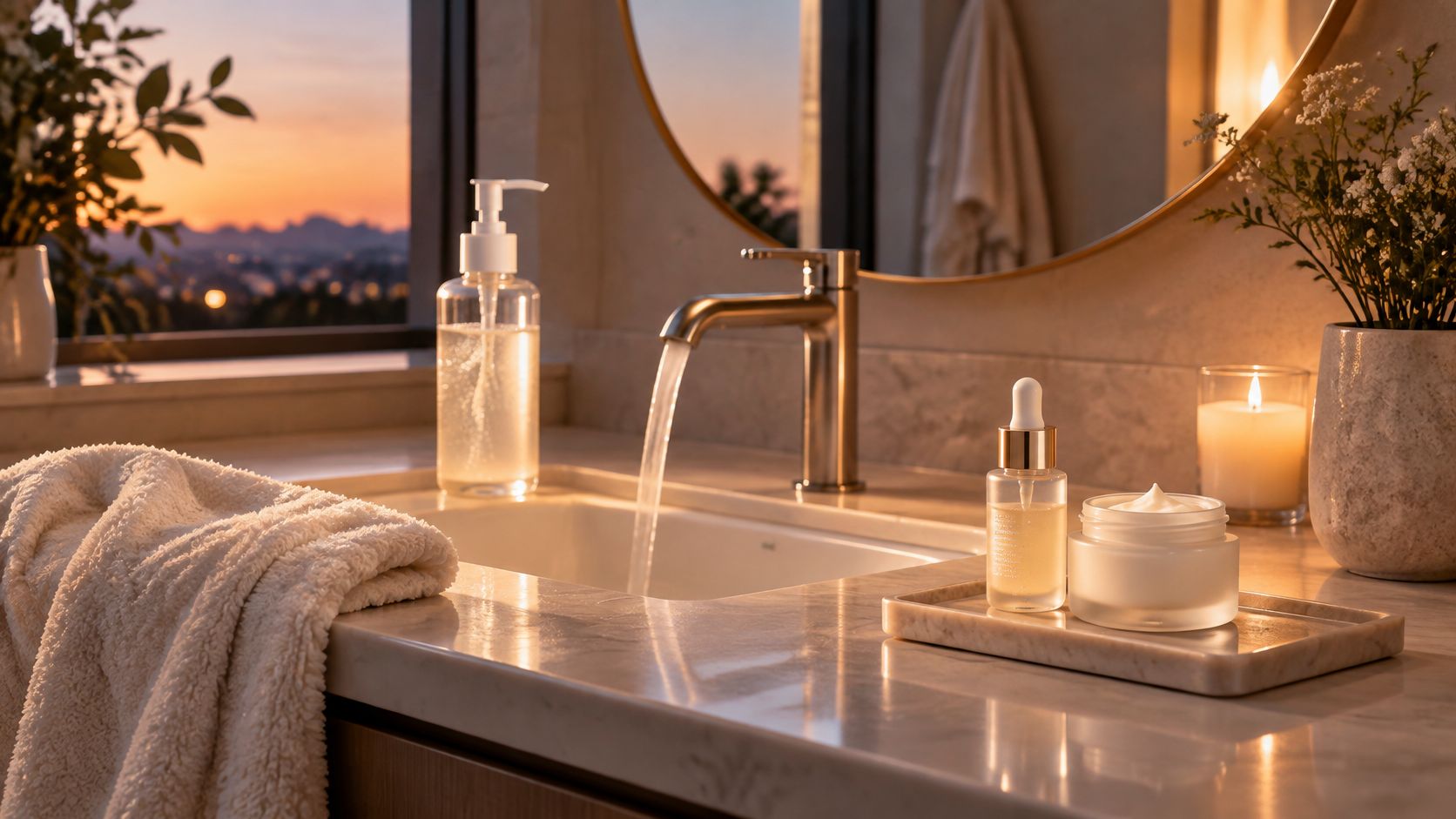
A low-friction evening routine
Cleanse gently. Remove makeup and sunscreen without scrubbing. Leave your skin barely damp for a hydrating serum, or let it dry fully if damp application makes your treatment sting.
Apply the watery niacinamide product sparingly. You need a thin film, not a slippery puddle. Wait until the surface no longer feels sticky before adding another layer.
Spread azelaic acid thinly. Follow the product's application directions and keep it away from the immediate eye area, lip border, and irritated creases. More product usually means more residue, not a smarter treatment.
Handle a silicone suspension differently. Smooth it into place with minimal passes, then stop touching it. Repeated rubbing over a tacky serum is an easy way to produce little rolls.
Finish with a plain moisturizer. Press it on gently rather than massaging every layer together. If this still pills, simplify the stack instead of adding another hydrating product.
The pause between layers is about the formula drying down, not a mandatory chemical waiting period. You don't need to stand at the sink timing an imaginary pH reset.
Introduce each bottle separately
For a cautious home introduction, use niacinamide alone during the first week. During the following week, try azelaic acid on alternate evenings without stacking the serum underneath it.
From the third week, consider combining them only if both separate applications have been comfortable. This is a conservative practical schedule, not a clinical protocol, and sensitive skin may need longer at every stage.
- If the suspension pills: Put azelaic acid on dry skin at night and move niacinamide to the morning.
- If washing already stings: Pause the experiment and return to gentle cleansing and moisturizer.
- If you already use prescriptions: Ask your prescriber how to introduce the cosmetic product.
In the morning, finish with broad-spectrum sunscreen and follow its reapplication directions. Don't add morning azelaic applications just because the evening layer went well.
Keep retinoids, glycolic acid, and benzoyl peroxide out of this introduction unless you're following an established clinician-directed plan. If exfoliation is already part of your routine, the guide to glycolic acid with niacinamide helps distinguish compatibility from the separate question of how much your skin can tolerate.
What Studies Prove and What They Do Not
The missing piece is a convincing comparison of the combination against each ingredient alone. Most of the useful human evidence concerns individual ingredients or niacinamide alongside other actives. That supports sensible ingredient choices, but it falls short of a synergy claim.
The Cochrane review of topical acne treatments included 49 randomized or controlled trials with 3,880 reported participants across several treatments, not azelaic acid alone. Its azelaic comparisons found little or no difference against tretinoin in a 289-participant study, and probably a weaker treatment response than benzoyl peroxide in a 351-participant study.
That is a more useful conclusion than calling azelaic acid the strongest acne ingredient. It has credible clinical support, and it still loses to an established alternative in at least one comparison. Treat it as a solid, well-tolerated option rather than a category winner.
Pigment results need their context
For post-inflammatory marks, a systematic review of hyperpigmentation treatments describes a 16-week study in 20 people with Fitzpatrick skin types IV to VI, using 15% azelaic acid gel twice daily, with improvement in acne and post-inflammatory hyperpigmentation. The design was baseline-controlled, so it does not establish that an inexpensive cosmetic serum will reproduce the result.
The distinction between melasma and leftover acne marks matters too. If you are unsure what you are treating, understanding patches of darker skin from Yoyime Clinic offers useful context before you choose a brightening routine.
The pigment literature also includes vehicle-controlled and hydroquinone comparisons, but those findings should not be repackaged as proof for this ingredient duo. Different diagnoses, vehicles, and treatment durations prevent that shortcut.
Niacinamide has a smaller, more variable file
An evidence summary of topical niacinamide studies covers 446 participants, with commonly studied formulations containing 2–5% niacinamide. Some acne comparisons reported performance comparable to topical clindamycin, but small trials, short follow-up, and differing combinations limit how confidently you can generalize.
What the file does not contain is a trial of azelaic acid plus niacinamide measured against either ingredient on its own. Until that exists, layering the two is a tolerance and cost decision rather than a proven upgrade, and you should buy it on that honest basis.
Personal-test rule: Change one variable, or you won't know what helped.
Once azelaic acid is established and comfortable, keep it consistent and add niacinamide to just one cheek. Take photographs in the same light and keep other treatments unchanged while you compare comfort, shine, and marks.
This is not a controlled clinical trial. It is a better spending decision than replacing your entire routine and crediting the newest bottle for every change.
Frequently Asked Questions About Azelaic Acid and Niacinamide
Can I use them with retinol or tretinoin?
Many people can, but don't introduce everything together. Keep azelaic acid on retinoid-free evenings initially, and retain niacinamide only if it feels comfortable. For prescribed tretinoin, ask your prescriber before changing an established routine.
Can I start either ingredient during pregnancy?
That's a decision for your obstetric clinician, not a blog. Bring the exact product names and ingredient lists to your appointment, including any other treatments you use. Don't treat an ingredient's reputation as personal medical clearance.
Can vitamin C share the routine?
It can, but morning vitamin C and evening azelaic acid is a practical split when you're trying to limit layering. Niacinamide doesn't automatically become incompatible because vitamin C is present. Persistent flushing is a reason to reassess the formula, not assume the combination is harmless for you.
Which side effects mean I should stop?
Burning, peeling, redness, itching, dryness, or flushing can occur with active products. Swelling, rash, or heat that persists after rinsing means stop the new products, rather than guessing which one is responsible. Seek medical advice for significant reactions; only consider restarting after recovery, at a reduced frequency, and don't rechallenge a suspected allergy without guidance.
Start With the Ordinary Pair
The Ordinary pair is my best functional-dupe starting point, provided the current formulas suit your skin and the retailer price still makes sense: Azelaic Acid Suspension 10% alongside Niacinamide 10% + Zinc 1%. Separate bottles let you pause one product without throwing out the entire routine, which is more useful than paying for an unproven synergy claim. Cos De BAHA Azelaic Acid 10 Serum is the one-bottle alternative to investigate after confirming its current formula and US availability. For pigment expectations, the dermatology evidence supports thinking in terms of roughly eight to sixteen weeks, not an overnight transformation; prioritize comfort throughout. Patch-test each formula along the jaw on separate evenings before beginning the gradual introduction, remembering that a home patch test can't rule out every reaction.
Finding Favourites, curated by Stef, offers budget beauty comparisons that weigh texture, finish, and practical value rather than treating a matching ingredient name as a perfect dupe. Visit Finding Favourites for more affordable skincare swaps, and sign up for the newsletter for future dupe roundups and discount codes.