
5 Best AHA BHA PHA Toner Dupes for Glowing Skin
You're standing in front of a bathroom shelf crowded with exfoliating cleansers, brightening serums, peeling solutions, and toners. One bottle promises smoother texture, another targets clogged pores, and a third claims to be gentle enough for sensitive skin. An AHA BHA PHA toner appears to solve everything in one step, but the key question is whether your skin needs three exfoliating families or just one well-formulated acid.
This post may contain affiliate links, which means I may receive a commission if you purchase through my links, at no extra cost to you. Please read the disclosure policy for more information.
The Multi-Acid Skincare Trend Explained
A three-acid toner looks efficient on a crowded bathroom shelf. One bottle promises smoother texture, clearer-looking pores, and a gentler exfoliating experience, so it can seem like an easy replacement for several targeted products. The appeal comes from combining AHAs, BHAs, and PHAs in one routine step.
The trade-off is less obvious. Multi-acid formulas often use low levels of each exfoliating family, allowing their effects to work together without making any single acid the entire focus. That synergy can suit shoppers who want broad, gradual support. It does not automatically make the formula stronger or better than a single-acid toner.
A single-acid product may be the more useful, budget-friendly choice when your concern is specific. Choose an AHA-focused option for surface roughness, a BHA-focused option for oily congestion, or a PHA-focused option when your skin is easily irritated. If your routine already contains retinoids, scrubs, or exfoliating cleansers, adding three acids may create more irritation than benefit.
A toner and an essence can also look similar but serve different purposes. Both are usually applied after cleansing, yet an essence often focuses on hydration, while an exfoliating toner is designed to deliver acids. This guide to the difference between toner and essence can help you decide whether another active step belongs in your routine.
Top 5 AHA BHA PHA Toner Dupes at a Glance
| Dupe Product | Key Acid Focus | Price Tier |
|---|---|---|
| The Ordinary Glycolic Acid 7% Exfoliating Toner | AHA | Affordable |
| Paula's Choice Skin Perfecting 2% BHA Liquid | BHA | Accessible premium |
| Thayers Blemish Clearing Toner | BHA-focused | Affordable |
| The INKEY List PHA Toner | PHA | Affordable |
| SOME BY MI AHA-BHA-PHA 30 Days Miracle Toner | Multi-acid blend | Affordable |
The alternatives represent different ways to pursue a glow. The Ordinary suits shoppers focused on visible surface smoothing. Paula's Choice and Thayers are more targeted toward oily skin and pore congestion. The INKEY List offers a gentler direction, while SOME BY MI is the closest match for shoppers who specifically want a multi-acid format.
The category has grown beyond a short-lived viral trend. One market report places exfoliating toners at 12.1% of the skin toner market. A separate analysis estimates that they represent 22.3% of the organic skin toner market and projects a 7.5% CAGR during its forecast period, as reported by Dataintelo's skin toner market analysis. The figures explain the range of products available, not a universal need for an acid toner.
How AHA BHA and PHA Work on Your Skin
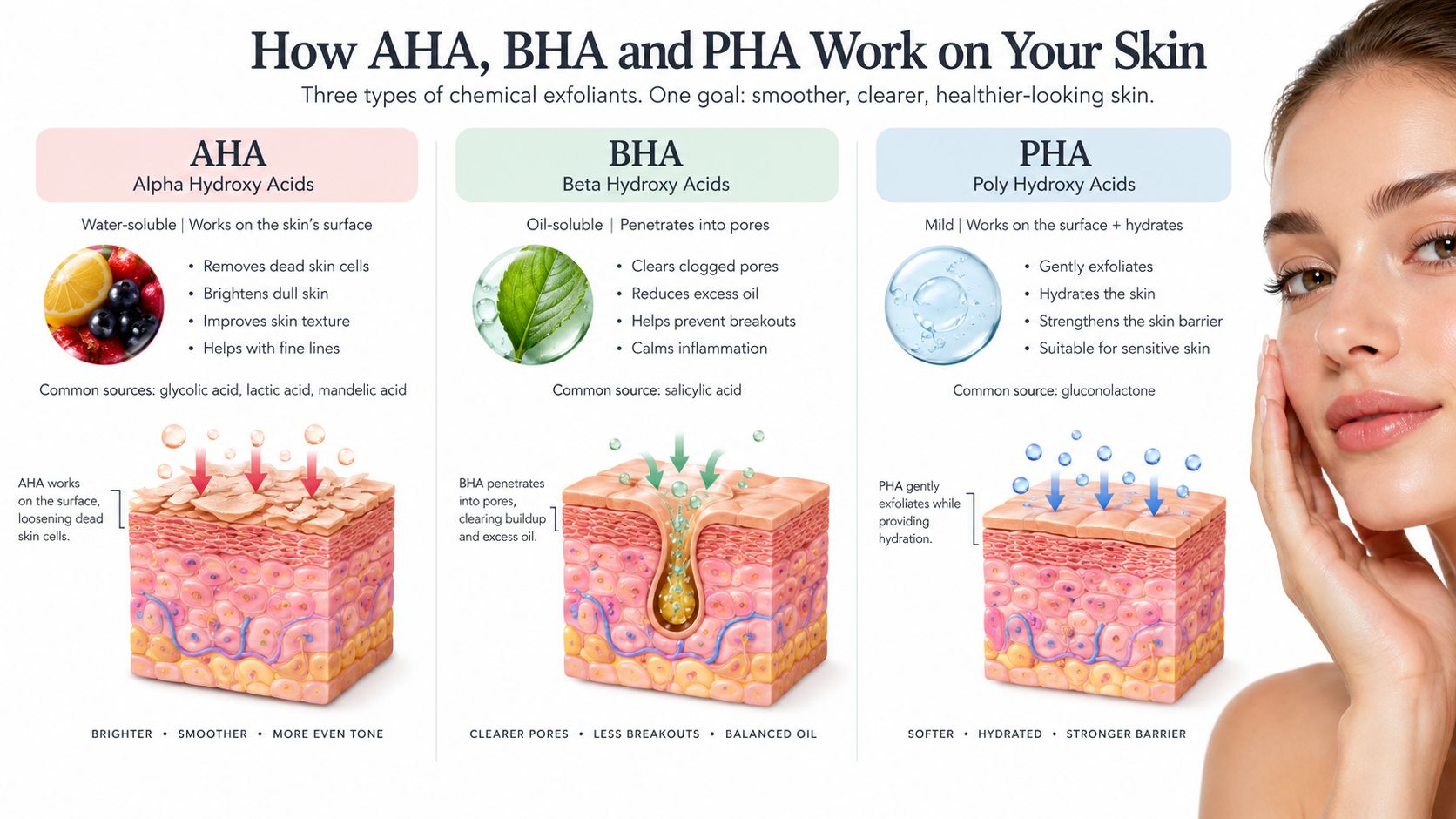
Think of the three acid families as different cleaning tools rather than interchangeable ingredients. One sweeps the floor, one reaches into the drains, and one performs a slower, softer polish.
AHAs, including glycolic acid, are water-soluble. They primarily work at the skin's surface by weakening the adhesion between corneocytes, the dead cells sitting in the outermost layer of skin. That action can make rough patches feel smoother and help dull-looking skin appear fresher. Glycolic acid is often chosen when texture and surface unevenness are the main concerns.
BHAs behave differently because salicylic acid is lipophilic, meaning it has an affinity for oil. It can partition into sebum-filled follicles, which makes it a logical choice for oily skin, blackheads, and congestion. If your problem feels like blocked pores rather than a dry layer of rough skin, BHA is usually the more targeted tool.
PHAs are generally treated as the gentler cousins of AHAs. Their larger molecular structure tends to limit how far they penetrate, so they work more gradually at the surface. PHAs are also associated with humectant and hydrating properties, which can make them more comfortable for dry, sensitive, or easily irritated skin. L'Oréal Paris' overview of PHAs describes them as a milder exfoliating class with surface action and moisture-supporting qualities.
Why formulas combine them
A combination toner tries to divide the workload. Glycolic acid can focus on the outer layer, salicylic acid can address oil within pores, and a PHA can add a milder exfoliating component. That sounds complete, but it also means the formula's overall strength matters more than the ingredient list's headline.
A person with combination skin might appreciate a multi-acid toner if they experience both dull cheeks and congested areas around the nose. Someone with sensitive skin, however, may prefer a PHA-only product because the total exfoliating load is easier to understand and control.
Practical rule: Choose the acid according to the problem you want to solve first. Add complexity only if your skin tolerates the simpler option.
For a more detailed comparison of the first two families, this AHA versus BHA guide explains why surface texture and pore congestion often call for different strategies. If you're considering a stronger peel instead of a toner, ArtNaturals' alpha beta peel guide is useful background reading, particularly because peel-style products shouldn't be treated as interchangeable with mild leave-on toners.
The Truth About Multi-Acid Concentrations
The phrase “contains AHA, BHA, and PHA” tells you what is present, not how powerful the product is. Concentration, pH, the surrounding ingredients, and how often you apply the product all influence the practical result.
A widely sold example, SOME BY MI AHA-BHA-PHA 30 Days Miracle Toner, includes niacinamide, tea tree leaf water, papaya fruit extract, lentil seed extract, witch hazel extract, sodium hyaluronate, salicylic acid, lactobionic acid, and citric acid. Its labeled exfoliating actives are notably low, including 100 ppm salicylic acid, 100 ppm lactobionic acid, and 500 ppm citric acid, according to the product's ingredient listing at Ulta.
That example challenges the assumption that every “acid toner” is a disguised professional peel. A low-dose blend may aim for a mild, repeatable experience rather than dramatic shedding. The trade-off is that a product can sound more active than it feels if shoppers focus only on the number of acid families included.
pH changes the equation
Acid strength isn't determined by concentration alone. In one expert-reviewed dual-acid toner example, a formula containing 7% glycolic acid and 0.5% salicylic acid had a pH of 3.5. The acidic environment increases the fraction of free acid available to exfoliate, but lower pH and greater strength can also raise the likelihood of irritation, as discussed in Elle's glycolic acid toner coverage.
The U.S. Food and Drug Administration states that AHA cosmetic products should generally remain at 10% concentration or less and have a final product pH of 3.5 or greater. Its AHA safety guidance also emphasizes that concentration and pH work together.
What to look for while shopping
A clear single-acid formula can be a better value than a complicated blend when you know your target. For AHA leave-on products, the commonly cited effective range is 5% to 10%, while beginners are often directed toward approximately 2% to 5% and once-weekly use, based on Paula's Choice's AHA guidance.
For BHA, cosmetic home-use products commonly fall between 0.5% and 2% salicylic acid, with 2% widely cited as the upper end for regular acne or oil-control use in Paula's Choice's over-exfoliation guidance. Read the label for the acid, its position in the formula, and supporting ingredients. “Three acids” is a description, not a performance guarantee.
5 Affordable Alternatives to Luxury Acid Toners
The right dupe isn't necessarily the bottle with the longest ingredient list. It's the product that matches the concern you have and doesn't duplicate several other strong steps in your routine.
1. The Ordinary Glycolic Acid 7% Exfoliating Toner
This is the most straightforward pick for shoppers who want an AHA-focused alternative to a more expensive glow toner. Its glycolic-acid positioning makes it a natural fit for dullness and uneven surface texture, rather than a dedicated pore-clearing treatment.
The liquid texture is uncomplicated and leaves the routine feeling active rather than heavily moisturized. Use it when your skin looks flat or feels rough, but don't add it only because your shelf lacks a multi-acid label. It's a better match for someone who wants to understand exactly what their exfoliating step is doing.
Best for: Dull, rough, or uneven-looking skin.
Choose it over a blend when: Surface texture is your only major concern.
2. Paula's Choice Skin Perfecting 2% BHA Liquid
For oily or congestion-prone skin, a BHA specialist can be more logical than a multi-acid toner. Paula's Choice Skin Perfecting 2% BHA Liquid focuses on salicylic acid, so it suits shoppers concerned with blackheads, visible pores, and oil-related buildup.
The lightweight liquid has a treatment-like feel rather than the cushion of a hydrating toner. It won't provide the same broad AHA and PHA positioning as a combination product, but that narrower focus can be an advantage. You're not paying for extra acid families that may be unnecessary for your routine.
Best for: Oily skin and pore congestion.
Choose it over a blend when: Salicylic acid is already the ingredient you know your skin needs.
3. Thayers Blemish Clearing Toner
Thayers Blemish Clearing Toner is another accessible BHA-focused option and is particularly relevant if you want a toner format that feels familiar and easy to add after cleansing. It belongs in the same practical category as other salicylic-acid choices, but its appeal is the simple shopping decision: choose a blemish-oriented toner instead of a three-acid formula when breakouts are the priority.
Apply it only where congestion tends to appear if your cheeks are more reactive than your T-zone. That targeted approach can make a BHA toner feel less drying than applying it automatically across the entire face.
Best for: Blemish-prone areas and combination skin.
Choose it over a blend when: You want to concentrate on congestion without exfoliating your whole face equally.
4. The INKEY List PHA Toner
A PHA-rich toner offers the gentler alternative in this group. It's designed for shoppers who want mild surface renewal but don't enjoy the sharp sensation that can accompany stronger acid products.
PHAs are often framed around a buffered pH near 3.5 to 4.0 for daily leave-on use, a range intended to preserve controlled exfoliation without the harsher behavior associated with very low pH formulas, according to Dermapedia's PHA ingredient guide. That doesn't mean every PHA product should be used daily, but it explains why this category appeals to sensitive and barrier-conscious shoppers.
Best for: Dry, sensitive, or easily reactive skin.
Choose it over a blend when: Comfort and consistency matter more than maximum resurfacing.
5. SOME BY MI AHA-BHA-PHA 30 Days Miracle Toner
For the shopper who specifically wants the viral multi-acid concept, SOME BY MI remains the closest format match in this list. Its formula combines AHA, BHA, and PHA-related ingredients with a broader collection of botanical and skin-supporting ingredients, while the labeled acid amounts are very low.
That makes it more of a gentle multi-target toner than a high-strength exfoliant. It may suit someone who wants one exfoliating step for mild dullness and occasional congestion, but it won't necessarily replace a clearly dosed glycolic or salicylic acid product.
Best for: Mild, multi-concern exfoliation.
Choose it over a single acid when: You want a low-dose blend and your routine doesn't already contain several active treatments.
The category has room for both approaches. Market coverage places the exfoliating toner segment at USD 1.3 billion in 2025 and projects growth to USD 2.5 billion by 2033 at a 9.2% CAGR, while broader acid-toner reporting identifies PHAs as a fast-growing area and AHAs as the largest share, according to Dataintelo's global acid toner market report. Growth doesn't tell you which bottle belongs in your bathroom, but it does explain the growing split between stronger traditional acids and gentler barrier-first formulas.
How to Safely Add Acid Toners to Your Routine
Start with the assumption that your skin needs time, not intensity. A toner that leaves your face feeling tight or hot isn't necessarily working better. That sensation can signal that the formula, frequency, or combination of products is too much.
A cautious first application
Patch test the product on a small area before applying it across your face. If your skin reacts, don't treat that response as a normal adjustment period. Choose a bland cleanser and moisturizer while the area settles.
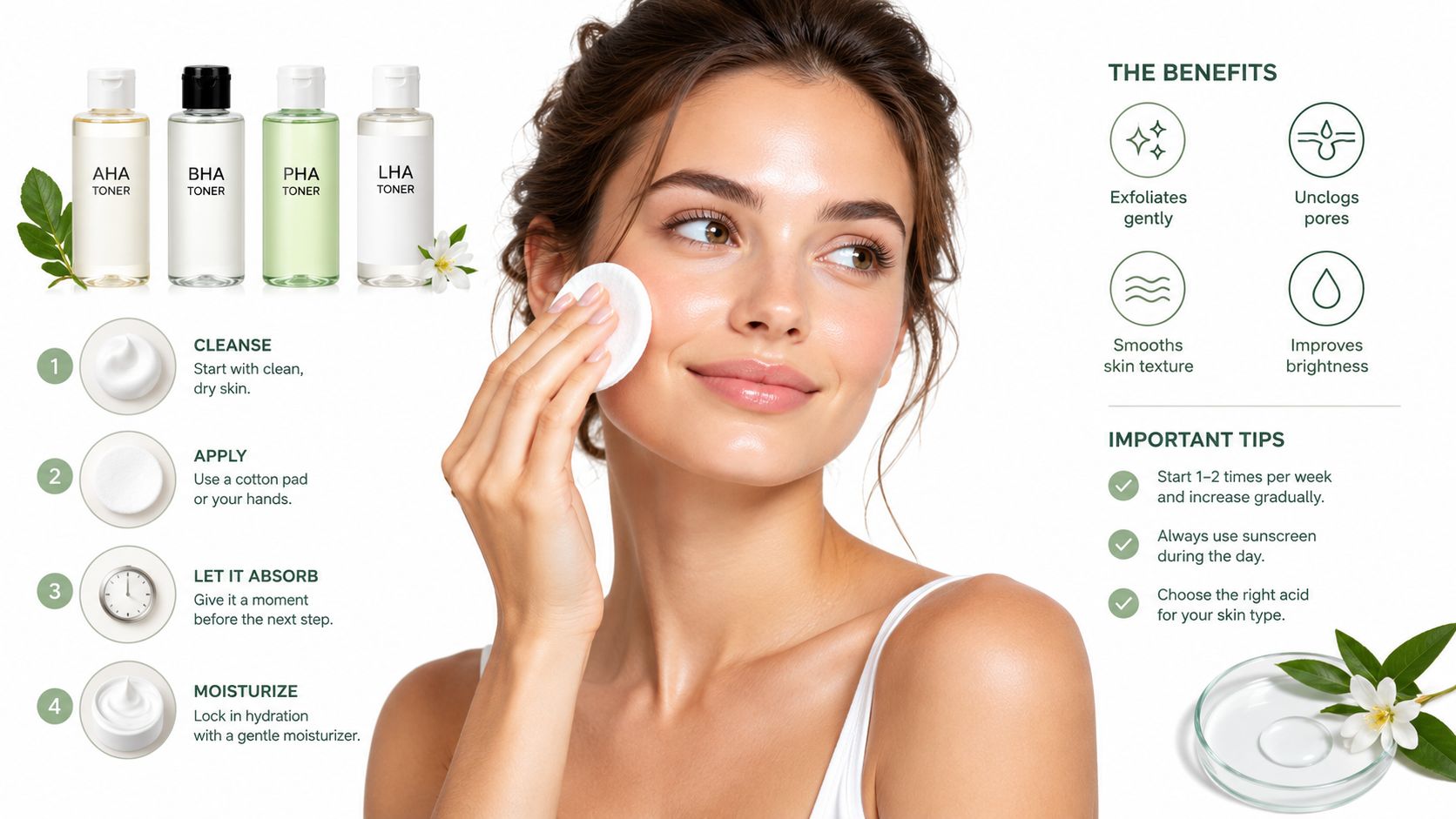
Use the toner on clean, dry skin in the evening. Damp skin can make a strong product feel more intense, so let your face dry after cleansing. Apply a thin layer with clean hands or a cotton pad, avoid the eye area, and follow with a simple moisturizer.
Start once or twice a week, then observe how your skin feels the next day. If you notice persistent redness, stinging, unusual tightness, flaking, or new sensitivity, reduce use or stop. Sensitive skin may be better suited to a PHA product than a blend containing several exfoliating families.
Keep competing actives apart
Don't stack an acid toner with retinoids, strong vitamin C products, benzoyl peroxide, or physical scrubs in the same routine. Combining multiple active steps can make it difficult to identify the source of irritation and can place unnecessary stress on the skin barrier.
Niacinamide is often used alongside exfoliating products, but your exact formula and tolerance still matter. For a closer look at the pairing, this guide to glycolic acid and niacinamide offers useful routine context.
Protect the result
Wear broad-spectrum sunscreen every morning. AHAs can increase photosensitivity, so sun protection is part of using them responsibly, not an optional extra. If your routine already includes an exfoliating cleanser, retinoid, or treatment serum, alternate the toner rather than adding it automatically.
Common Questions and Final Verdict
Can sensitive skin use an AHA BHA PHA toner?
Sometimes, but the answer depends on the complete formula, its pH, concentration, and your routine. A PHA-focused product is usually the more sensible starting point than a strong multi-acid blend. A PHA label alone doesn't make an aggressive formula gentle.
How can I tell purging from barrier damage?
Purging tends to appear where you usually experience clogged pores after introducing an exfoliant. Burning, widespread redness, tightness, flaking, and sensitivity in areas that don't normally break out point more strongly toward irritation or barrier disruption. Stop the active if your skin feels raw rather than just bumpy.
Is a toner redundant if I use a salicylic acid cleanser?
It can be. If your cleanser already supplies the pore-focused step your skin needs, adding a BHA toner may offer little benefit while increasing dryness. A PHA toner or a non-exfoliating hydrating product may be a better complement.
What's the best overall dupe?
The Ordinary Glycolic Acid 7% Exfoliating Toner is the best overall dupe for shoppers seeking a visible glow and smoother surface texture at an accessible price tier. The broader lesson is more important than the winner: read the acid focus and formulation details instead of assuming that three acid families outperform one well-dosed ingredient. Sign up for the Finding Favourites newsletter for more budget beauty discoveries and practical product comparisons.
Finding Favourites helps beauty shoppers compare affordable alternatives to luxury makeup, skincare, and fragrance, including dupe roundups organized by product type and price tier. Visit Finding Favourites to find more budget-conscious skincare swaps and new beauty discoveries.